A Landlord's Guide to Buy To Let Home Insurance
If you’re a landlord, staring at insurance quotes can feel like navigating a maze but understanding buy-to-let home insurance isn’t as complicated as it seems. It’s not just another box to tick for your mortgage lender; it's a specialist financial shield built specifically to protect your rental property investment from the unique risks that come with it.
A common and costly mistake is assuming a standard home policy will do the job. It won’t. That’s like using your personal car insurance to run a taxi service – the risks are fundamentally different and so is the cover you need.
What Is Buy To Let Home Insurance Really For?
A standard policy is designed for an owner-occupier. It focuses on personal belongings and the liabilities that come with living in your own home. Buy-to-let insurance, on the other hand, recognises the commercial nature of renting out a property. Its core purpose is to safeguard two critical things: the physical building itself and the income stream it generates.
This infographic breaks down the core protective elements of a solid buy-to-let policy.
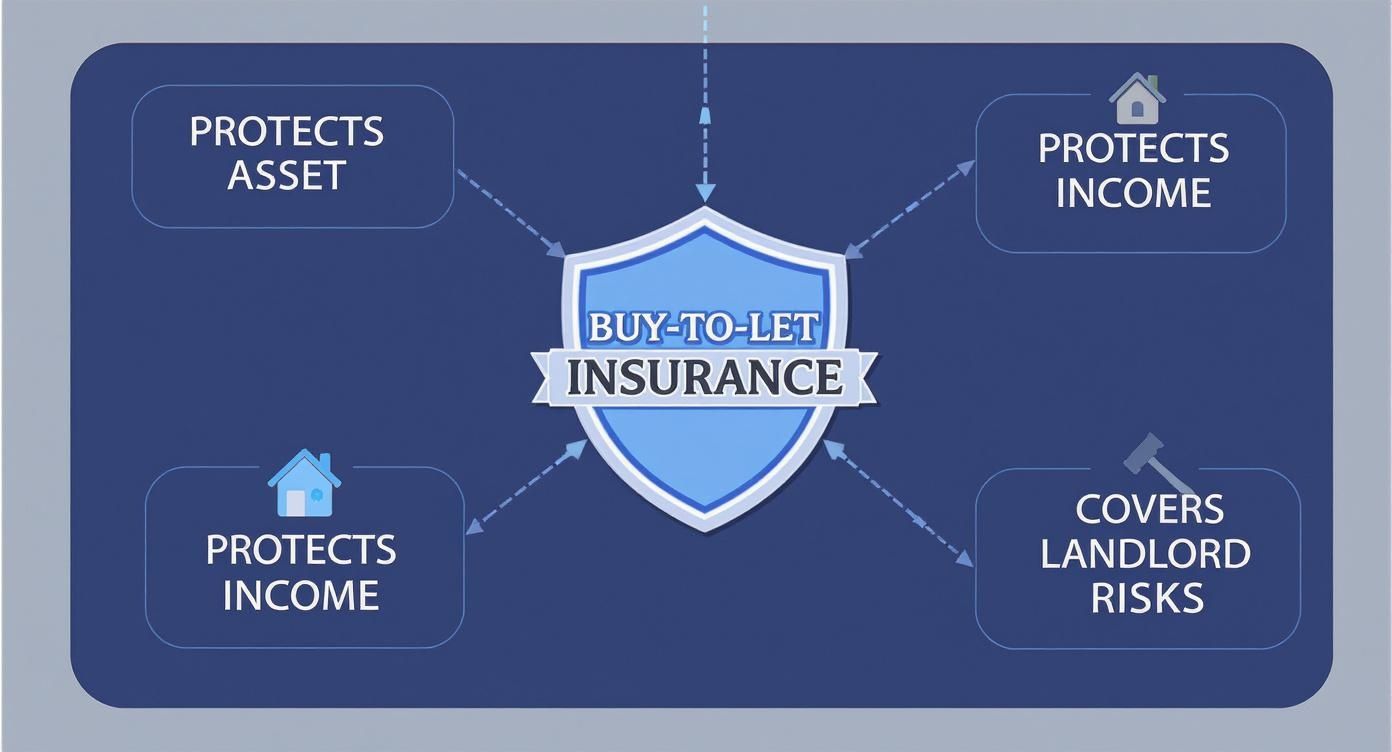
As you can see, it provides a multi-layered defence. It covers the property structure, the rental income you depend on and specific landlord liabilities. These are risks that standard policies simply ignore, leaving you dangerously exposed financially.
To put it into perspective, here’s a quick comparison of the key differences.
Standard Home Insurance vs Buy To Let Insurance At a Glance
This table highlights the critical differences in cover between a policy for your own home and one for a rental property. It shows why trying to use a standard policy for a tenanted property is a recipe for disaster.
| Feature | Standard Home Insurance | Buy To Let Home Insurance |
|---|---|---|
| Primary Purpose | Protects the homeowner's residence and personal belongings. | Protects the landlord's financial investment in a rental property. |
| Occupancy | Covers a property occupied by the policyholder and their family. | Covers a property occupied by tenants under a rental agreement. |
| Contents Cover | Insures the policyholder’s personal possessions. | Insures the landlord's contents (e.g. furniture, appliances). |
| Liability Cover | Public liability for injuries to visitors on your property. | Property owner's liability for tenant or visitor injuries. |
| Loss of Rent | Not included. | Included – covers lost income if the property is uninhabitable. |
| Alternative Lodging | Covers costs for the homeowner to live elsewhere. | Covers costs to re-house tenants if the property is uninhabitable. |
| Legal Expenses | Optional, for personal disputes. | Optional, for tenant disputes, evictions and rent recovery. |
Ultimately, having the wrong policy means you effectively have no policy. If you make a claim on a standard home insurance policy for a tenanted property, it will almost certainly be rejected.
The Problem of Provability and Fraud
The necessity for this specialist cover is thrown into sharp relief when a claim must be made. The burden of proof always falls on the landlord. Proving the condition of a property or the value of its contents before a tenancy began can be incredibly difficult, especially after a fire, flood or malicious damage.
On top of this, the insurance industry is in a constant battle with fraudulent claims. This is not a victimless crime against a faceless corporation; it has a direct financial impact on every single policyholder. To remain viable, insurers must investigate claims rigorously to weed out illegitimate ones.
Every fraudulent claim that is paid contributes to a collective loss pool. To cover these losses, insurers have no choice but to increase premiums for everyone. In short, honest landlords end up paying for the dishonesty of others.
This reality highlights just how vital it is to have the correct insurance and verifiable documentation to support it. A standard policy will likely be voided the second an insurer discovers the property is tenanted, leaving you with nothing.
A proper buy-to-let policy provides the right framework for a legitimate claim but keeping the system fair and affordable for all landlords depends on being able to quickly validate genuine claims and robustly defend against fraudulent ones.
Decoding Your Landlord Insurance Cover

When you take out buy-to-let home insurance , you're not just buying a single product. Think of it more like building a customised financial safety net, piece by piece. Getting your head around these components is the only way to be sure you’re properly protected without shelling out for extras you do not need.
The absolute heart of any policy is Buildings Insurance . This is the non-negotiable foundation, protecting the actual bricks and mortar of your property. It covers the immense cost of repairing or completely rebuilding your house if it’s hit by a major event like a fire, storm, flood or subsidence.
If you have a mortgage on the property, your lender will almost certainly insist on Buildings Insurance. They have a vested interest, after all. This cover ensures their investment can be restored, safeguarding the value of their security.
Core Components of a Landlord Policy
Beyond the basic structure, a truly robust policy needs a few other key elements that tackle the specific risks that come with being a landlord. These parts work together to create a complete shield for your investment and rental income.
-
Property Owner's Liability: This is arguably one of the most critical parts of your cover. If a tenant, their visitor or even a courier trips on a loose paving stone and gets injured, this insurance steps in. It covers your legal defence costs and any compensation awarded. A serious personal injury claim could be financially crippling without it.
-
Loss of Rent Cover: Picture this: a fire makes your property uninhabitable for six months. Your tenants will have to move out, meaning your rental income dries up instantly but the mortgage payments do not stop. Loss of Rent cover is what protects your income stream during this chaos, paying you the equivalent of the lost rent until the property is liveable again.
-
Landlord's Contents Insurance: If you let your property furnished, or even part-furnished, this is essential. It covers the items you own inside the property, from big-ticket things like sofas, beds and white goods to the carpets and curtains.
These components are what transform a basic policy into a genuine tool for asset protection. The entire point is to insulate you from the financial shock of those unexpected events that are just part and parcel of renting out property.
Bringing Your Cover to Life
Let's walk through a common real-world scenario. A water pipe bursts in the upstairs bathroom, causing absolute havoc. The ceilings, walls and flooring below are ruined. Your tenant has no choice but to move into temporary accommodation for a month while you get it all fixed.
A comprehensive buy-to-let home insurance policy would trigger multiple layers of protection here. Buildings Insurance would pay to repair the water-damaged structure, Loss of Rent would cover that month's lost income and Landlord's Contents would pay to replace your ruined carpets.
This example really shows how the different parts of a policy work in concert to manage a crisis. Without this combined cover, you’d be staring down the barrel of thousands of pounds in repair bills and a loss of income, all at the same time. It is so important to read your policy documents carefully to see what’s included as standard and what you might need to add on.
Knowing how to handle a claim when the time comes is just as important. For a solid guide on navigating property insurance claims, you can find valuable insights that apply just as much to landlords. Knowing the process helps you prepare for what’s needed to get things sorted quickly. You also need to be clear on your policy's excess—the amount you have to chip in for any claim. Our guide offers a detailed breakdown of your compulsory and voluntary excess explained clearly.
Understanding the Cost of Protecting Your Investment

When you start gathering quotes for buy-to-let insurance, you’ll likely notice the prices can vary wildly. This isn't just random pricing; every single premium is the end result of a detailed risk assessment by an underwriter. Their entire job is to calculate the chances of a claim being made on your property and what it might cost, which directly shapes the price you pay.
Getting your head around this process is a game-changer. It helps you move beyond just hunting for the cheapest policy and instead focus on finding the best value for your specific rental property. Let's pull back the curtain and look at the key factors insurers really care about when they’re working out your premium.
The Property Itself
First and foremost, it all starts with the property’s rebuild value . This is a crucial number and it’s not the same as the market price you paid. It’s the estimated cost to completely demolish and rebuild your property from the ground up, factoring in all the materials and labour. A higher rebuild value means a bigger potential payout for the insurer, so your premium will be higher to reflect that risk.
To get this figure right, it’s always a good idea to use a professional tool like a UK Rebuild Cost Calculator. Nailing this number is vital to make sure you’re not underinsured if the worst happens.
Location, location, location isn’t just an estate agent’s mantra—it's a huge deal for insurers too. They use postcode data to analyse local risks like crime rates, historical subsidence and even environmental threats. A property in a high-burglary area or a designated flood zone will naturally come with a higher premium because, statistically, it’s more likely to be the subject of a claim.
The age and construction of your property also have a say. Older buildings might have outdated wiring or plumbing, pushing up the risk of fire or water damage. Likewise, a flat in a modern, purpose-built block presents a very different risk profile to a Victorian semi-detached house.
The Influence of Your Tenants
Who you rent to matters. A lot. From an underwriter’s perspective, different types of tenants carry different levels of risk. For instance, renting to students is often considered higher risk, largely due to the perception of more frequent accidental damage and a faster turnover of occupants.
On the flip side, a professional couple in a long-term tenancy is generally seen as a much safer bet, which can often lead to a lower premium. Insurers will definitely ask about your tenants’ employment status and the kind of tenancy agreement you have in place.
It all boils down to a simple equation for insurers: the higher the perceived risk, the higher the premium. This is exactly why being upfront about your tenants is so important—giving inaccurate information could render your policy useless right when you need it most.
Your own track record as a landlord comes under the microscope too. If you've made several claims in the past, insurers might see you as a higher risk and adjust your premium upwards. A clean claims history, however, can often earn you a welcome discount.
Putting It All Together
Each of these factors—the property, its location, your tenants and your history—are combined to create a unique risk profile for your investment. That profile is what ultimately determines your premium. And, of course, any extras you add on, like accidental damage or rent guarantee insurance, will increase the final cost.
This explains why landlord insurance costs can be all over the map. In 2025 , the average cost of buy-to-let insurance in the UK for a standard property with employed tenants in a low-risk area hovers around £225-£235 a year .
But that’s just an average. Premiums can start from as little as £101 for a small studio flat and rocket up to nearly £4,768 for a high-value property with a rebuild cost of £5-£6 million. It’s a stark reminder of how much the property itself drives the cost.
Similarly, if you're letting a furnished property, the value of the contents you provide will influence your quote. Getting a handle on what your items are worth is key to securing the right level of cover. You can find out more by reading our guide explaining the UK average house contents value. By understanding what goes into your premium, you can make a much more informed decision and ensure your investment is properly protected.
Why Your Insurance Premiums Are Going Up
If your recent buy-to-let insurance renewal made you do a double-take, you’re not alone. Landlords across the UK are facing rising costs and it’s easy to think your provider is just hiking prices for the sake of it.
But the reality is a lot more complex. The price you pay is caught up in some powerful economic forces that are putting pressure on the entire insurance industry. These increases aren’t arbitrary; they’re a direct response to the escalating, real-world costs insurers are facing every time they pay out a claim.
Understanding what’s happening behind the scenes shows that your premium is part of a much bigger economic picture.
The Soaring Cost of Repairs
The single biggest driver is the dizzying increase in the cost of building materials. Global supply chain headaches have sent the prices of essentials like timber, steel, cement and plasterboard through the roof.
So, when an insurer pays to repair a fire-damaged kitchen or a storm-battered roof, their bill for the raw materials is significantly higher than it was just a few years ago.
This problem is made worse by a stubborn shortage of skilled labour. Finding good plumbers, electricians and roofers has become harder and a lot more expensive. This one-two punch of pricier materials and higher labour costs directly inflates the final bill for every single property claim.
Insurers have to price their policies based on what future claims might cost. When the fundamental cost of repairing and rebuilding a property shoots up, premiums inevitably have to follow. It’s the only way the industry can remain solvent and be there to pay out when you need it.
You can see this financial pressure in the industry-wide figures. Recent reports show a major jump in home insurance premiums right across the UK, a trend that hits buy-to-let properties hard.
As of 2025 , combined UK home insurance premiums have reportedly climbed by around 8.5% , pushing the average policy cost to about £231 a year, with some sources reporting even sharper increases. Insurers paid out a staggering £1.6 billion in home-related claims in just one quarter of 2025 – a 7% jump on the previous quarter. Rebuilding costs alone have climbed by roughly 21% in the last two years, driven by those very material and labour shortages. You can discover more insights about why home insurance premiums are going up.
More Frequent and Severe Claims
Another huge factor is the weather. We’re seeing more frequent and extreme weather events across the UK, from intense storms to widespread flooding. Naturally, this leads to a higher volume of expensive and complicated claims.
A single major flood in a town can trigger hundreds of claims all at once, putting immense financial strain on insurers.
These large-scale events mean insurers must keep more money in reserve to cover potential losses, which in turn influences how all policies are priced. The risk models that underwriters use are constantly being updated to reflect this new reality of more volatile, unpredictable weather.
So, your buy-to-let home insurance premium isn’t just based on your property’s individual risk profile. It’s also shaped by these broader, national climate risks that affect the entire property market and the insurers who protect it.
Your Legal Duties: Don't Let a Valid Policy Go to Waste
Having a solid buy-to-let home insurance policy is about more than just setting up a direct debit for the premium. It’s a two-way street. Your insurer agrees to cover you against a list of very real risks and in return, you agree to act like a responsible landlord and meet your basic legal duties.
Get this part wrong and the consequences can be brutal. If you’ve neglected your responsibilities, an insurer may have perfectly legitimate grounds to slash your payout or, worse, reject your claim outright. Suddenly, that policy you’ve been paying for is worthless right when you need it most.
Why Insurers Care About Your Compliance
From an underwriter's perspective, the price you pay for your premium is calculated on a key assumption: that your property is legally compliant and isn't falling apart. When a landlord starts cutting corners on safety, they are single-handedly changing the level of risk the insurer agreed to take on.
Think of it like this: an insurer covers a car assuming the owner gets it MOT’d and keeps the tyres legal. If they find out the owner has been driving on slicks with no brakes, the risk of a crash is obviously much higher than they priced for. It’s the exact same principle with a rental property. Neglecting mandatory safety checks creates a tinderbox, making fires or injuries far more likely.
This isn't some obscure clause buried in the small print. It’s a fundamental principle of insurance law known as the duty of reasonable care . In plain English, it means you have to take sensible, common-sense steps to prevent loss or damage. Fulfilling your legal obligations is the most straightforward way to prove you’re doing just that.
The Non-Negotiables: Gas and Electrical Safety
Some duties aren't just 'best practice'; they are baked into UK law. For landlords, these are the absolute must-dos and your insurer will expect you to have them sorted, no excuses. The two big ones are gas and electrical safety.
-
Annual Gas Safety Checks: Every 12 months , you must get a Gas Safe registered engineer to inspect every gas appliance, flue and bit of pipework in your property. Your tenants need a copy of that Gas Safety Certificate. If a fire starts because of a faulty boiler you never bothered to service, an insurer could easily argue your negligence was the direct cause and walk away from the claim.
-
Electrical Installation Condition Reports (EICRs): The law says you must have the electrical wiring and installations in your rental checked by a qualified electrician at least every five years . The EICR flags any defects or dangers. Trust me, an electrical fire in a property with an out-of-date (or non-existent) EICR is a massive red flag for any claims adjuster.
An insurance policy is a contract built on good faith. When a landlord skips mandatory safety checks, they are effectively breaking that faith, creating the perfect conditions for a claim to be rightfully denied.
The Ongoing Job: Maintaining Your Property
Beyond the official certificates, you have a general, ongoing duty to keep your property in a good state of repair. It sounds broad but this responsibility has a direct and serious impact on your insurance cover.
This means getting on top of issues as they pop up, not waiting for them to become disasters. That loose roof tile you’ve been meaning to fix? Ignore it for months and it could lead to thousands of pounds in water damage after a storm. An insurer will investigate and could argue that your failure to do a simple repair made the damage far worse, giving them grounds to reduce your payout for negligence.
Pro tip: Keep a clear record of all your maintenance and repairs. It provides crucial evidence that you’re a switched-on, responsible landlord and it can make any future claims process a whole lot smoother.
The Hidden Cost of Insurance Fraud to Every Landlord
It’s easy to think of insurance fraud as a victimless crime—a bit of harmless exaggeration against a massive, faceless corporation but for landlords, the reality is starkly different. Every dishonest claim, whether it’s padding a genuine loss or inventing one out of thin air, is a direct hit on the pockets of every honest property owner out there.
This isn't just about big companies absorbing losses. It creates a powerful ripple effect that drives up the cost of buy-to-let home insurance for everyone. Insurers are not bottomless pits of money; they are managers of a collective pool of funds paid in by all policyholders.
When a fraudulent claim is paid, that money is drained from the shared pot. To keep the pool solvent and able to cover future legitimate claims, insurers really only have one option: they have to recover those losses by raising premiums across the board.
The Real Price of Dishonesty
Think of the collective insurance fund like a community water tank. All the honest landlords contribute what’s needed to keep it full, ready for a real emergency. A fraudulent claim is like someone secretly opening a tap and draining gallons for themselves, leaving less for everyone else when a real fire breaks out.
This creates a vicious cycle of rising costs. The more fraudulent claims that are paid, the higher premiums must climb to replenish the funds. It’s a simple but brutal economic reality and it means you end up paying for someone else’s dishonesty. The impact of this isn't trivial and you can learn more about what insurance fraud really costs the industry.
Every inflated invoice for a minor repair or falsified report of stolen goods contributes directly to the premium you pay at your next renewal. The link between fraud and your rising insurance costs is direct and unbreakable.
Fraudulent activity doesn't just involve outright lies. It also includes more subtle forms of deception that are just as damaging, from minor exaggerations to more calculated schemes.
- Exaggerating Claims: A landlord might claim for a top-of-the-range television when it was actually a mid-range model that was damaged.
- Falsifying Damage: Deliberately causing damage to an item just to include it in a claim for a genuine event, like a flood.
- 'After the Event' Fraud: This is a particularly sneaky one. Someone damages an item, waits a few weeks, then takes out a policy before submitting a claim for the pre-existing damage.
Fighting Back with Verification
To protect honest landlords and maintain the integrity of the system, the insurance industry is increasingly turning to verification technology. These tools help insurers quickly and accurately validate the legitimacy of a claim before it gets paid.
By using platforms that can verify the existence, condition and ownership of property and contents right at the start of a policy, insurers can create a clear, undeniable baseline. This makes it significantly harder for fraudulent claims—particularly 'after the event' fraud—to succeed.
But this isn't about making it harder for genuine claimants. In fact, it's about speeding up the process for them. When an insurer can instantly verify the details of a legitimate claim, they can approve and pay it much faster, reducing the stress and financial strain on the landlord. Ultimately, this technology helps ensure the shared pot of money is protected and used only for its intended purpose, working to keep premiums fairer for everyone.
Got a Question About Buy-to-Let Insurance?
When you're navigating the world of being a landlord, a few specific questions always seem to pop up. Let's get them answered so you can manage your investment with more confidence.
What if My Property Is Empty?
You absolutely must have it insured. Do not make the mistake of thinking an empty property is a low-risk one; insurers see the exact opposite.
Most standard buy-to-let policies have an 'unoccupancy clause'. This usually gives you a grace period of 30 to 60 days of cover while the property is empty. After that, your standard cover might be severely limited or even voided entirely. If you know you're facing a longer void period, you need to tell your insurer right away. They will almost certainly require you to take out a specialist unoccupied property policy. It might seem like an extra cost but an empty house is a magnet for vandalism, theft and undetected problems like a slow leak that can cause thousands in damage.
Am I Covered for Malicious Damage by Tenants?
This is a huge one and it catches so many landlords out. The short answer is: probably not, unless you've specifically asked for it.
Standard landlord policies often exclude malicious damage caused by the people living in your property. This kind of protection is typically an optional add-on. If you do not have it and a tenant deliberately smashes up your kitchen, you're on the hook for the entire repair bill yourself. Always double-check your policy wording on this.
Trying to save a few quid by skipping malicious damage cover is a classic false economy. A single bad tenancy could easily cost you more in repairs than you'd pay in premiums over many years.
Can I Just Charge the Tenant for My Insurance?
No, you cannot. You cannot itemise the cost of your buy-to-let insurance and charge it to the tenant as a separate fee. The policy protects your financial asset, so it's considered one of your business running costs as a landlord.
Of course, all your running costs—from insurance and maintenance to letting agent fees—will naturally factor into the rent you decide to charge. The key is that it has to be baked into the single rental figure, not billed separately.
At Proova , we get the challenges landlords and their insurers are up against. Our platform gives you a straightforward way to verify the state of a property and its contents from day one. This creates a crystal-clear record that helps speed up genuine claims and acts as a powerful deterrent to fraud, protecting everyone from rising costs. Discover how Proova is making insurance fairer and faster.