A Guide to Your Certificate for Insurance in the UK
Think of a certificate for insurance as the official handshake that proves a policy actually exists. It’s not the full, lengthy contract but it's a vital one-page summary that confirms your cover is active and valid. This simple document is often your first line of defence when you need to show you are financially responsible.
Why Your Certificate for Insurance Is So Important
A certificate for insurance is a bit like a passport for your policy. It does not detail your entire life story or every single clause in the contract but it instantly verifies your identity and status. It offers undeniable proof that you have the required cover in place, which is a critical requirement in countless business and personal situations.
This provability is absolutely essential for establishing trust and ensuring everyone is compliant. In fact, many organisations will not even let work begin until they have seen one.
Who Relies on This Proof?
The need for verification is universal, touching everything from homeowners hiring a local contractor to massive corporations tendering for multi-million-pound projects.
Just think about these common scenarios:
- Clients hiring tradespeople: They need to see a Public Liability certificate to know they’re protected if an accident happens on their property.
- Businesses engaging subcontractors: Verifying a subcontractor's cover stops the main contractor from inheriting unexpected liabilities down the line.
- Landlords checking tenant insurance: This ensures their property is protected against damage caused by the tenant.
- Companies needing to prove compliance: Many commercial contracts legally demand specific insurance levels and the certificate is the standard way to provide evidence.

A Foundation for Claims and Compliance
Without this simple document, proving you have the right cover can become a real headache. The importance of your certificate for insurance becomes crystal clear when you need to make a claim, often kicking things off with an insurance claim form template. If an incident occurs, it’s the very first piece of evidence an insurer or another party will ask for.
This is especially relevant as the UK insurance market continues to expand. The market recently saw a 6.8% expansion, with personal insurance premiums alone climbing by 5.6% . The growth in employer-provided group life policies—up by 10.7% —further highlights just how many people rely on this proof of cover in their daily lives. You can find out more about the trends in the UK insurance industry.
A certificate for insurance is more than just paperwork. It is a fundamental tool for managing risk, giving everyone involved immediate, verifiable assurance that financial safeguards are in place.
Getting to Grips with a UK Insurance Certificate
At first glance, a certificate for insurance might seem simple enough. But every single field on that document contains information that's vital for proving your cover. Learning to read it properly is not just a box-ticking exercise; it is about knowing how to spot red flags and protect your business from serious risk. Each detail, from the name on the policy to the dates it covers, is a critical checkpoint for validity.
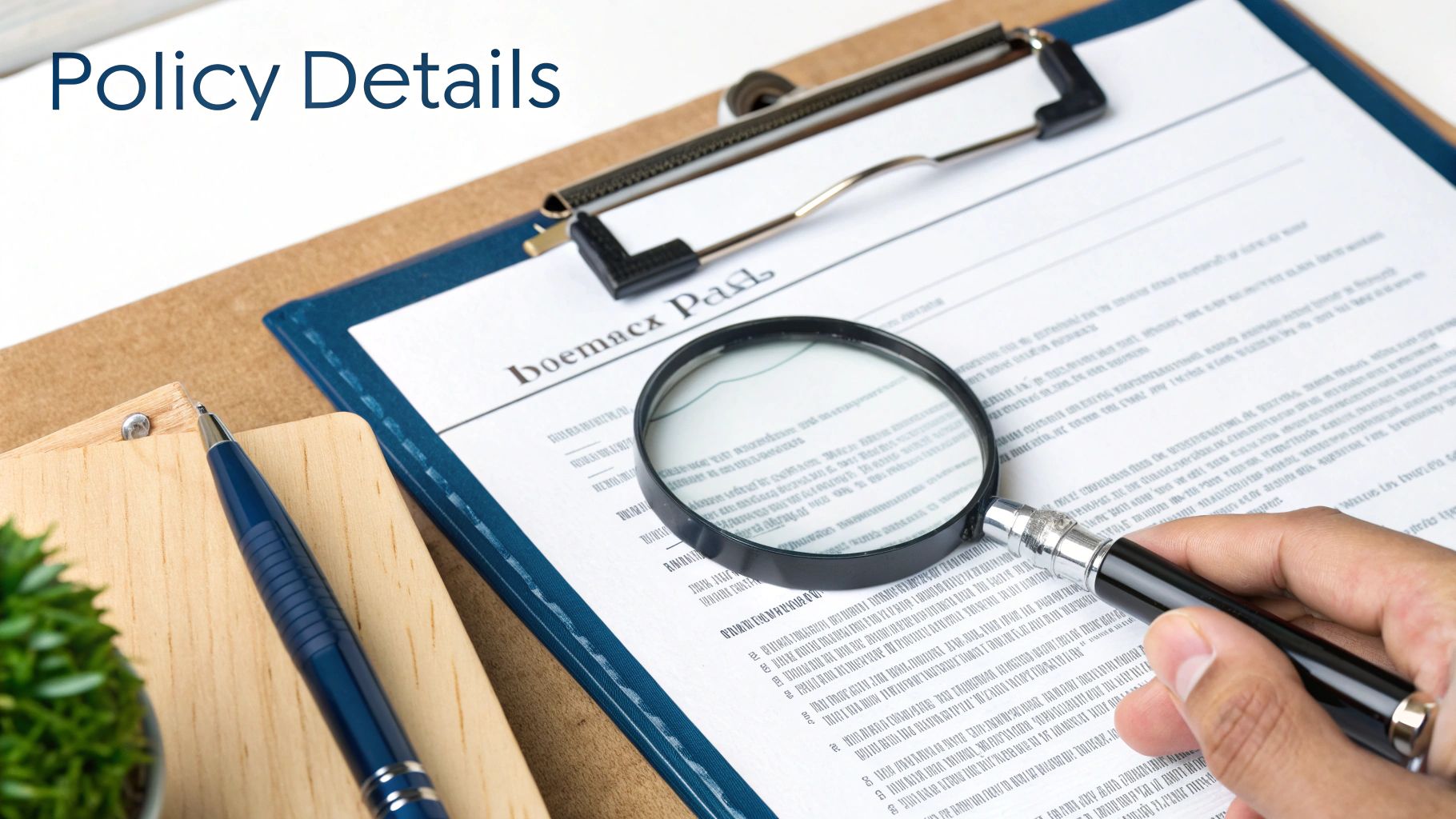
It is crucial to remember that this document is just a snapshot in time. It confirms that a specific policy was active on the day the certificate was issued but it does not amend, extend or alter the actual cover provided by the policy it represents. Think of it as evidence, not the contract itself.
To really understand what you are looking at, applying some solid document analysis techniques will help you catch all the important details and their implications. A methodical review is the only way to make sure nothing gets missed.
Key Information on a Certificate for Insurance
When you are handed a certificate, you need to know exactly what to look for. This table breaks down the essential components you must verify on any certificate to ensure it is legitimate and provides the cover you need.
| Component | What It Is | Why It's Critical |
|---|---|---|
| Policyholder’s Name | The full legal name of the individual or business insured. | It must be an exact match for the person or company you are working with. A different trading name or a simple typo could invalidate the cover for your project. |
| Insurer’s Details | The name of the authorised insurance company underwriting the policy. | This confirms the policy is backed by a legitimate, regulated provider and not a fraudulent entity. |
| Policy Number | The unique reference number assigned to the insurance contract. | This is essential for any verification checks with the insurer or broker and it’s the first thing you will need if a claim has to be made. |
| Effective & Expiry Dates | The start and end dates of the policy's period of cover. | This is arguably the most critical section. The cover is only valid between these two dates. Your work must fall entirely within this window. |
| Limits of Indemnity | The maximum amount the insurer will pay out for a single claim or in total. | You must check that this limit meets your contractual requirements and offers enough financial protection if something goes wrong. |
Each piece of information builds a picture of the policy's validity and overlooking even one component can leave you exposed.
Why Every Detail Matters
A seemingly tiny error can have huge consequences. For instance, a certificate might show a £5 million Public Liability limit, which looks great. But if the expiry date has passed, that document is completely worthless. Fraudsters know exactly what to look for and often target dates or liability limits, hoping you will not check them too closely.
An insurance certificate is only as reliable as the information it contains. Verifying each detail is not just administrative diligence; it is a fundamental act of risk management that protects you from inheriting someone else’s liability.
Ultimately, the certificate is your starting point. It gives you the key details you need to go and confirm the policy’s status directly with the insurer or broker. This is the only way to be certain that the cover you are relying on is genuine, active and sufficient for your needs.
The Real-World Cost of a Fake Insurance Certificate
Insurance fraud is not a distant, victimless crime. It is a real and growing problem and fake certificates are one of its most common weapons. A forged document might look like an easy shortcut but it triggers a devastating chain reaction, creating huge financial and legal risks for businesses and individuals across the UK. It is a deception that chips away at the very trust our industry is built on.
The reasons for faking a certificate often come down to financial pressure or simple dishonesty. Some businesses forge documents to dodge paying premiums while others do it to win contracts they are not qualified for. It is shockingly easy to alter an expiry date to make a dead policy look live or to inflate liability limits just to meet a project's minimum requirements.
This deception places anyone accepting that certificate in an incredibly dangerous position. When things go wrong, the fallout can be catastrophic.
The Immediate Fallout for Victims
Picture this: you hire a contractor for a big job. They hand over a certificate that looks perfectly legitimate and you file it away. Then, an accident happens on-site, causing serious property damage or, even worse, injuring someone. You go to make a claim against their policy, only to get the gut-wrenching news: the certificate was a fake. There is no cover.
Suddenly, the financial responsibility lands squarely on your shoulders. Without a valid policy to fall back on, your business is on the hook for:
- Legal Fees: The costs of defending yourself against lawsuits from injured parties.
- Compensation Payouts: Covering all the damages and injuries from your own pocket.
- Reputational Damage: The hit your business takes for failing to do its homework.
A simple decision to trust a piece of paper without checking it first can spiral into financial ruin.
A Problem That Affects Everyone
The damage from insurance fraud does not stop with the immediate victim. When these activities become common, they create systemic problems that hurt every single policyholder and the UK economy. The Association of British Insurers (ABI) has highlighted the sheer scale of the issue, with detected fraudulent claims running into the billions.
This fraud creates a ripple effect. Insurers have to spend more on detection and absorb the losses from the scams that slip through. Where do those costs go? They are passed on to honest customers through higher premiums. In short, everyone pays for the crimes of a dishonest few.
Insurance fraud is not just a problem for insurers; it is a tax on every honest policyholder. Each forged certificate and bogus claim contributes to the rising cost of cover for individuals and businesses across the country.
One of the most damaging tactics is 'ghost broking' . This is where criminals sell fake, impossibly cheap insurance policies to unsuspecting drivers and businesses. They create official-looking documents that are completely worthless, leaving their victims uninsured and breaking the law without even knowing it. This organised crime does not just steal people's money; it floods our roads and worksites with uninsured parties, pushing up the risk for all of us. The cost is not just financial—it destroys public trust and forces insurers to bring in stricter, more expensive checks, which only drives up the price of every legitimate policy.
How to Properly Request and Verify a Certificate
Knowing the risks that come with a fake certificate for insurance is one thing but what can you actually do about it? The good news is that securing and verifying a certificate is a fairly straightforward process but it does demand a bit of diligence.
The first and most important rule is this: the certificate must always come directly from the insurer or an authorised insurance broker.
Never, ever accept a certificate that has been forwarded to you by the policyholder. This one simple step shuts down the most common route for forgery, where someone tweaks a PDF before passing it on. If you insist that proof of cover is sent directly from the official source, you have already won half the battle.
Moving Beyond Outdated Verification
In the past, a quick phone call to the broker might have felt like enough to check a policy was real. But fraudsters have got a lot more sophisticated and frankly, that method just does not cut it anymore. It is far too easy for someone to give you a fake number or for a busy broker’s office to provide a rushed, incomplete answer over the phone.
Modern verification needs a more direct and foolproof approach. This is where technology steps in, offering ways to confirm a certificate’s authenticity instantly and without any ambiguity. Direct-from-insurer verification tools give you real-time confirmation that a policy is active and matches the details on the document you are holding.
The journey from a simple document forgery to full-blown fraud and its fallout shows just how high the stakes are when checks are not up to scratch.
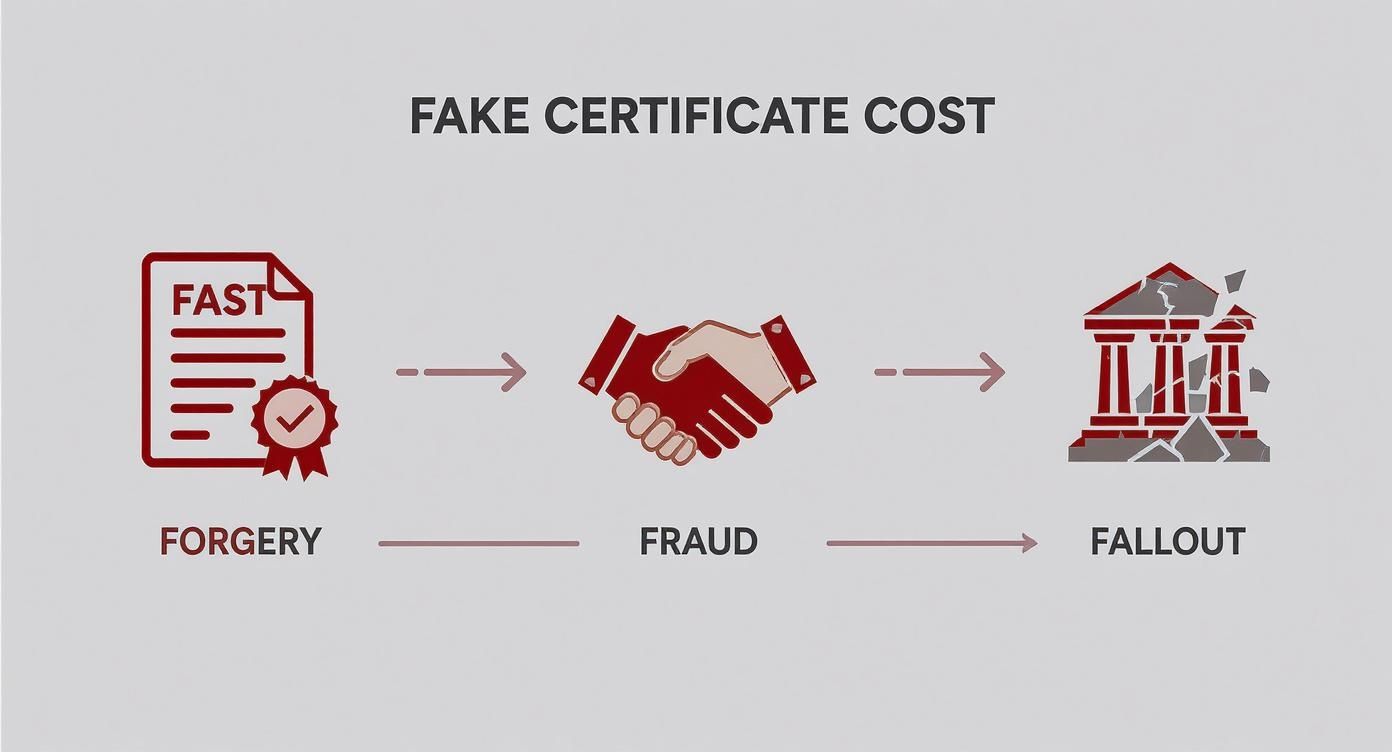
This process really highlights how a single doctored document can trigger severe financial and legal consequences for businesses that unknowingly accept it.
A Modern Framework for Verification
To protect your business properly, you need to adopt a clear, modern verification process. This is not about creating more work; it is about working smarter to stamp out risk.
Here is a simple, actionable framework to follow:
- Request Direct Issuance: Always insist that the certificate for insurance is sent to you directly from the insurer or their authorised broker. Make this a non-negotiable part of your onboarding for any new contractor or partner.
- Use Digital Verification Tools: Whenever you can, use digital platforms or insurer portals that offer instant verification. These tools plug directly into the insurer's live database, giving you undeniable proof of cover.
- Check Every Detail: Cross-reference the key details on the certificate—like the policyholder's name, policy number and dates—against your own contractual agreements. Even a tiny discrepancy is a massive red flag that needs immediate clarification.
This reliance on certificates is especially critical in sectors like professional indemnity (PI). The UK's PI market is valued at around £3.3 billion , yet a worrying 22% of businesses have reportedly stopped buying this cover. With PI claims making up over 26% of all annual insurance claims, robust verification has never been more vital.
Verification is not an act of distrust; it is an essential business practice. In an environment where fraud is rife, using technology to confirm the legitimacy of a certificate for insurance is your best defence against liability and loss.
By implementing these steps, you are not just ticking a box. You are actively building a defence against the very real financial and reputational damage that insurance fraud can inflict. For more on staying one step ahead, see the power of verified evidence and how it can secure your operations. This approach turns verification from a reactive chore into a proactive strategy.
Insurance Types That Commonly Need a Certificate
Think of a certificate for insurance as a passport for your business. In many day-to-day situations, it’s the one document that proves you are a safe, responsible operator, allowing you to get on-site, win contracts and give clients the peace of mind they need. While some policies are smart safeguards, others are legal must-haves. The certificate is what makes them all work in the real world.
For countless businesses, this simple piece of paper (or its digital equivalent) is the key that unlocks new opportunities.
Public Liability Insurance
This is probably the one you will be asked for most often. Public liability cover is your shield if your business operations accidentally injure a member of the public or damage their property.
Imagine you are hiring a builder. You would definitely want to see their certificate for insurance before they start work. It’s your confirmation that if a ladder slips and shatters a window, their insurance will pick up the bill—not you. To get a better handle on this essential cover, check out our complete guide to public liability insurance in the UK.
Employers’ Liability Insurance
Unlike public liability, this one is not a choice. If you have employees in the UK, you are legally required to hold employers’ liability insurance with a minimum cover of £5 million .
The certificate for this policy is special. It must be displayed where your team can easily see it, whether that’s pinned to a noticeboard or uploaded to the company intranet. It’s an immediate, visible promise that they’re protected if they get ill or injured because of their work.
A certificate for insurance is not just for clients; it is a fundamental tool for legal compliance and employee welfare. For policies like Employers' Liability, it serves as a public declaration of a business's commitment to its legal and moral duties.
Professional Indemnity Insurance
This cover is non-negotiable for any business that gives advice, creates designs or offers professional services. It protects you from claims of negligence or a simple mistake that ends up costing your client money.
A marketing consultant, for instance, will need to show their professional indemnity certificate before landing a major contract. It proves they have the financial backing to cover losses if their strategy recommendations backfire and cause harm to the client’s business.
Product Liability and Life Insurance
It does not stop with those core business policies. Certificates are vital in many other areas too. For manufacturers and retailers, product liability insurance is crucial, providing proof of cover in case a faulty product causes an injury.
The sheer scale of the insurance market highlights just how widespread these documents are. Take life insurance, where sales in the UK often range between 450,000 and 600,000 new policies every quarter. Each one of those policies generates a certificate, a critical legal document providing financial protection. Every type of insurance is designed to manage a specific risk and its certificate is the verifiable proof that makes it real.
Protecting Your Business from Risk and Fraud
A certificate for insurance is so much more than just a piece of administrative paper. Think of it as a fundamental tool in your kit for managing risk and proving you have got the financial muscle to handle things if they go wrong. Getting your head around what this document contains is your first line of defence but in today’s world, the threat of fraud means simply holding one is not enough.
Insurance fraud is not a victimless crime. It is a serious issue that drives up premiums for honest businesses and individuals, chipping away at the trust the entire market is built on.
When a business accepts a fake or altered certificate, it unknowingly opens its doors to enormous liabilities. If an incident happens, you could be left completely exposed, facing a financial crisis. This is exactly why diligent, modern verification has shifted from a "nice-to-have" to an essential business practice.
Taking verification seriously does not just protect your own operations; it helps build a fairer, more transparent insurance industry for everyone. By adopting robust validation methods, you empower your organisation and strengthen your overall approach to a solid business risk management framework.
Diligence is your best defence against financial loss and legal liability. Verifying every certificate for insurance is a critical act of self-preservation that secures your business against the significant and widespread damage caused by fraud.
Got Questions? We’ve Got Answers
Here are some quick, clear answers to the most common questions we hear about certificates of insurance.
Is a Certificate for Insurance the Same as My Policy Document?
No, they are two very different things. Think of the certificate as a snapshot – it’s a one-page summary proving you have cover at a specific point in time. Your policy document, on the other hand, is the complete rulebook. It is the full, detailed contract that lays out every term, condition and exclusion.
Should I Be Charged for a Certificate of Insurance?
Typically, no. Your insurer or broker should give you a certificate free of charge as part of the service. After all, it’s just proof of a product you have already paid for. Some brokers might charge a small admin fee for lots of requests or more unusual needs, so it’s always worth checking with them first.
Accepting a dodgy certificate from a contractor is not just a paperwork mistake. If an incident happens and their insurance is not valid, your business could be left footing the bill for damages, injuries and hefty legal costs. This is exactly why solid, modern verification is so critical.
What Happens If I Accept a Fake Insurance Certificate?
Getting caught out by a fraudulent certificate is a massive risk. If an accident occurs and it turns out the third party has no valid insurance, your business could be held 100% liable for everything – damages, injuries and all the legal fees that come with it. This single mistake can lead to devastating financial losses, which is why checking certificates is not just admin, it is a fundamental part of managing your business's risk.
How Often Should I Check a Contractor's Insurance?
Best practice is to verify their certificate before they set foot on your site or start any work. For ongoing contracts, you should also re-check it every time the policy's renewal date comes around. Modern tools can even check the live status of a policy at any time, which is a game-changer for making sure it has not been cancelled just days after the certificate was issued.
Secure your assets and stop fraud in its tracks. With the Proova app, you can create a verifiable inventory of your property, making underwriting simpler and getting claims paid much faster. Visit https://www.proova.com to see how we can help.