
A Complete Guide to the Deed of Assignment in the UK
A deed of assignment is a formal legal document used to permanently transfer ownership of a right or asset from one person to another. It is not just a simple agreement; it is concrete, legal proof that the transfer has happened. This distinction is crucial for heading off disputes and fraud, especially within the insurance industry.
Why This Legal Document Matters

Think of a deed of assignment as the legal equivalent of a car's V5C logbook but for intangible things like rights and claims. A verbal agreement or a basic contract might show intent but a deed provides undeniable, legally binding proof that a transfer has officially occurred. This is not just a technicality; under UK law, it is the bedrock of a secure transaction.
The document formally passes rights—like an insurance claim, a debt or even intellectual property—from the original owner (the assignor ) to a new one (the assignee ). Once executed correctly, the assignor gives up all their interest. The assignee effectively steps into their shoes, gaining full control over the asset. This permanent transfer is what makes it different from temporary arrangements, like a lease, which only grants the right to use something for a set period.
The High Stakes in the Insurance Sector
Nowhere is the importance of a deed of assignment more obvious than in the insurance world. When an insurance claim is assigned, perhaps from a policyholder to a repair company, that deed has to be completely watertight. Its provability is everything because the potential for fraud is massive.
A poorly verified deed of assignment can easily become a vehicle for deception. Fraudsters can forge signatures, invent claims or transfer non-existent rights, creating a complex web of deceit that is difficult and costly to unravel.
This is where the real-world consequences hit home. Insurance fraud is not a victimless crime. It inflates operational costs for insurers, who then have to pass those expenses on to all policyholders through higher premiums. The industry loses billions every year to fraudulent activity and a huge chunk of that comes from manipulated or entirely fabricated documents.
Setting the Stage for Security
Ensuring a deed of assignment is authentic and legally sound is the very first line of defence. Without rigorous verification, insurers are left vulnerable and the entire system suffers. The costs ripple outwards, affecting honest customers and damaging trust across the board.
Throughout this guide, we will break down the mechanics of these deeds, their legal requirements and how modern verification can protect against the costly threat of fraud, making sure every transaction is built on a foundation of verifiable truth.
The Legal Power Behind a Deed of Assignment
A deed of assignment is not just a strong agreement; its power is rooted in centuries of UK law, meticulously crafted to create certainty and shut down disputes before they even start. Its authority does not come from fancy wording but from specific legal requirements that lift it far above a standard contract, offering a much higher level of security for everyone involved.
This legal muscle is entirely intentional. It is built to withstand challenges and provide clear, undeniable proof that a transfer has taken place.
The Essential Pillars of a Valid Deed
Unlike a casual agreement scribbled on a napkin, a deed has a defined legal structure. These are not just bureaucratic hurdles; they are essential safeguards. For a deed of assignment to be legally watertight in the UK, it must tick several critical boxes.
- It must be in writing. A verbal promise simply will not cut it. The entire transfer must be documented.
- It must be clear it is a deed. The document has to shout its intentions from the rooftops, using explicit wording like, "This document is executed as a deed".
- It must be signed. The assignor—the person or entity transferring the rights—must sign the document.
- The signature must be witnessed. An independent person must watch the assignor sign and then add their own signature to confirm they saw it happen.
- It must be ‘delivered’. Do not picture a postman. In legal terms, 'delivery' just means the parties show they intend to be bound by the deed, which is usually confirmed by dating the document.
These steps create a formal, deliberate process that leaves very little room for confusion or fraud. The witness, for instance, is a crucial defence against forged signatures, a headache that continues to plague insurance and property deals.
Why a Deed Carries More Legal Weight
So, what is the big difference between a deed and a standard contract? Why go through the extra hassle of witnesses and formal wording? The answer lies in the legal advantages this formality provides.
Before we dive deeper, let us compare them side-by-side. It is easy to see why a deed is the preferred choice for high-stakes transfers.
Deed of Assignment vs Standard Contract
| Feature | Deed of Assignment | Standard Contract |
|---|---|---|
| Legal Formality | High: must be in writing, witnessed and explicitly state it's a deed. | Lower: can often be verbal or written, with no witness required. |
| Limitation Period | 12 years to bring a legal claim for a breach. | 6 years to bring a legal claim for a breach. |
| Consideration | Not always required. A promise in a deed can be binding without something being exchanged. | Required. Both parties must provide something of value (e.g., money for goods). |
| Presumption of Validity | Assumed to be valid once executed correctly, making it harder to challenge. | Validity can be more easily challenged on grounds like lack of consideration. |
| Common Use Cases | Transferring property, high-value assets, intellectual property or insurance policies. | Everyday business agreements, sales of goods and service contracts. |
As the table shows, one of the most powerful advantages is the limitation period —the time you have to take legal action if something goes wrong.
For a breach of a simple contract, you generally have six years to make a claim. With a deed, that window is doubled to a massive 12 years . This extended timeframe provides far greater security and peace of mind, especially when significant assets or long-term rights are on the line.
This enhanced legal status is deeply woven into the fabric of UK property law. The formal transfer of rights by deed has been the cornerstone of a reliable system for proving ownership, a principle that underpins institutions like HM Land Registry. The registry's entire mission—to provide a state-backed guarantee of title—relies on deeds to formalise transfers when property is sold or mortgaged. This system, with roots stretching back to the Law of Property Act 1925 , creates an authoritative record that helps prevent the kind of title-related fraud that still fuels a significant number of property disputes.
As you can discover on the HM Land Registry blog, the strict rules governing a deed of assignment are not arbitrary. They are the result of a long legal evolution aimed at one primary goal: creating an undisputable record of transfer. This provability is what makes it such a potent tool in preventing fraud and ensuring that when rights are handed over, the transfer is final, clear and legally enforceable for years to come.
How a Deed of Assignment Works in Insurance
In the world of insurance, a deed of assignment is not just another bit of legal paperwork. It is a powerful tool that cleanly redirects financial rights and responsibilities from one person or company to another. This is the legal instrument that makes many everyday insurance processes run smoothly and securely.
The most common place you will see a deed of assignment is in streamlining the claims process. Picture this: you have had a car accident and your vehicle needs major repairs. Instead of paying the garage a huge sum out of your own pocket and waiting for your insurer to pay you back, you can simply sign a deed of assignment. This document legally transfers your right to the insurance payout directly to the repair shop.
The benefits are immediate and practical. The garage gets to work right away, knowing they will be paid directly by the insurer. For you, it removes the headache and financial strain of fronting a large payment. And for the insurer, it simplifies everything by letting them deal with a single, approved supplier.
Securing Loans and Planning Estates
A deed of assignment is also a cornerstone of financial planning, especially when a life insurance policy is used as collateral for a loan. A lender will often ask the borrower to assign their life insurance policy to them for the term of the loan.
- How it works: A formal deed of assignment is signed, which makes the lender the temporary beneficiary of the policy.
- The outcome: If the borrower passes away before the loan is paid off, the insurance payout goes straight to the lender to clear the debt. Any money left over is then given to the policy's original beneficiaries.
This gives the lender solid security and helps the borrower get hold of funds they might not have qualified for otherwise. It is a similar story in estate planning, where someone might assign a life insurance policy to a trust. This makes sure the proceeds are managed exactly as they wished after their death, avoiding the often slow and complex probate process.
Corporate Applications and Transfers
In the corporate world, the deed of assignment is just as vital. Imagine a company has a 'key person' insurance policy on a crucial director. If that company is bought out or merges with another, the policy has to be transferred to the new parent company.
A deed of assignment is what makes this transfer official and legally binding. It guarantees the new business entity owns the policy and can claim the benefits if something happens to that key person. This provides essential continuity and protects the business from the financial shock of losing a critical member of the team.
The core function of a deed of assignment in all these cases is to create a legally binding, provable chain of ownership. It cuts through any ambiguity and ensures that when a claim is made, the money goes to the right and legally entitled party.
But this is exactly where fraudsters see an opportunity. The perceived authority of a legal deed can be twisted to divert funds. A forged signature on an assignment form could send a legitimate payout for a storm-damaged roof straight into a criminal's bank account. This is not just a theoretical threat; insurance fraud costs the UK economy over £3 billion every year and fake documentation is a major part of the problem.
These criminal schemes drive up costs for everyone. Insurers have to plough huge amounts of money into fraud detection and those expenses inevitably get passed on to honest customers through higher premiums. So, the provability of a deed of assignment is not just a legal detail; it is the main line of defence against fraud that hurts the entire industry. While it is different from subrogation—where an insurer recovers costs from a third party—assignment directly transfers the policyholder's own rights. You can learn more about the distinction in our comprehensive UK guide to subrogation in insurance. Verifying the legitimacy of every single assignment is essential to protect the integrity of the whole system.
The Anatomy of a Legally Sound Deed
A legally sound deed of assignment is not just a jumble of legal jargon; it is a precisely engineered document. Every single clause has a job to do. Understanding its structure is the first step in telling the difference between a robust, enforceable deed and a weak one that is just asking to be exploited for fraud.
Breaking down its core components shows you how it creates a clear, provable transfer of rights. The document’s strength comes from being absolutely clear and complete. From identifying the parties to detailing the asset being transferred, each section builds on the last to form an unshakeable record. This structure is designed to leave zero room for ambiguity—a critical defence against disputes and fraudulent claims.
The Foundational Clauses Every Deed Needs
Every deed of assignment rests on a few essential pillars. These clauses establish the who, what and why of the transfer, forming the legal bedrock of the agreement. Without them, the document is fundamentally flawed and wide open to challenge.
- Parties: This section must precisely identify the assignor (the one transferring the rights) and the assignee (the one receiving them). It needs full legal names and addresses to prevent any confusion over identity, a common weak point exploited in insurance fraud.
- Recitals: Often starting with "WHEREAS", these are the background statements. They set the scene, explaining the context of the assignment—for instance, that the assignor holds a particular insurance policy and has agreed to transfer their rights under it.
- Operative Part: This is the engine room of the deed. It contains the active language that actually performs the transfer, using crystal-clear terms like "the Assignor hereby assigns..." to get the job done.
The operative part also needs a perfectly clear description of the asset being assigned. If it is an insurance claim, it should reference the policy number, the date of loss and the nature of the claim. Vague descriptions create loopholes for fraudsters and can render the entire deed useless.
Critical Legal Language Explained
Beyond the basics, specific clauses add extra layers of legal protection and spell out each party's responsibilities. The wording here is very deliberate and carries serious legal weight, so it is vital to understand what these clauses mean in practice.
Sample Consideration Clause: "IN CONSIDERATION of the sum of one pound (£1.00), the receipt of which the Assignor hereby acknowledges, the Assignor as beneficial owner HEREBY ASSIGNS absolutely to the Assignee all its right, title, and interest in and to the Assigned Rights."
This clause, known as the consideration , confirms that something of value has been exchanged, even if it is just a token amount like £1.00. While a deed does not strictly need consideration to be valid (unlike a simple contract), including it strengthens the document by showing a clear commercial reason for the transfer.
Another crucial element is the covenant . This is where the assignor makes promises—for instance, that they have the full right to transfer the asset and that it is free from any other claims or charges. This gives the assignee a legal guarantee, reinforcing the transfer's provability and offering a way to seek recourse if the statements turn out to be false. The formalisation of these transfers has a long history, evolving from some pretty archaic practices. In the evolution of UK property law, the Statute of Uses in 1535 was a huge step, allowing freehold property to be transferred by deed instead of the old way of literally handing over a clump of turf in front of witnesses. You can find more fascinating insights into the history of the land registry on Property Chronicle.
The diagram below shows just a few of the common areas in insurance where a deed of assignment is put to work.
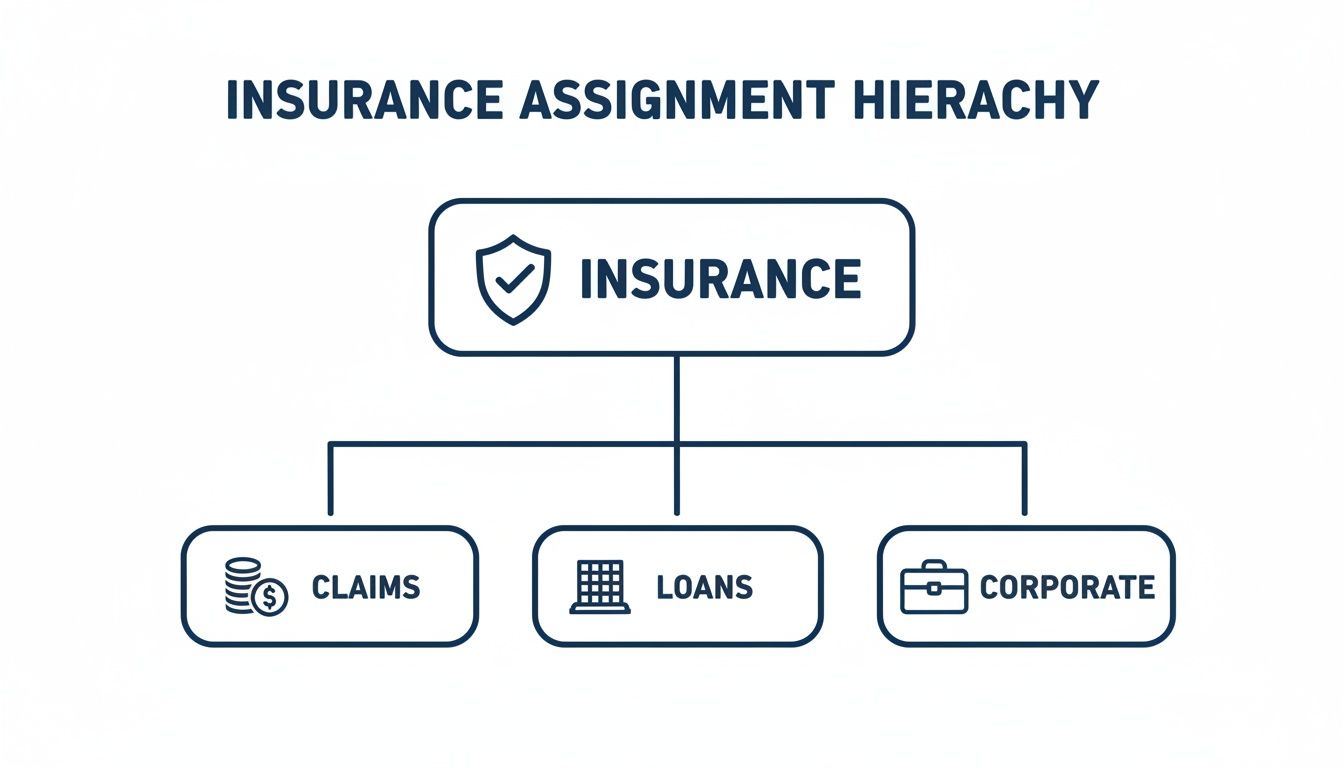
This hierarchy illustrates how assignments are used to manage claims, secure loans and handle corporate transactions—all of which rely on a meticulously drafted deed to work properly.
The Final Step: Execution and Delivery
The last piece of the puzzle is the execution block , where the deed is signed, witnessed and dated. This is the exact moment the deed becomes legally binding. Getting the execution right is non-negotiable; an unwitnessed signature or an incorrect date can invalidate the entire document.
This formality is the ultimate safeguard. It creates the final, verifiable proof that the assignment was intentional and properly concluded, making it substantially harder for fraudsters to challenge or replicate.
Uncovering the Real Cost of Assignment Fraud
While a deed of assignment is a powerful legal tool, its very strength is what makes it such an attractive target for fraudsters. The formality that provides security can be twisted and exploited to commit sophisticated crimes with devastating financial fallout.
When fraud enters the picture, it attacks the one thing a deed is supposed to guarantee: provability. A criminal does not need to break into a building; they just need to convincingly fake a document. The impact is not a minor hiccup—it is a direct financial drain on the insurance industry and, by extension, every single person paying a premium.
Common Schemes Exploiting Deeds of Assignment
Fraudsters can be creative but their methods often follow familiar, predictable patterns. By understanding how they operate, insurers and policyholders can get much better at spotting the red flags. These schemes are cleverly designed to look legitimate on the surface, which is why diligent, evidence-based verification is the only real defence.
Here are a few of the most common tricks:
- Forged Signatures: This is the simplest and most widespread tactic. A criminal forges a policyholder’s signature on a deed of assignment, illegally redirecting a legitimate claim payment to themselves or an associate. The real claimant is left completely empty-handed.
- Fabricated Claims: In this scenario, criminals invent a claim out of thin air—a fictional property flood or a non-existent workplace accident. They then create a deed to assign this "claim" to a complicit third party, like a repair company or solicitor who is in on the con.
- Inflated Invoices: Here, a legitimate claim gets assigned but the assignee (like a vehicle repair shop) submits grossly inflated invoices to the insurer. The deed provides a cloak of legitimacy for what is, in reality, outright theft.
These are not victimless crimes. They are calculated attacks on the financial system that is supposed to support us all when things go wrong.
The Ripple Effect of Fraud Across the Industry
The cost of insurance fraud is staggering and it is not just insurers who absorb these losses. The financial damage ripples outwards, impacting everyone. When insurers are forced to pay out on fraudulent claims, they have to recoup those losses somewhere. Inevitably, that means higher premiums for all honest policyholders.
The very structure of a deed, designed to offer certainty and clarity, becomes the fraudster’s camouflage. They count on busy departments and the assumed legitimacy of the document to push their claims through, knowing that once the money is paid out, getting it back is next to impossible.
This erosion of trust has wider consequences too. It forces insurers to bring in more stringent and often slower claims processes for everyone. Legitimate claims get delayed while investigators sift through mountains of paperwork, causing frustration and financial hardship for genuine claimants who are already in a vulnerable position. You can explore the sheer scale of this problem in our detailed analysis of what insurance fraud really costs the industry.
Why Provability Is the Only Defence
The entire concept of a deed is built on providing an ironclad, indisputable record of a transfer. This principle has deep roots in UK law, evolving over centuries to create a reliable system for proving ownership.
When a deed of assignment is presented, the central question must always be: can its authenticity be proven beyond any doubt?
This means verifying:
- The identity of both the assignor and the assignee.
- The existence and legitimacy of the asset being assigned.
- The integrity of the signatures and the entire witnessing process.
Without absolute proof at each of these stages, the door is left wide open for fraud. In this high-stakes environment, assuming a document is legitimate just because it looks official is a recipe for financial disaster. Rigorous, evidence-based verification is not just a best practice; it is the only viable defence against criminals determined to exploit the system.
Using Modern Technology to Stop Fraud

The traditional, paper-based nature of a deed of assignment has long been its greatest weakness, opening the door for fraud that costs the insurance industry billions. Thankfully, modern technology offers powerful tools to shut that door, shifting the focus from reacting to fraud to proactively preventing it.
The solution hinges on one thing: absolute provability. By digitally verifying the identities of everyone signing and confirming the document's authenticity, technology creates a secure, auditable trail that is incredibly difficult to fake or argue against. This transforms the deed from a vulnerable piece of paper into a hardened digital asset.
Adopting these tools is not just about efficiency. It is a critical move to protect the integrity of the entire assignment process, restore trust and cut down the financial burden of fraud that policyholders ultimately carry.
Building an Unbreakable Chain of Evidence
Digital verification platforms create an unchangeable record of a deed's entire lifecycle, from creation to signing. This is done by securely linking the identities of both the assignor and assignee directly to the document itself.
This process builds multiple layers of security:
- Identity Verification: Advanced checks confirm that the people signing the deed are exactly who they claim to be, stopping fraudsters from using stolen or fake identities in their tracks.
- Document Authentication: The deed is digitally locked and timestamped. This creates a unique digital fingerprint that instantly reveals if anyone has tried to tamper with it.
- Auditable Trail: Every single action—from someone viewing the document to the final signature—is logged, providing a clear, chronological history of the whole process.
By weaving verification directly into the workflow, insurers can build a fortress of evidence around every single deed of assignment. This makes it almost impossible for a fraudulent document to slip through the cracks, safeguarding assets and bringing down claim-handling costs.
It is also worth noting that modern legal practices are increasingly using AI-powered contract review workflows to boost accuracy and spot red flags. These tools can automatically flag suspicious clauses or inconsistencies, adding yet another layer of defence.
The move to secure digital processes is a vital step forward. To see how these principles work across the wider sector, you can explore the broader impact of digital transformation in insurance to fight fraud. Ultimately, technology delivers the provability needed to stop fraud before it can even start, protecting insurers and consumers alike.
Got Questions? We've Got Answers
When you are dealing with legal documents like a deed of assignment, it is natural for a few questions to pop up. Let us clear up some of the most common queries to give you a better understanding of how they work in the UK.
Is a Witness Always Required for a Deed of Assignment?
Yes, absolutely. For a deed to be legally binding in the UK, the person assigning the rights (the assignor) must sign it in the presence of a witness. This is not just a formality—it is a critical safeguard.
The witness has to be independent, meaning they cannot be one of the parties involved or stand to gain from the agreement. Their job is to watch the assignor sign, then add their own signature, name and address. This simple act confirms the signature is genuine and helps prove the document's validity, making it much harder to challenge later on.
Can a Deed of Assignment Be Cancelled?
A deed of assignment is designed to be a final, permanent transfer. Once it is signed and delivered, the assignor cannot just change their mind and revoke it. However, it is not entirely set in stone.
If both the assignor and the new owner (the assignee) agree, the rights can be transferred back. This usually requires drawing up a new legal document, often called a deed of re-assignment , to make it official. In very rare situations, a court might step in and set a deed aside, but only if there is proof it was signed under duress, as a result of fraud or based on a fundamental mistake.
What Is the Difference Between a Deed of Assignment and a Novation?
This is a common point of confusion but the distinction is crucial. Both documents transfer contractual responsibilities but they do it in very different ways.
A deed of assignment only transfers the rights or benefits of a contract. The original party (the assignor) is still on the hook for their obligations.
For example, imagine a building contractor assigns their right to be paid for a project to one of their suppliers. The supplier now gets the money but the original contractor is still responsible for actually finishing the construction work.
A novation agreement , on the other hand, transfers both the rights and the obligations to a new party. It essentially tears up the old contract and creates a brand new one, completely releasing the original party from their duties. Because it is a much bigger step, a novation requires the consent of all three parties involved.
Safeguard your assets and prevent costly fraud. With Proova , you can create a verifiable digital record of your property, ensuring every insurance claim is built on a foundation of undeniable proof. Secure your peace of mind by visiting https://www.proova.com to learn more.