
Modern Car Accident Management
Effective car accident management is not just a reactive process. It is a strategic framework built to control costs, verify claims and stop fraud in its tracks—right from the first notification of loss. This is about moving beyond simple claims handling to a proactive system built on verifiable evidence and smarter workflows.
The Real Cost of Inefficient Car Accident Management
The moments immediately following a road traffic collision are critical. They set the tone for the entire claims journey. Get it right and you build customer trust with an efficient, smooth process. Get it wrong and it can spiral into a costly, drawn-out affair plagued by uncertainty and doubt.
For insurers, the financial and reputational stakes could not be higher. Inefficient processing and fraudulent activity punch huge holes in the bottom line, with losses that are ultimately passed on to every single policyholder. The cost of insurance fraud to the industry and to all of us is immense.
This whole process is not just about settling claims; it is about ensuring they are provable. Every unsubstantiated detail creates an opening for exaggeration or outright fraud, a major drain on the industry. The financial hit from bogus claims is staggering and affects everyone. You can learn more about what insurance fraud really costs the industry and how it drives up premiums for honest customers.
The core principle of modern car accident management is simple: shift from a reactive, claims-paying function to a proactive, loss-prevention system. This is achieved by building every decision on a foundation of verified, undeniable evidence captured right at the source of the incident.
Fraud: The Hidden Cost to Policyholders
Insurance fraud is far from a victimless crime. It inflates operational costs and claim payouts, which leads directly to higher premiums for honest customers. We see organised fraud rings exploiting any weakness they can find in the claims process, submitting fabricated claims for phantom accidents or exaggerating the extent of genuine damage and injuries.
Without a robust system to verify every piece of information, insurers are left completely vulnerable. This lack of provability is a direct threat to the financial health of the insurer and the fairness of the premiums paid by the public.
This problem is made worse by the sheer volume of incidents. In the UK alone, the human cost of road accidents is significant. Beyond the 1,671 road deaths , official statistics show 28,804 people sustained serious injuries and 105,291 suffered slight injuries , bringing the total casualties to a staggering 135,766 .
Each one of these incidents represents a potential claim and a portion will inevitably involve opportunistic or premeditated fraud.
Dealing with the volume and complexity of claims is a major hurdle. The table below breaks down the core challenges that modern claims handlers face every day.
Core Challenges in Modern Claims Handling
An overview of the primary obstacles insurers face and the strategic objectives to overcome them.
| Challenge | Impact on Insurers | Strategic Objective |
|---|---|---|
| Claim Volume | High operational overhead and potential for human error. | Automate routine tasks and triage claims effectively. |
| Fraudulent Activity | Significant financial losses and increased premiums for honest customers. | Implement robust, evidence-based fraud detection workflows. |
| Evidence Integrity | Difficulty verifying the time, location and authenticity of submitted proof. | Adopt technology that captures immutable, verifiable evidence at FNOL. |
| Customer Experience | Slow, opaque processes lead to dissatisfaction and churn. | Create transparent, fast-track pathways for legitimate claims. |
| Data Silos | Disconnected systems prevent a holistic view of the claim and policyholder. | Integrate data sources for a single source of truth. |
As you can see, the path forward requires a more integrated and evidence-led approach to overcome these persistent industry challenges.
Establishing Provability From the Start
To tackle these challenges head-on, the focus has to be on the provability of the claim from the word go. This means arming your claims teams with the tools and workflows they need to scrutinise every piece of evidence presented.
A modern approach demands more than just accepting a policyholder's account at face value. It requires a system that can verify the time, location and integrity of photographic evidence and cross-reference details to spot inconsistencies immediately.
By prioritising provability, insurers can confidently fast-track legitimate claims while flagging suspicious ones for deeper investigation. This protects both their bottom line and their honest customers from the ever-increasing cost of fraud.
Building a Fraud-Proof Evidence Foundation
The fight against insurance fraud is often won or lost in the first few minutes after an incident. It all comes down to the quality of the evidence gathered at the scene. For claims teams, knowing the immediate post-accident steps for truck drivers and other motorists is crucial but it is only half the battle. Your real goal is to create an undeniable, time-stamped record that solidifies your position on legitimate claims while shutting the door on opportunistic fraud.
Every single piece of evidence that lands on your desk—every photo, video and statement—needs to be viewed with a healthy dose of professional scepticism. Without proper verification, you are essentially operating on trust. In the world of modern car accident management , that is a gamble you cannot afford to take.
This is where the right digital tools become your greatest asset. Guiding a policyholder to capture specific, high-quality evidence through a dedicated app or portal is your first line of defence. This is not just about snapping a few pictures of a dented bumper; it is about building a complete, verifiable picture of the entire incident scene.
Capturing Verifiable Incident Data
Let us be honest, traditional evidence collection is full of holes. Photos can be pulled from old accidents, timestamps can be doctored and locations can be faked. A modern approach has to go beyond simple image capture and secure verifiable data points that are incredibly difficult to manipulate.
The trick is to embed verification directly into the capture process. This means using technology that automatically validates crucial information as it is being recorded , leaving zero room for someone to alter it later.
This simple shift turns a policyholder's smartphone into a powerful forensic tool for your claims handlers. It guarantees that the data you receive is not just a picture but a certified record of a specific time and place.
By focusing on the provability of claims from the very beginning, you completely change the dynamic. You are no longer just reacting to whatever information you are given; you are actively directing the capture of evidence you know you can trust. This is absolutely critical for fighting fraud before it even happens.
Key Elements of a Verified Evidence Package
To build a truly fraud-proof case, the evidence needs multiple layers of verifiable data. A single photograph on its own is weak. But a collection of data-rich files? That creates a compelling and believable narrative.
An effective evidence package should always include:
- Immutable Geolocation Data: GPS coordinates embedded directly into the file's metadata, confirming the exact spot where each photo or video was taken.
- Tamper-Proof Timestamps: Server-verified timestamps that prove the precise date and time of capture, making it impossible to submit old or recycled images.
- High-Resolution Visuals: Clear, uncompressed images and videos that show the full extent of the damage, road conditions, vehicle positions and any other relevant details.
- Authenticated Witness Statements: Digital recordings or written statements from third parties, all captured and verified within the same secure environment.
This multi-faceted approach makes it exceptionally difficult for a claimant to construct a false story. Each piece of data backs up the others, building a cohesive and trustworthy account of what really happened.
From Capture to Automated Analysis
Once this verified data is captured, it can be fed directly into an automated analysis workflow. This is where you can use AI and machine learning to spot inconsistencies that a human reviewer, no matter how sharp, might miss.
For example, an automated system can instantly flag a claim where a photo's metadata shows it was taken miles away from the reported accident location. It can also detect anomalies in timestamps, like spotting photos of the same damaged car being submitted for different claims months apart.
This automated first pass is essential for efficient car accident management . It frees up your experienced claims handlers to focus on genuinely complex cases instead of wasting hours trying to manually verify basic facts. Any inconsistencies are automatically flagged for review, creating a powerful, evidence-based workflow to challenge suspicious activity and protect your business—and your honest policyholders—from the spiralling cost of fraud.
Accelerating Claims Triage and Processing
Getting claims processed quickly is not just good customer service—it is a critical lever for controlling costs in car accident management. The longer a claim sits idle, the more it costs. A modern, efficient workflow uses technology to speed up the initial triage, making sure your resources are pointed exactly where they are needed most.
The old way of treating every claim as equal until proven otherwise creates massive bottlenecks. This approach forces straightforward, low-value claims to wait in the same queue as complex, high-risk cases. Not only does this frustrate honest policyholders but it also inflates administrative costs and opens the door to claim inflation.
A smarter system analyses the initial incident data automatically to segment claims right from the start. This allows for immediate sorting based on complexity, severity and fraud potential. Simple, low-risk claims get fast-tracked for a quick settlement, while more complicated or suspicious cases are automatically flagged and sent to your expert human reviewers.
Segmenting Claims for Maximum Efficiency
Effective triage starts the moment the first notification of loss (FNOL) comes in. It is not about just taking the claimant's story at face value; it is about interrogating the verified evidence that backs it up. Automated systems can chew through this information in seconds to make an initial assessment and push the claim down the right path.
The key data points for an effective triage include:
- Vehicle Damage Analysis: AI-powered tools can scan photos to estimate repair costs, pinpoint the impact points and even spot pre-existing damage that has nothing to do with the current incident.
- Injury Reports: Initial reports of injury, especially vague ones like whiplash, can be cross-referenced with the incident's severity. A claim for serious injury from a low-speed car park bump should immediately raise a red flag.
- Geolocation and Timestamps: Verified data confirms the incident happened when and where the claimant said it did. This instantly weeds out claims built on fake or doctored evidence.
- Third-Party Involvement: The number of vehicles, witnesses and injuries adds complexity. An automated system can flag multi-party incidents for a much closer look.
This initial, data-driven segmentation is fundamental to the whole process. The flow is simple: capture the evidence, verify it and flag anything that does not add up.
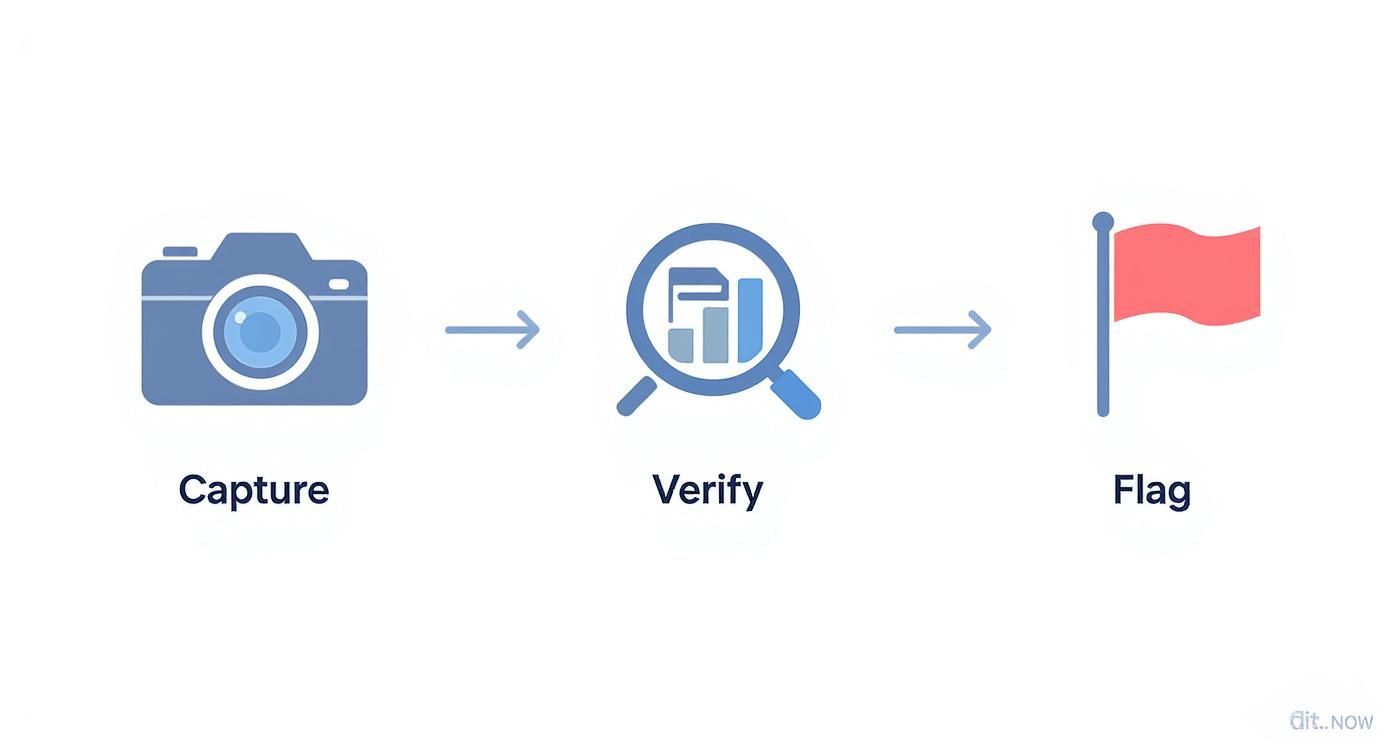
This simple Capture, Verify and Flag process ensures every claim is built on a solid, provable foundation before it even lands in a handler's workflow. It is a non-negotiable first step in any robust car accident management strategy.
The Human Element in an Automated World
Automation does not replace experienced claims adjusters; it empowers them. By taking care of the high-volume, low-complexity tasks, technology frees up your best people to focus on the cases that genuinely need their expertise. Think complex settlement negotiations, serious injury claims and investigations into organised fraud rings.
This structured approach stops your best handlers from getting bogged down in admin, ensuring their skills are applied to the most costly and challenging files. It changes their role from data processors to strategic investigators. The end result is a massive drop in the overall cost per claim.
A well-designed triage system directs the right claim to the right person at the right time. Fast-tracking simple claims can drastically improve customer satisfaction, while flagging complex cases ensures they receive the scrutiny they deserve, protecting the business from unnecessary losses.
Ultimately, accelerating the claims journey is about much more than just speed. It is about accuracy, efficiency and fairness. When you can trust the evidence from day one, you can make faster, more confident decisions. This not only contains costs but also builds a reputation for being a fair and efficient insurer. To see this in action, you can find out how platforms like Proova help brokers speed up claim resolutions by 70%.
Implementing Advanced Fraud Detection

Insurance fraud is not just a nuisance; it is a multi-billion-pound drain on the industry that ultimately pushes up premiums for every honest policyholder. To really get a grip on it, you need to move past simply looking for obvious red flags. It demands a sophisticated, multi-layered detection strategy that treats every claim with a healthy dose of professional scrutiny.
The focus has to shift from a claim's plausibility to its provability .
Effective car accident management today means breaking down data silos. We can no longer afford to look at data points in isolation. The real power comes from building a connected intelligence web, pulling in your own historical claims data, tapping into third-party databases and even leveraging open-source intelligence to see the whole picture.
When you start connecting these dots, subtle patterns emerge that would otherwise go completely unnoticed. A single exaggerated claim might slip through the net but what if you could link that claim to a specific repair shop that keeps popping up in dozens of similar, questionable cases? Now you are onto something much bigger. This is where a modern fraud detection workflow really proves its worth.
Uncovering Hidden Networks and Suspicious Links
Let us be honest, organised fraud is rarely a one-off. It is a business and it operates through networks of connected people and companies. These webs can include claimants, solicitors, medical providers and repair garages, all collaborating to exploit the system. Trying to spot these connections manually across thousands of claims is a fool's errand.
This is where technology, particularly AI and machine learning, becomes an absolute game-changer. These systems can churn through enormous datasets, spotting non-obvious relationships and suspicious patterns that scream "coordinated fraud."
For instance, the system might instantly flag situations where:
- Multiple claimants from different accidents all list the same mobile number.
- A particular medical clinic consistently diagnoses whiplash from incredibly low-impact collisions.
- The same garage repeatedly bills for identical, high-cost replacement parts across a string of minor incidents.
Are these definitive proof of fraud? Not on their own. But they are powerful, evidence-based indicators that demand a much deeper look. They give your team a solid, data-backed reason to challenge a claim and ask for more rigorous proof.
The real goal here is to flip the script. Instead of reacting to suspected fraud, you get proactive, with a system that automatically shines a light on high-risk networks. This data-driven approach gives you an evidence-based workflow to systematically dismantle fraudulent operations.
The Problem with Official Accident Data
Building your own robust, internal fraud detection model is also critical because you cannot always trust external data sources. Take the UK's road accident statistics, which have faced significant scrutiny. While official police figures might suggest a drop in casualties, hospital admission data for traffic-related injuries often tells a different story.
This discrepancy hints that official stats may not capture the full reality of incidents on our roads, perhaps due to changes in reporting habits rather than a genuine improvement in safety. For an insurer, this highlights the immense risk of relying on a single source of truth. It is a stark reminder of why strong internal verification processes are non-negotiable. You can read more about the discrepancies in UK road casualty reporting to understand the full picture.
Ultimately, this makes your own verified claims data an incredibly valuable asset for understanding real-world risk and spotting fraud patterns.
From Red Flags to Provable Evidence
A truly effective fraud detection system does more than just wave a red flag. It equips your team with the hard evidence needed to act with confidence. When the system highlights a suspicious link between a claimant and a garage, it should not stop there. It should also pull up every associated claim, evidence file and communication log.
This gives the claims handler instant context. They can review past incidents involving that same garage, compare damage photos side-by-side and spot repeated patterns in repair invoices. What started as a vague suspicion becomes a concrete, data-driven line of inquiry.
Here is a look at how this evidence-based workflow operates in the real world:
- Automated Network Analysis: The system constantly scans incoming claims, cross-referencing all entities (people, vehicles, businesses) against your entire historical database.
- Risk Scoring: Any claim linked to known high-risk networks or showing suspicious patterns gets an elevated fraud score, pushing it up the priority list.
- Investigative Dossier Creation: The platform automatically assembles a digital case file for the flagged claim, linking all relevant prior incidents and their supporting evidence.
- Informed Human Review: Your expert handler receives this complete dossier. They can then make a quick, informed decision on how to proceed—whether that is requesting more information, denying the claim or escalating it to your specialist fraud investigation unit.
This structured process ensures your team’s valuable time is focused on the most significant threats, protecting your business and helping keep premiums fair for the vast majority of your honest customers.
Using Claims Data for Smarter Underwriting
The smartest car accident management does not start when a claim is filed; it starts before a policy is even written. Your richest source of risk intelligence is sitting right inside your own business: historical claims data. Too often, though, this goldmine of information is siloed, completely cut off from the underwriting department.
Breaking down that wall is the single most effective way to price risk accurately. It lets underwriters move beyond generic demographic data and start making decisions based on real-world loss patterns, turning past incidents into future profitability.
Creating a Data-Driven Feedback Loop
The relationship between claims and underwriting should be a two-way street. When the claims team spots a new fraud trend or notices that a specific type of vehicle is involved in a disproportionate number of costly accidents, that insight needs to land on an underwriter's desk—fast.
This means getting away from clunky manual reports and building integrated systems where data flows freely. Imagine your claims data reveals a spike in accidents involving certain performance modifications. With a proper feedback loop, your underwriters can immediately adjust premiums or add specific exclusions for those mods. It is a proactive stance against future losses.
To get a broader view of how AI is shaping risk management and claims across the sector, this guide on the AI in Insurance Industry offers a comprehensive look.
Performing Pre-Bind Checks
A crucial part of this proactive approach is running solid pre-bind checks before you ever issue a policy. This is your first, best and cheapest chance to catch misrepresentations that could snowball into a fraudulent claim later. It costs far less to turn away a high-risk applicant than it does to investigate a bogus claim months down the line.
These checks need to be more than just a quick look at their driving history. Think deeper:
- Verifying No Claims Bonus: Are you cross-referencing their declared no-claims history against industry databases? It is a simple check that catches out blatant lies.
- Checking for Undisclosed Modifications: Use data from previous claims or external sources to flag applicants who conveniently "forget" to mention performance tweaks that seriously impact their risk profile.
- Analysing Address Risk: Postcode fraud is still rampant. Use geolocation data to confirm the address they give is actually where the car is kept overnight.
This level of scrutiny before a policy goes live is fundamental to maintaining a healthy book. It stops problems before they even begin.
An underwriter's best tool for predicting future risk is an insurer's claims history. By analysing precisely how, where and why losses occur, you can build underwriting models that are tuned to the real world, not just actuarial tables.
Identifying Emerging High-Risk Profiles
Risk is not static; it evolves. By constantly analysing your claims data, you can spot emerging trends and adjust your underwriting strategy in real-time. Just look at the recent data on road fatalities in Great Britain—it is a sobering reminder of how risk profiles can shift.
While car occupants still account for the largest proportion of fatalities at 43% , the really alarming figure is the 9% rise in motorcyclist deaths compared to the previous year. This points to a growing challenge in managing accidents involving vulnerable road users, a trend that underwriters absolutely must factor into their pricing models. You can dig into more of these road fatality trends on RAC.co.uk.
This kind of data-driven insight allows you to stay ahead of the curve. When you spot these high-risk segments early, you can take decisive action—whether that is adjusting premiums, offering risk-reduction incentives or simply deciding not to write certain types of business at all. This continuous cycle of analysis and action is the hallmark of modern, intelligent underwriting.
Where Automation Fits into Modern Claims
Let us be honest: manual processes are a liability in today's competitive insurance market. The sheer administrative weight of verifying evidence, triaging claims and flagging potential fraud creates costly delays. These delays do not just frustrate honest policyholders; they give fraudsters the breathing room they need to build a convincing story.
This is why effective car accident management now hinges on smart, end-to-end automation.
We are not just talking about automating a single task. Technology platforms now exist that can handle the entire claims journey. Take a platform like Proova as a practical example. It shows exactly how automation can connect every stage—from the first notification of loss and evidence capture, right through to fraud detection and final settlement.
This kind of integrated approach closes the gaps and breaks down the data silos where fraudulent activity tends to hide. It ensures every decision is built on a solid foundation of verifiable proof.
Creating a Single Source of Truth
The single greatest strength of an automated system is its power to create one, undeniable source of truth for every claim. When a policyholder submits evidence through a secure portal that automatically verifies the time, date and location, the debate over the basic facts of the incident is effectively over.
This foundation of provability is the cornerstone of modern claims handling.
From there, the benefits ripple outwards. Simple, legitimate claims can be fast-tracked for payment, sometimes getting settled in hours instead of weeks. Even more importantly, it gives your claims handlers the concrete evidence they need to confidently challenge—and reject—fraudulent or exaggerated claims, protecting the business from unnecessary losses.
By building the entire claims file on a bedrock of verifiable evidence, automation empowers teams to make faster, more confident decisions. It shifts the focus from administrative box-ticking to strategic risk management and fraud prevention.
This efficiency delivers tangible results that hit the bottom line hard. Slashing claim cycle times and reducing human touchpoints drastically cuts operational costs. In fact, industry analysis shows that insurers adopting these technologies can see a significant drop in their expense ratios.
The Financial Case for Automation
The return on investment here is not theoretical; it is clear and compelling. Automation delivers real value in several key ways:
- Slashing Fraudulent Payouts: By flagging inconsistencies and suspicious patterns right at the start, these platforms stop bogus claims from ever reaching the payment stage. This alone can save a business millions every year.
- Lowering Operational Costs: Automating routine tasks like data entry, initial triage and evidence verification frees up your skilled handlers. They can then focus their expertise on complex cases, which reduces the overall cost per claim.
- Accelerating Claim Cycles: Getting claims processed faster does not just improve customer satisfaction. It also cuts down the risk of claim inflation, where costs creep up the longer a file stays open.
Ultimately, these platforms are not just about moving faster; they are about integrity. They ensure the claims process is fair, transparent and robust. This protects honest policyholders from the financial burden of fraud, which costs the industry billions and drives up premiums for everyone.
By embracing automation, insurers can manage risk more effectively, cut costs and build a far more resilient business.
Your Questions Answered
When you start updating your car accident management framework, it is natural for questions to pop up, especially for claims and operations leaders. Getting the implementation right is the difference between simply having new tech and actually seeing a real drop in fraud and a boost in efficiency.
Let us tackle some of the common ones we hear.
How Can We Encourage Better Evidence Capture?
It all comes down to making it ridiculously simple for your policyholders. Give them a guided, app-based process that literally walks them through capturing the right photos and videos right there at the scene.
The magic happens when this process automatically embeds tamper-proof time and location data into every file. This means the evidence is verifiable from the moment it is captured. It completely removes the guesswork for them and ensures your team gets the exact, high-quality information needed to assess a claim properly.
What Is the First Step in Automated Fraud Detection?
Start by centralising your data. Seriously, this is the foundational step. You need to connect your historical claims information with the new, verifiable FNOL data you are collecting.
This creates a single, powerful data pool. From there, an automated system can get to work analysing patterns, spotting hidden connections between claimants and third parties and flagging suspicious activity. It shifts your team from relying on gut feelings to making decisions based on solid evidence.
How Do We Measure ROI on New Technology?
Measuring the return on investment (ROI) is absolutely critical. You cannot just hope it is working; you have to prove it. The best way to do this is to focus on tracking a few core metrics before and after you roll out any new technology.
We recommend focusing on these key performance indicators:
- Claim Cycle Time: How long does it take from FNOL to settlement? A significant drop here is a clear win for efficiency.
- Cost Per Claim: Look at the average claim cost, including both the settlement and your team's handling expenses. You want to see this number go down.
- Fraud Detection Rate: This is a big one. You should see a clear increase in the number of fraudulent claims you identify and successfully deny.
By tracking these figures, you build an undeniable business case. You can clearly show how investing in provability directly cuts fraudulent payouts and operational costs. It is a win that benefits the entire industry and, most importantly, every single one of your honest policyholders.
Take control of your claims process and stop fraud before it starts. With Proova , you can build a foundation of verifiable evidence for every claim. Learn how our platform delivers provability and protects your bottom line.