Mastering Your Non Fault Claim in the UK
When you hear the term ‘non-fault claim’ you’d be forgiven for thinking it means you’re completely off the hook financially speaking. It’s an insurance claim where another party is 100% responsible for what happened and their insurer is supposed to pick up the tab.
But here’s a common misconception: ‘non-fault’ doesn’t always mean ‘no cost’ to you. Any claim, regardless of who was to blame, can have a knock-on effect on your future insurance premiums and even your precious No Claims Bonus. The entire process hinges on one critical factor: provability.
The True Cost of a Non Fault Claim
It’s one of the most frustrating situations to be in. You’ve been involved in an accident that was clearly someone else’s fault yet you could still end up facing a financial sting. While the other driver’s insurer is liable for the repair bills and other direct costs, the ripple effects can certainly reach your own policy when it’s time to renew.
Why? Because insurers analyse risk based on your entire claims history, not just who was at fault in each incident.
From an insurer's point of view, being involved in any incident—even as the innocent party—suggests a higher statistical risk of you making future claims. It might not seem fair but it can lead to a hike in your underlying premium even if your No Claims Bonus discount stays untouched.
Rising Repair Costs and Industry Pressures
Let's be clear: the entire motor insurance industry is feeling the squeeze and that pressure inevitably trickles down to every policyholder. The costs to repair modern cars are climbing at an alarming rate, mostly thanks to all the sophisticated tech packed into them like sensors and ADAS (Advanced Driver-Assistance Systems). A minor bump that would have been a simple fix a decade ago can now result in a bill running into thousands of pounds.
The numbers don't lie. Between 2019 and mid-2025, the average repair cost for a non-fault claim vehicle in the UK is projected to jump from £4,162 to £5,191 . That's a massive increase of 24.7% . This trend is forcing insurers to be far more scrupulous with every single claim that crosses their desk. You can explore more data on rising repair costs and their industry impact.
The reality is, every claim—fault or not—gets added to the overall pool of costs that insurers have to manage. When those costs go up for the industry they are eventually passed on to all of us through higher premiums.
Why Provability is More Important Than Ever
With repair costs soaring, insurers are also quicker to write vehicles off completely. The proportion of non-fault incidents resulting in a total loss shot up from 58% to 66% during that same period. This makes proving your side of the story decisively more critical than it's ever been.
A well-documented non-fault claim that clearly proves the other party’s liability can be processed much more efficiently, saving the insurer time and administrative headaches. That efficiency can sometimes be reflected in how your own insurer views your risk profile at renewal.
On the flip side, a disputed or poorly evidenced claim just creates uncertainty and expense for everyone involved. It drags things out and leaves the door open for your insurer to view you as a higher risk, regardless of the final outcome. Provability is your shield against these rising costs and industry pressures.
What To Do Right at the Scene of an Accident
The few minutes immediately after a car accident are absolutely crucial. They lay the foundation for your entire non-fault claim. What you do, say and document in those initial moments can be the difference between a smooth, quick resolution and a long, drawn-out dispute.
Your main job here is to gather solid, undeniable evidence that clearly shows the other party was at fault.
First things first, check that everyone is safe. Call the police if you need to. Once that's sorted, your focus must switch to collecting evidence. One golden rule: never apologise or admit fault even if it’s just a reflex. A simple "I'm sorry" can be twisted later and used as an admission of guilt which really complicates your non-fault claim.
Document Everything on the Spot
Your smartphone is your best friend at the scene of an accident. Before anyone thinks about moving their car, get some wide-angle photos. You need to capture the final positions of the vehicles, the layout of the road and any important signs or road markings. After that, get closer and take detailed pictures of the damage to every vehicle involved.
It's also vital to swap details with the other driver. You need to note down:
- Their full name, address and phone number .
- The vehicle's registration number, make and model .
- Their insurance company and policy number .
Don't just take their word for it. If they're willing, take a clear photo of their driving licence and insurance documents. This one small step can save you a world of hassle with incorrect details down the line.
The diagram below shows how a non-fault claim works financially—from the initial incident to the repair costs and how it all filters down to insurance premiums.
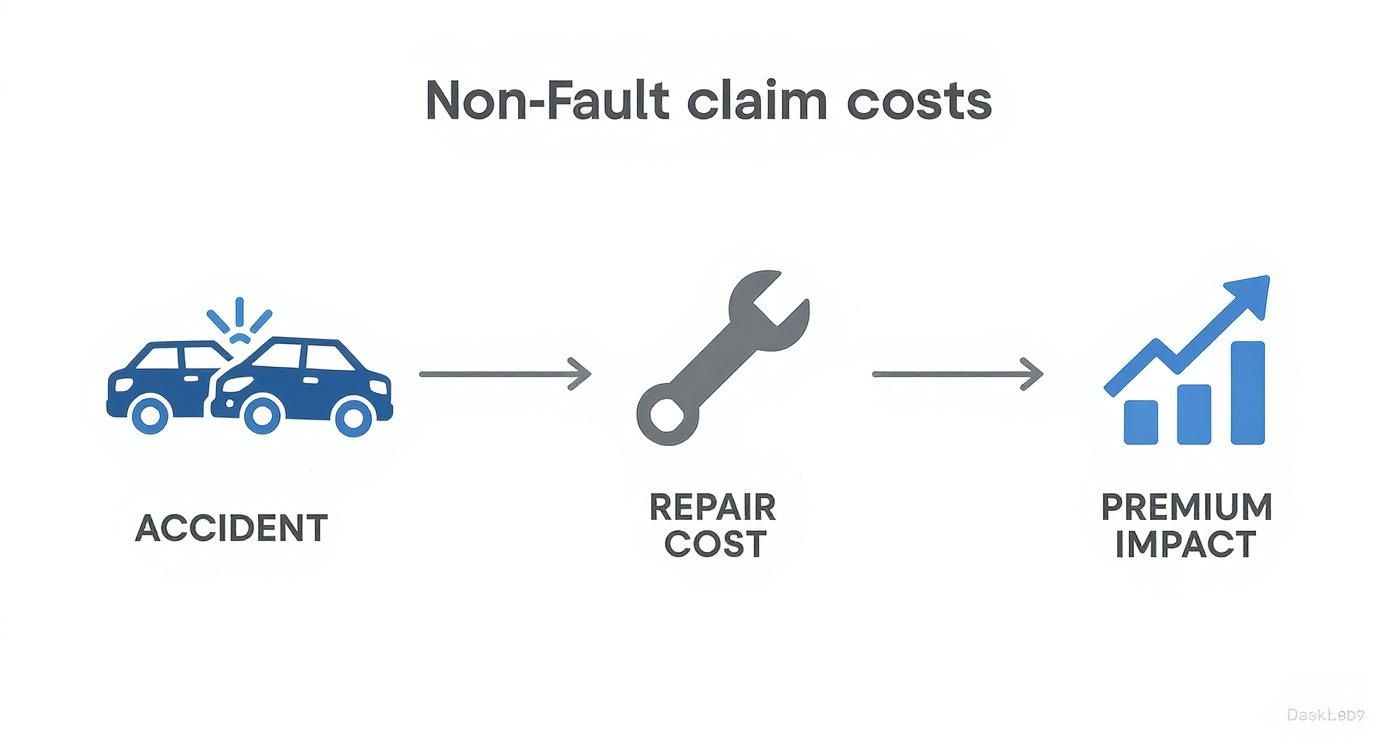
This is exactly why insurers look so closely at every claim. Keeping repair costs under control is essential to managing the financial impact that eventually affects every policyholder.
The Power of Video and Witnesses
These days, dashcam footage is a total game-changer for proving a non-fault claim. If you have one, make sure you save the footage right away. This kind of video evidence is often the clearest, most objective proof you can have, leaving very little room for argument.
Witnesses are just as important. If anyone else saw what happened, politely ask for their name and contact details. A statement from an independent third party can back up your story and carries a lot of weight with insurers.
Remember, the responsibility is on you to prove the accident wasn't your fault. A claim backed up with photos, witness details and dashcam footage is so much stronger and less likely to be challenged. It’s your best defence against the financial hit from insurance fraud and rising industry costs.
How to Prove Liability and Win Your Claim
After a non-fault accident, proving the other driver was 100% responsible is the single most important thing you’ll do. This is where all the evidence you managed to gather at the scene really comes into its own. Insurers need solid proof to piece together what happened and officially decide who was at fault.
Don't mistake this for a simple formality. The motor insurance industry is grappling with soaring costs so rigorous investigation is now standard procedure for almost any claim. Your evidence is the best tool—frankly, the only tool—you have to secure a quick and fair outcome.
Building an Unshakeable Case
To figure things out, insurers look at a few key sources of information. Dashcam footage is often the star witness, giving an unbiased, real-time account of the collision. A clear video showing you were hit from behind or that another driver pulled out without looking can shut down a dispute before it even starts.
Witness statements are also incredibly powerful. An independent account from a pedestrian or another driver carries significant weight with claims handlers and can back up your version of events perfectly. Lastly, a police report provides an official, authoritative record which is especially vital in more serious incidents.
In today's claims environment, ambiguity is your enemy. The more concrete, verifiable proof you can provide, the less room there is for the other party's insurer to challenge liability or delay the process.
This is more crucial than ever given the current climate of repair delays and spiralling costs. The overall cost of UK road accidents has shot up, partly because repair times have exploded—lead times before work even starts have more than doubled and the repairs themselves now take 36% longer.
Between 2019 and 2023, replacement vehicle costs surged by nearly 48% while the average amount non-fault insurers recovered from at-fault parties jumped by 49% from £2,780 to £4,134. You can dig into the numbers yourself by reading the full FCA analysis of motor insurance claims.
To help you get it right, here’s a quick checklist of the evidence you need to build a strong case.
Evidence Checklist for a Non Fault Claim
| Evidence Type | Why It's Important | Top Tip |
|---|---|---|
| Dashcam Footage | Provides an unbiased, real-time view of the incident. Often the most conclusive proof available. | Ensure your dashcam's date and time are set correctly. A wrong timestamp can create unnecessary complications. |
| Photos & Videos | Documents vehicle positions, damage, road conditions and any relevant signs or markings. | Take photos from multiple angles—close-ups of the damage and wider shots showing the entire scene. |
| Witness Details | Independent accounts add huge credibility to your claim and can counter any false narratives from the other driver. | Get names, phone numbers and email addresses. Ask if they’d be willing to provide a written statement. |
| Police Report | An official, authoritative record that is invaluable in serious accidents or when liability is disputed. | Always get the police reference number if they attend the scene. This makes it easy for your insurer to find the report. |
| Geo-Location Data | Modern tools can provide irrefutable, timestamped proof of your vehicle's exact location and movements. | Apps and telematics devices can automatically log this data, leaving no room for doubt about where and when it happened. |
Putting this evidence together gives your insurer the ammunition they need to fight your corner effectively.
Common Scenarios and Complexities
Some accidents make proving a non-fault claim pretty straightforward.
- Rear-End Collisions: If you’re hit from behind, the driver who hit you is almost always considered at fault. Simple as that.
- Roundabout Incidents: A driver pulling onto a roundabout and hitting a car already on it is typically liable.
- T-Junctions: When a car emerges from a minor road and collides with traffic on the major road, it's a clear-cut case of fault.
But not every situation is black and white. Disagreements often pop up in incidents involving lane changes, unmarked junctions or scenarios where both drivers might share some of the blame. This is where the quality of your evidence truly makes or breaks your case.
Modern tools that offer irrefutable proof are changing the game. For instance, you can learn more about how geo-location data strengthens insurance claims and helps eliminate any doubt.
Ultimately, your goal is to present a case so clear and well-supported that the other insurer has no choice but to accept liability—and fast. This is how you avoid delays and protect yourself from the stress and financial headaches of a long, drawn-out dispute.
The Hidden Impact on Your No Claims Bonus
One of the biggest and most costly myths out there is that a non-fault claim leaves your insurance completely untouched. It’s a logical assumption—after all, the other driver’s insurer is footing the bill. But the incident itself still leaves a mark on your record and it can have a surprising financial knock-on effect.
So many drivers are shocked when their premium shoots up at renewal, even after a clear-cut non-fault accident. The simple truth is that your No Claims Bonus (NCB) and your overall premium are two very different things. Getting your head around how they interact is key to managing your expectations.
Why Your Premium Can Still Go Up
At the end of the day, insurers work on risk. From their point of view, being involved in any accident—regardless of who was to blame—statistically increases the likelihood of you being involved in another one down the line. It might not feel fair but you were still present at the scene of an incident and that fact gets logged against your policy history.
This is why even with a protected NCB, which is designed to safeguard your discount percentage, the underlying premium that discount is applied to can still rise. A 10% hike on your base premium can easily cancel out the savings from another year of no claims.
The value of a healthy NCB is undeniable, though. UK data shows a massive difference in premiums. Drivers with no NCB are paying an average of £2,804 a year while those with 20 years of no claims can see rates as low as £832 . Given that gap, it’s completely understandable why any threat to your bonus is a major concern. You can discover more insights about car insurance statistics on Uswitch.com.
A protected No Claims Bonus isn’t an immunity shield for your premium. It protects the percentage of your discount, not the base price of your insurance policy. Any claim, even a non-fault one, can still lead to a higher premium at renewal time.
This distinction is absolutely crucial. Your NCB is a reward for claim-free driving and making any kind of claim can disrupt that record. While a non-fault incident shouldn't technically reduce your bonus years (provided your insurer gets all their money back), the mere fact a claim was made is noted.
Understanding the NCB System
The NCB, often called a no claims discount, is one of the single biggest factors that determines your car insurance premium here in the UK. For every consecutive year you drive without making a claim, you earn another year's discount. Over time, this can build into some pretty substantial savings.
But the rules can feel a bit convoluted, especially when a non-fault claim enters the picture.
- Standard NCB: If you make a non-fault claim and your insurer successfully recovers 100% of the costs from the at-fault party's insurer, your NCB should stay exactly as it was. But if they can't recover every penny, your bonus could take a hit.
- Protected NCB: This is an optional extra you can add to your policy. It typically lets you make a certain number of claims (usually two in three years) without losing your hard-earned discount. But as we've covered, it won’t stop your base premium from going up. For a deeper dive, check out our guide on how No Claims Bonuses work in the UK.
The main takeaway here is that proving your non-fault claim decisively isn't just about getting your car fixed. It’s also about protecting your long-term insurance costs and making sure your driving record stays as clean as possible in the eyes of insurers.
Spotting and Stopping Insurance Fraud
Insurance fraud isn't some victimless, white-collar crime. It's a calculated act of deception that costs the industry billions every year and guess who picks up the tab? Honest motorists, through higher premiums. Criminal schemes like staged 'crash for cash' accidents are a massive part of this problem, turning an already stressful non-fault claim into an absolute nightmare.
These scams are meticulously engineered to make you look like you're at fault for a collision that the fraudster orchestrated from the start. Knowing the warning signs is your best line of defence. When you connect robust evidence gathering with sharp fraud awareness, you not only protect yourself but also contribute to a fairer system for everyone on the road.
Tell-Tale Signs of a Staged Accident
Fraudsters aren't usually very creative; they tend to rely on a predictable playbook to pin the blame on you. Being aware of these red flags can make all the difference, helping you stay calm and react the right way if you ever find yourself in a suspicious situation.
Keep an eye out for these classic setups:
- The Brake Slam: The driver ahead of you suddenly and for no good reason slams on their brakes, giving you no chance to avoid a rear-end collision. Often, they'll have sneakily disabled their brake lights to make it a dead cert.
- The Wave-In: Another driver gives you a friendly wave to pull out of a junction only to accelerate and hit you. They then deny ever waving and claim you pulled out right into their path.
- Suspicious Behaviour: After the incident, the other driver might seem strangely calm, almost rehearsed or become overly aggressive and pushy. A big giveaway is if they have pre-written insurance details ready to go or start talking about personal injury claims for what looks like a minor prang.
If your gut is telling you something isn't right, listen to it. Scammers count on the shock and confusion of an accident to let them control the story.
The core principle of stopping fraud is irrefutable proof. A provable claim is a fraud-proof claim. When facts are clear and evidence is undeniable there is no room for deception to take root.
Protecting Yourself from a Non-Fault Claim Scam
If you think you've been targeted, your actions in the moments that follow are critical. Don't let them fluster you and definitely don't get drawn into an argument at the roadside. Your job is to switch into evidence-gathering mode.
Here’s what to prioritise:
- Document Everything: Get your phone out and take photos of it all. The positions of the cars, the damage to both vehicles (close up and from a distance), the number of passengers in the other car and the wider scene including road markings and traffic signs.
- Find Independent Witnesses: Witnesses who have no connection to either party are worth their weight in gold. Politely ask anyone who saw what happened for their name and phone number.
- Make Detailed Notes: As soon as you can, jot down exactly what the other driver said and how they behaved. Did they seem reluctant to call the police? Were they vague about their details? Every little thing matters.
- Report Your Suspicions: When you report the claim to your insurer and the police, make it crystal clear from the very beginning that you suspect it was a staged incident.
To really get ahead of dishonest claims, having a solid grasp of fraud risk assessment principles is invaluable. We highly recommend this comprehensive guide to fraud risk assessment. For more specific advice on this topic, you can also get tips on spotting car insurance scams and proving false claims in our detailed article.
Your Non-Fault Claim Questions, Answered
Navigating a non-fault claim can feel like a minefield. Even when liability seems clear-cut, all sorts of questions and unexpected hiccups can pop up. Let's tackle some of the most common queries to give you the confidence to handle your situation.
Will a Non-Fault Claim Definitely Increase My Premium?
Not always but it’s a strong possibility. It’s a common misconception that only ‘at-fault’ claims impact your price. Insurers base their risk analysis on your entire claims history, not just who was to blame.
Being involved in any accident, even as the innocent party, statistically increases your likelihood of being in another one. Some insurers might let it slide, especially if you have a long and spotless record but many will apply a small increase at renewal. This is completely separate from your No Claims Bonus. A protected NCB will safeguard your discount but the base premium that discount is applied to can still go up.
What Happens If the Other Driver Is Uninsured?
This is where things get a bit more complex but don't panic—you can still make a claim. Your case will typically be handled by the Motor Insurers' Bureau (MIB), a body funded by all UK motor insurers specifically to compensate victims of uninsured and untraced drivers.
You’ll still report the incident to your own insurer and they'll liaise with the MIB on your behalf. The good news is your No Claims Bonus should be protected, provided it’s crystal clear you weren't at fault. The catch? You'll likely have to pay your policy excess upfront, though this can often be recovered later in the process.
The key takeaway here is that solid evidence is just as vital when dealing with an uninsured driver. The MIB needs undeniable proof of the other party's fault to process your claim and protect your record.
How Long Does a Typical Non-Fault Claim Take to Settle?
This is the classic "how long is a piece of string?" question. The timeframe can vary massively. A straightforward claim—where the other driver admits liability straight away and there are no injuries—could be wrapped up in a few weeks. That’s the dream scenario.
However, if liability is disputed, personal injury is involved or there are delays sourcing parts for repairs, the process can drag on for several months, sometimes even over a year. Your best bet for speeding things up is to provide clear, comprehensive evidence right from the very beginning. It’s the single most effective way to avoid frustrating delays.
Should I Use a Claims Management Company?
Claims Management Companies (CMCs) can seem very appealing. They often promise to handle everything, arranging vehicle repairs and a hire car without you needing to pay an excess. They then recover their costs directly from the at-fault party's insurer which sounds incredibly convenient.
A word of caution, though. Always read the small print, especially regarding credit hire car costs. These can be surprisingly high and are sometimes disputed by the other insurer, potentially leaving you in a tricky spot. It’s always worth speaking to your own insurer first. You might find they offer a very similar service, saving you the hassle of bringing in a third party.
Whether you’re a policyholder or an insurer, the secret to a fast, fair resolution is always the same: irrefutable proof. Proova offers a simple way to document and verify your assets before a claim ever happens, which can shut down disputes and prevent fraud from the get-go. By creating a clear, timestamped record of what you own and its condition, you put yourself in the strongest possible position for any future claim.