
Insurance Fraud Prevention Scheme: Essential Guide
An insurance fraud prevention scheme is a structured set of policies, processes and technologies designed to detect, deter and disrupt fraudulent activities before they drain your bottom line. Think of it as a proactive defence system, protecting both your financial stability and your honest policyholders from the spiralling costs of deceitful claims.
The Hidden Costs of Insurance Fraud
It is easy to think of insurance fraud as a distant, corporate problem but its consequences hit the wallets of every single person who pays a premium. Far from being a victimless crime, it is a pervasive issue that forces insurers to raise prices for everyone to cover the immense losses from dishonest claims. The cost to all of us and the industry is profound.
This reality makes a robust insurance fraud prevention scheme an absolute necessity—not just for profitability but for maintaining a fair and trusted market.
The scale of the problem is staggering. According to the Association of British Insurers (ABI), UK insurers uncovered over £1.1 billion in fraudulent general insurance claims in a recent year. That figure represents a worrying trend, with the number of dishonest claims jumping by 12% to more than 98,400 cases. You can see the full breakdown on the ABI's website.
Beyond Opportunism to Organised Crime
When most people picture insurance fraud, they imagine minor exaggerations—adding a few extra items to a burglary claim or slightly inflating the damage from a car park ding. Whilst this opportunistic fraud is certainly part of the problem, the truly damaging threat often comes from sophisticated, organised crime rings.
These groups orchestrate elaborate schemes that can include:
- Staged Accidents: Deliberately causing vehicle collisions to submit a flood of false injury and damage claims.
- Ghost Broking: Selling fake or invalid insurance policies to unsuspecting drivers, leaving them dangerously uninsured.
- Large-Scale Property Fraud: Conspiring to submit claims for fabricated events like fires or floods at commercial properties.
This level of organised deception requires a response that is equally organised and systematic. A piecemeal approach simply will not cut it against criminals who are experts at exploiting every possible loophole.
Why a Formal Scheme Is Non-Negotiable
Relying on individual adjusters to spot suspicious activity is an outdated and ineffective strategy. A formalised insurance fraud prevention scheme shifts your organisation from a reactive stance to a proactive one. It establishes clear protocols, integrates advanced technology and fosters a culture of vigilance across the entire business.
By creating a structured framework, you are not just catching fraudsters after the fact; you are building a fortress that deters them from targeting you in the first place. This protects your genuine customers and your company's long-term financial health.
The financial impact is undeniable and reverberates throughout the entire industry. To get a clearer picture of these expenses, explore our detailed analysis of what insurance fraud really costs the industry.
Ultimately, investing in prevention is not just an operational cost—it is a fundamental part of ethical business practice and a critical component of survival in a competitive market.
Laying the Groundwork for Your Strategy
An effective insurance fraud prevention scheme does not just appear out of nowhere. It is not about buying the latest piece of software or hiring a team of analysts and hoping for the best. It starts with a proper blueprint, one built on a crystal-clear understanding of your unique risks and backed by a genuine, top-down commitment from the business.
Without this solid foundation, even the most advanced tools are set up to fail.
The first real step is to conduct a thorough risk assessment . This cannot be a simple box-ticking exercise; it needs to be a deep dive into your specific vulnerabilities. You have to get granular, analysing where fraud is most likely to hit you across every single business line, from motor and home to complex commercial liability.
Think about it: a personal motor insurance book might be a prime target for organised 'crash for cash' gangs or exaggerated whiplash claims. In contrast, your commercial property division is probably more concerned about arson for profit or claims being massively inflated after a legitimate event like a flood. The threats are different, so your defences must be too.
Defining Your Defence Structure
Once you have mapped out your specific threats, it is time to build a clear governance structure. Any anti-fraud initiative without defined ownership and real accountability is dead in the water. This means you need more than just passive approval from senior management; you need their active buy-in.
You absolutely must have a champion at the executive level. This is the person who will fight for the resources you need and continually reinforce why this matters across the entire organisation.
Your governance framework should spell out, in no uncertain terms:
- Roles and Responsibilities: Who owns the success of this scheme? You need to define the specific duties of everyone involved, from the fraud investigation team to the underwriters and the claims handlers on the front line.
- Escalation Paths: When an employee suspects fraud, what do they do? A clear, documented process removes all ambiguity and makes sure every potential case is handled consistently and correctly from the get-go.
- Oversight Committee: Pull together a cross-functional group to review how the scheme is performing, keep an eye on emerging threats and sign off on any strategic changes.
A critical piece of the puzzle at this stage is a formal fraud prevention policy . This document is the absolute cornerstone of your whole strategy.
It needs to articulate a zero-tolerance stance towards fraud. This sends an unmistakable message to both your own people and your customers: dishonest activity will be investigated and it will be pursued. This policy is what sets the cultural tone.
But it is more than just a statement. It is a practical guide that details the exact procedures for investigating and managing suspected fraudulent claims.
The chart below shows the damaging and direct line from fraudulent acts to the rising premiums that hit honest customers, really driving home why a strong prevention scheme is so vital.
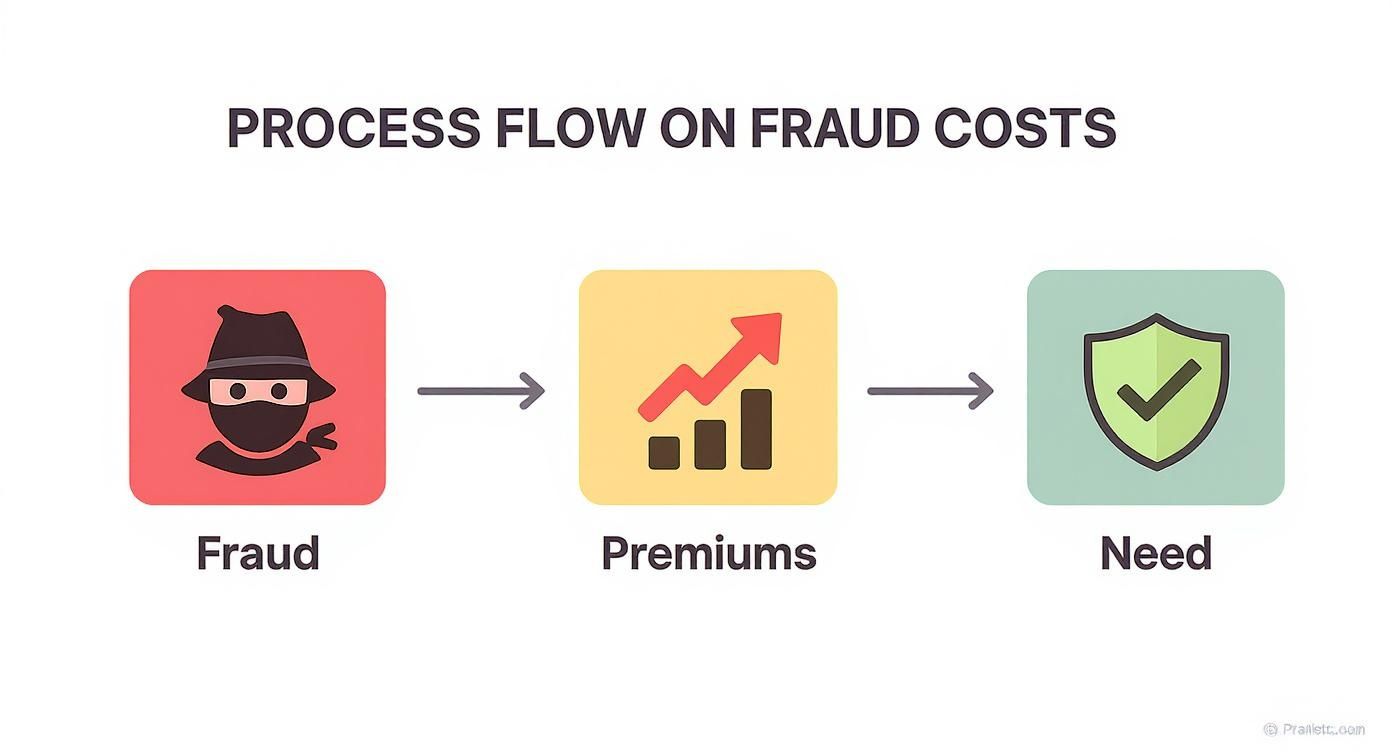
This visual journey makes it plain to see how every single fraudulent act feeds into higher costs for everyone, making a robust insurance fraud prevention scheme non-negotiable for market stability.
The True Cost of Inaction
Mapping out these initial stages might feel a bit administrative but they are profoundly strategic. They prove to regulators, stakeholders and genuine customers that your organisation is serious about protecting its integrity. The entire promise of insurance rests on the provability of claims and insurance fraud is a direct attack on that trust.
The cost of insurance fraud is not just another line item on an annual report; it is a direct tax on every honest policyholder. When insurers are forced to pay out on billions of pounds worth of bogus claims, those losses inevitably get passed on through higher premiums for everyone else.
It is a vicious cycle that erodes consumer trust and makes essential cover less affordable. By laying the proper groundwork now, you ensure your insurance fraud prevention scheme is built on a solid, strategic and well-supported base right from the start.
Designing Resilient Underwriting and Claims Processes
An effective insurance fraud scheme is not a bolt-on. You cannot just react to fraud after the fact. It has to be woven into the very fabric of your daily operations. Fraudsters are smart and they will exploit weaknesses at every single stage of the insurance lifecycle.
This means your defences need to start the moment a customer applies for a policy and run all the way through to the final claim settlement. The real challenge is designing processes that are tough on fraudsters but smooth for your honest customers. It is a tricky balance but getting it right stops fraud at the source without alienating the genuine clients you want to keep.

Fortifying the Front Door: Underwriting
Think of your underwriting process as the front door to your business. Weak checks here are like leaving that door unlocked. Once a fraudulent policy is on your books, a future loss is almost inevitable. The key is to verify everything rigorously before you agree to provide cover.
A major focus has to be identity verification . In the UK, identity theft is fuelling a huge portion of insurance fraud. The Insurance Fraud Bureau (IFB) reported that cases of identity theft linked to insurance scams have shot up more than sevenfold since 2021 , often tied to bigger criminal operations like ghost broking. You can read more about this alarming trend on the IFB's website.
This statistic alone makes robust Know Your Customer (KYC) protocols completely non-negotiable. It is no longer good enough to take the details on an application form at face value.
Here are a few practical actions to secure your underwriting process:
- Implement Digital Identity Verification: Use tech to cross-reference an applicant's details against trusted third-party data sources in real time. This can instantly confirm names, addresses and dates of birth.
- Validate Insurable Interest: Does the applicant actually own the thing they are trying to insure? For cars or property, this is critical. Tools like Proova can verify the existence and ownership of high-value items before a policy is issued, shutting down claims for assets that do not even exist.
- Screen Against Fraud Databases: Check applicant details against industry-wide databases that track known fraudsters and suspicious activity.
Building a Multi-Layered Claims Defence
When a claim lands, your prevention scheme kicks into its next critical phase. A solid claims process is not about treating every claimant like a criminal. It is about having an intelligent system that can separate genuine claims from the dodgy ones. This requires a multi-layered approach, blending smart tech with human expertise.
The first layer should be an automated red flag system . This software scans incoming claims for common fraud indicators in real time. These flags do not prove anything but they are a clear signal that a claim needs a closer look from a human.
A common misconception is that fraud detection is solely about finding the 'big lie'. More often, it's about spotting a collection of small inconsistencies that, when viewed together, paint a suspicious picture.
For example, a system might flag a claim that has several of these traits:
- The incident was reported suspiciously soon after the policy started.
- The claimant has a history of previous claims with other insurers.
- The incident happened at an odd time or in a location with zero witnesses.
- The contact details on the claim form do not match the original policy application.
Escalating and Investigating with Precision
Once a claim is flagged, it moves to your next defensive layer: human review. This is where your trained claims handlers and specialist investigators earn their keep, using their experience to spot the nuances an automated system might miss.
You need a clear protocol for these flagged claims. A low-risk flag might just need a quick follow-up call to clarify a few details. But a claim with multiple high-risk indicators? That needs to go straight to your Special Investigation Unit (SIU).
Real-World Scenario: Spotting an Inflated Property Claim
Imagine a claim for water damage to a high-end home cinema system. The automated system flags it because the policy was only taken out three weeks ago. The claims handler notices the receipts for the electronics look pixelated and the vendor details are vague.
Instead of paying out, the claim is escalated. The SIU investigator uses a tool to check the metadata of the submitted photos and discovers they were taken months before the policy even started. This proof of pre-existing damage, combined with the other red flags, gives them solid grounds to deny the claim. This is a perfect example of the provability of claims being central to the process and how a layered defence works in practice.
Using Technology and Data for Proactive Detection
Relying on gut feelings and manual checks just does not cut it anymore. The scale and sheer cleverness of modern insurance fraud mean we have to fight fire with fire. A truly effective insurance fraud prevention scheme today is built on a solid foundation of technology and data, helping you get ahead of the problem.
It is about shifting your entire mindset from reacting to claims after the fact, to proactively spotting the subtle red flags in a sea of information before they turn into expensive fraudulent payouts.
This means pulling everything together. Forget isolated spreadsheets and siloed knowledge trapped in different departments. The real goal is to create a single, unified view of risk by integrating every scrap of data you can get your hands on—internal policy and claims histories, third-party databases, even public records. When you start connecting these dots, you uncover patterns that are completely invisible when you are looking at just one piece of the puzzle.

The Power of AI and Machine Learning
Artificial Intelligence (AI) and machine learning are the real workhorses here. These systems are designed to chew through immense datasets far quicker and more accurately than any human team possibly could. Crucially, they do not just hunt for known fraud indicators; they learn and adapt on the fly, spotting new and emerging fraudulent behaviours as they happen.
A key part of this is predictive analytics . This technology scores every single incoming claim for its fraud potential in real-time. If a claim gets a low score, it can be fast-tracked for payment, which is a fantastic experience for your honest customers. But if it gets a high score? It is immediately flagged for a human expert to review, making sure your best investigators focus their time where it is needed most. For any team looking to get started, understanding how to apply specialist data analytics for insurance is a great first step.
Shining a Light on Hidden Networks
One of the most powerful ways to use technology in fraud detection is through network analysis . Organised fraud is rarely a one-person show; it is usually carried out by interconnected rings of criminals. Network analysis tools are specifically built to visualise and expose these hidden connections.
For instance, the system might flag that multiple claimants from completely different accidents all share the same phone number, address or are using the same solicitor or body shop. Good luck trying to spot that with a traditional, case-by-case review. It is almost impossible.
By mapping these relationships, you can shift from tackling individual fraudulent claims to dismantling entire criminal networks. You are not just stopping one payout; you are preventing hundreds of future fraudulent claims.
This tech gives you that crucial bird's-eye view, connecting what look like unrelated claims into a clear picture of organised deception.
Building Your Technology Stack
To make all this happen, you need a robust tech stack. Whilst every insurer’s setup will be slightly different, some core components are non-negotiable. These tools work together to create a multi-layered defence against fraudsters.
The right technologies are the bedrock of any modern fraud prevention strategy. Here is a look at the essential pieces of the puzzle:
Key Technologies in a Modern Fraud Prevention Scheme
| Technology | Primary Function | Key Consideration |
|---|---|---|
| Artificial Intelligence (AI) & Machine Learning | Analyses vast datasets to detect subtle fraud patterns and predict high-risk claims in real-time. | Requires clean, high-quality data to be effective. The model's accuracy depends entirely on the data it learns from. |
| Network Analysis Software | Visualises connections between claimants, policies and third parties to uncover organised fraud rings. | Integration with all relevant data sources (internal and external) is critical to building a complete network view. |
| Digital Identity Verification Tools | Confirms the identity of applicants at the underwriting stage using third-party data sources. | Must be seamlessly integrated into the application process to avoid creating friction for genuine customers. |
| Data Aggregation Platforms | Gathers and unifies data from various internal and external sources into a single, accessible repository. | Data governance and compliance with privacy regulations like GDPR are paramount when consolidating sensitive information. |
Getting these systems in place is a game-changer. Our guide on digital transformation in insurance to fight fraud dives deeper into this process. Ultimately, by using data-driven insights, you can stop fraudulent activity before it ever causes a loss, protecting your business and, just as importantly, your honest policyholders.
Building a Fraud-Aware Culture and Ensuring Compliance
Advanced tech and clever processes are powerful tools in any fraud prevention scheme but they are only half the story. The truth is, your most valuable asset—and your first line of defence—is your people. A disengaged team can miss even the most obvious red flags, whilst a vigilant, well-trained one can spot subtle inconsistencies that a machine might overlook.
This human element is what turns a good scheme into a great one. It is about creating a culture where every single employee, from the newest hire to the most experienced claims director, understands their role in protecting the business from fraud. This is not just another corporate initiative; it is a collective responsibility.

Developing Comprehensive Training Programmes
Effective training is the bedrock of a fraud-aware culture. It cannot be a one-off presentation that staff forget within weeks; it has to be continuous, role-specific and genuinely engaging. The goal is to arm your teams with the knowledge to recognise suspicious signs and the confidence to act on them correctly.
A successful training programme should be tailored:
- Frontline Staff: Teach them to spot red flags at the point of sale or first notification of loss. Think of an applicant who is overly eager for cover but does not care about the price, or a claimant who is unusually vague about an incident's details.
- Claims Handlers: They need deeper training on common fraud types in their specific line of business. A motor handler needs to know the signs of a staged accident, whilst a property handler must understand how to spot inflated repair quotes.
- Specialist Investigators: This training should focus on advanced techniques—interview skills, evidence gathering and the legal parameters of an investigation.
Crucially, every employee must know the exact escalation procedure. There should be zero ambiguity about what to do and who to tell when they suspect something is amiss.
Navigating the Complexities of Compliance
Whilst you empower your teams to be vigilant, you must also ensure every action taken is ethical, lawful and fully compliant. An investigation that breaches data protection laws can cause far more damage than the fraudulent claim it was trying to stop.
The core principle is balance. Your fraud prevention scheme must be robust enough to deter criminals but also respectful of individual privacy and compliant with all legal frameworks. Getting this wrong can lead to severe regulatory fines and reputational damage.
This is particularly true when it comes to the General Data Protection Regulation (GDPR). When you are investigating a claim, you are handling highly sensitive personal data. Every step of your process must have a clear legal basis and be meticulously documented. For a closer look at the governing bodies involved, it is worth reading our guide that explains the UK insurance fraud prevention authority.
Establishing robust controls and adhering to regulations are paramount. For deeper insights into maintaining regulatory peace of mind, exploring top compliance management solutions can provide valuable guidance.
Ultimately, the goal is to show fraudsters there are serious repercussions. Insurers are getting better at this every day. For example, Aviva recently reported it had detected and prevented over 6,000 fraudulent claims in the UK in just six months, saving over £60 million . More importantly, the cumulative prison sentences handed to fraudsters in that period totalled more than 32 years , demonstrating the severe consequences of being caught.
Measuring Success and Continuously Improving Your Scheme
Building an insurance fraud prevention scheme is not a "set it and forget it" project. There is no finish line. The moment you stand still is the moment the fraudsters get ahead. To have any real, lasting impact, your scheme must be a living, breathing part of your organisation—one that constantly adapts to new threats as they emerge.
This means you have to get serious about measuring what is working and what is not, then using that intelligence to make smart improvements. Success is not just about the total value of fraud you catch. A truly effective scheme proves its worth through a range of balanced, insightful metrics.
Defining Your Key Performance Indicators
Looking beyond simple detection rates is absolutely crucial. Whilst the amount of money saved is always a great headline figure, it really does not tell the whole story. A more nuanced set of Key Performance Indicators (KPIs) will give you a much clearer, more honest picture of your scheme’s health and efficiency.
You should be tracking metrics like:
- False Positive Ratio: How many legitimate claims are you flagging for unnecessary review? A high ratio is a big red flag. It means you are creating friction for honest customers and, frankly, wasting your investigators' valuable time.
- Investigation Cycle Time: How long does it take to resolve a flagged claim, from the initial alert right through to the final decision? Faster, more efficient investigations do not just improve the customer experience; they significantly cut down your operational costs.
- Return on Investment (ROI): This is the bottom line. For every pound you spend on anti-fraud tech and staff, how many pounds are you saving in prevented fraudulent payouts? This is the number that proves the financial viability of your entire scheme to senior leadership.
Fostering a Culture of Continuous Improvement
The data from your KPIs is invaluable but it has to be combined with human insight to drive real progress. You need to establish strong feedback loops to keep refining your strategy and ensure your scheme stays agile.
The most effective fraud schemes are those that learn from every single case, win or lose. Your investigation teams on the front line possess a wealth of practical knowledge about emerging fraud tactics that no dataset can fully capture.
Regularly scheduled review meetings are vital for this. These sessions should bring together your claims handlers, investigators and data analysts to talk about recent trends and review the performance of your automated detection rules.
This collaborative approach allows you to adjust your systems on the fly. For instance, if investigators notice a new type of doctored invoice doing the rounds, the rules in your detection engine can be updated almost immediately to spot similar patterns in future claims. It is this proactive cycle of feedback and refinement that ensures your defences never become outdated.
Answering Your Questions
When you are designing a fraud prevention scheme, a few common questions always come up. Let’s tackle them head-on.
How Can We Implement Stronger Fraud Checks Without Ruining the Customer Experience?
This is the classic balancing act but it is more straightforward than it seems. The answer lies in a risk-based approach , not a one-size-fits-all one. Your goal is to make the journey seamless for the vast majority of honest customers.
Think about it: a straightforward claim from a loyal, long-term policyholder with a clean history should fly through the system. You can use technology to run silent, background checks without them even noticing.
On the other hand, when certain high-risk flags pop up—maybe inconsistent details or a history of suspicious claims—that is when you trigger more robust verification steps. By automating the bulk of your checks, you free up your human experts to focus their attention where it is genuinely needed.
What's the Single Biggest Hurdle to Getting Started?
From my experience, it is rarely the technology or the process design. The biggest challenge is almost always internal: getting genuine, cross-departmental buy-in. Fraud prevention is not just a job for the claims team; it is a company-wide mission.
You need underwriting, claims, IT and legal all pulling in the same direction. Without that unity, efforts get stuck in silos, data remains fragmented and progress grinds to a halt.
That is why securing senior leadership sponsorship from day one is non-negotiable. An executive champion can break down those internal barriers and ensure the scheme gets the resources and data access it needs to actually work.
We Are a Smaller Insurer. How Can We Afford an Effective Scheme?
This is a great question. You do not need a massive, multi-million-pound system to make a real dent in fraud. Smaller insurers can get fantastic results by being smart and focusing on the areas with the biggest impact first.
A practical, budget-friendly starting point looks like this:
- Sharpen Your Manual Processes: Start by improving your existing manual checks in underwriting and claims. A bit of process refinement can go a long way.
- Turn Your Team into a Defence Line: Invest in solid fraud awareness training. Your own people are often the best defence you have when they know what to look for.
- Be Smart with Tech: Choose cost-effective, modular tools. You can start with something essential like identity and ownership verification and then add more sophisticated analytics as you grow.
Do not forget to collaborate. Tapping into industry bodies like the Insurance Fraud Bureau gives you access to a huge pool of shared intelligence without the hefty price tag.
Ready to build a resilient defence against fraud? Proova provides the tools to verify ownership and assets from day one, stopping fraud before it starts. See how we can strengthen your insurance fraud prevention scheme at https://www.proova.com.