How to Find Your Electricity Meter Serial Number
That string of letters and numbers on your electricity meter is more than just a random code—it’s the unique fingerprint for your property's energy supply. Think of it as your meter's passport, a distinct identifier that links your home or business to the national grid. Correctly identifying this electricity meter serial number is absolutely essential, especially when you need to prevent fraud or sort out a billing dispute.
Why Your Electricity Meter Serial Number Matters
At first glance the serial number on an electricity meter seems like a minor technical detail, something most people would easily overlook. But this unique identifier plays a surprisingly critical role in the integrity of both the energy and insurance industries. It is the definitive link between a physical location and its energy consumption data, making it an indispensable piece of evidence.
Without this specific number, proving that a particular property was occupied or heated becomes a real challenge. This ambiguity creates a weak spot that opens the door for dishonest claims and complicates legitimate ones. The cost of this fraud is ultimately passed on to all of us through higher premiums.
The Foundation of Provable Claims
In the world of insurance, provability is everything. An insurer needs concrete evidence to validate a claim and the meter serial number provides just that. It acts as an anchor point that connects energy usage data directly to the specific property in question.
Take a common but costly scenario: a burst pipe in a rental property during a severe winter freeze. The policyholder claims the property was adequately heated but the landlord suspects negligence. An energy bill alone is not enough proof; it is the data tied to the unique electricity meter serial number that can prove continuous heating was active, potentially validating or invalidating a claim worth thousands of pounds.
An incorrect or unverified meter number can be the weak link that causes a legitimate claim to fail or an invalid one to succeed. It transforms abstract energy data into verifiable proof of presence and activity at a specific location.
This verification is not just for major incidents. It is also crucial for confirming the correct location in claims involving large multi-unit buildings or sprawling commercial sites where meters can easily be confused.
A Critical Tool Against Insurance Fraud
Insurance fraud is not a victimless crime. It is a pervasive issue that costs the industry billions annually and those costs are inevitably passed on to honest policyholders through increased premiums. Fraudsters often exploit gaps in information and a mismatched or unrecorded meter serial number is a significant vulnerability they can leverage.
Here is how a correct serial number helps shut down fraud:
- Verifying Occupancy: It confirms that a property was inhabited when a loss allegedly occurred which helps stop claims for vacant properties that have been deliberately damaged.
- Preventing 'After the Event' Fraud: It can help prove that damage happened before a policy was taken out by showing inconsistent energy usage patterns linked to that specific meter.
- Establishing Location: For complex claims with multiple buildings it ensures the claim corresponds to the correct insured property, preventing asset-swapping or location misrepresentation.
By insisting on accurate meter identification insurers are not just adding a layer of bureaucracy; they are actively closing loopholes that fraudsters exploit. This simple act of diligence helps in fighting fraud before it happens and protects the integrity of the entire system, ensuring premiums remain fair for everyone. The cost of failing to verify this simple detail is ultimately shared by all of us.
Finding the Serial Number on Any Meter Type
Trying to find your electricity meter's serial number can feel a bit like a treasure hunt if you do not know where to start. This unique code is often tucked away in different spots depending on the meter's age and model but once you know what you are looking for it is pretty straightforward. Getting this right is the first step towards accurate record-keeping, whether you are sorting out an energy bill or providing evidence for an insurance claim.
First things first, where is the meter itself? They are usually installed in out-of-the-way places like a cupboard under the stairs, a cellar, a hallway or sometimes mounted on an outside wall in a weatherproof box. The serial number is almost always physically printed or embossed directly onto the meter's faceplate.
Think of it as a simple three-step flow: you identify the meter, verify the number against official documents and then protect that information for when you need it.
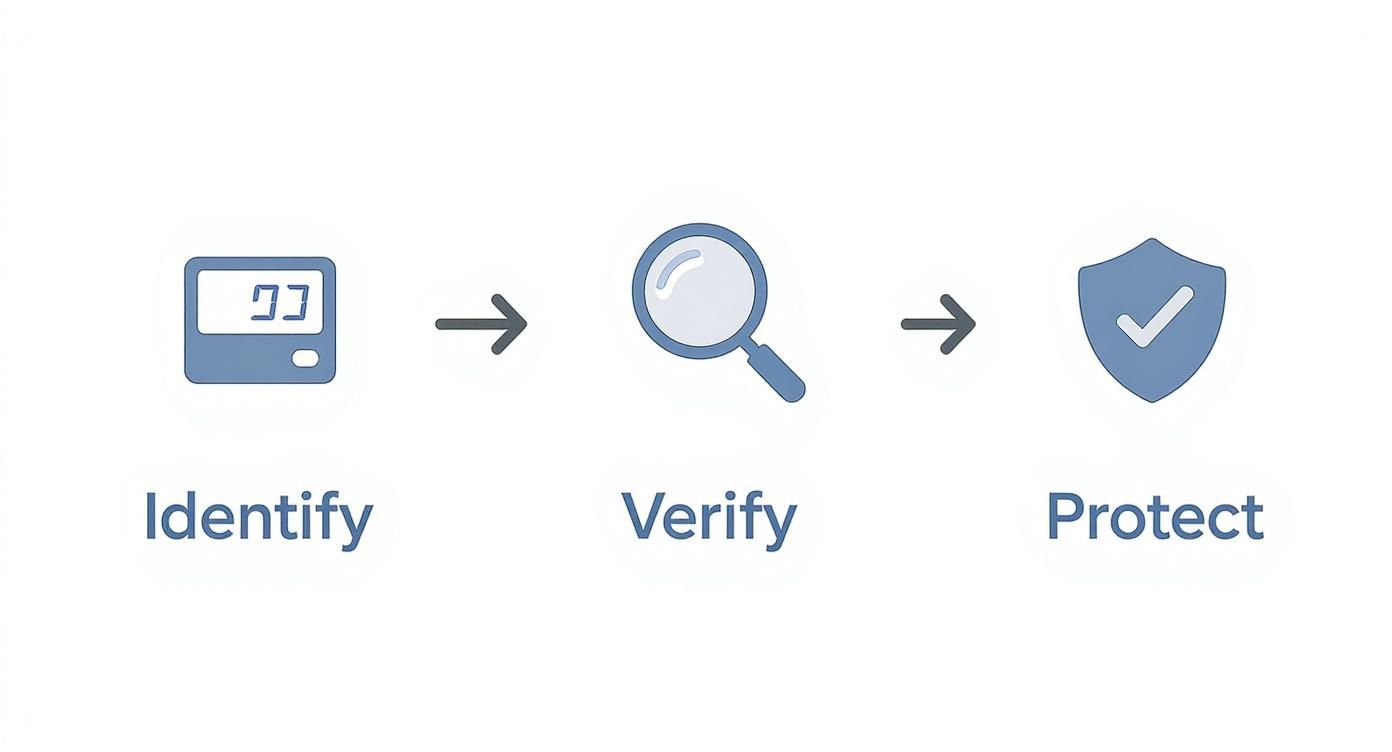
The key takeaway here is not just finding the number. The process only becomes truly reliable when you have also verified it and documented it securely.
Navigating Different Meter Models
The UK has a real mix of meters installed in homes and businesses and each design requires a slightly different approach to finding that all-important serial number.
- Older Mechanical or Dial Meters: These classic meters are the ones with the little spinning dials. The serial number is almost always printed clearly on the front plate, often just below the dials themselves. Look for a string of letters and numbers, sometimes embossed on a small metal strip.
- Digital Meters: On models with an LCD screen the serial number is typically printed on the casing around the display. It is often labelled as ‘Meter Number’ or ‘Serial No.’ and you will usually spot it near a barcode. This is a permanent part of the meter's body.
- Pay-As-You-Go or Prepayment Meters: Much like standard digital meters the serial number is clearly visible on the unit's faceplate. Just be careful not to mix it up with your top-up card number or other identifiers.
This physical number is the definitive identifier for that specific device.
Finding the Number on Smart Meters
Smart meters can be a little different as they cycle through various screens on their digital display. Whilst the serial number is still physically printed somewhere on the meter's body you can also often find it by using the on-screen menu.
You will probably need to press a button to "wake up" the display and then click through the different screens. On these displays the serial number is frequently called the ‘MSN’ (Meter Serial Number) . The exact process can vary between models but repeatedly pressing the main display button is the usual way to find it.
A very common point of confusion is mistaking the Meter Serial Number (MSN) for the Meter Point Administration Number (MPAN) . They are completely different. The MSN identifies the physical meter whereas the MPAN identifies the electricity supply point to your property.
You will find the MPAN – a 21-digit number often shown in a grid – on your electricity bill. The meter serial number on the other hand is a much shorter alphanumeric code found on the meter itself. For any official purpose like an insurance claim you need the number from the physical meter.
A Common Pitfall to Avoid
One of the most frequent mistakes we see is people recording the wrong number entirely. Meters are covered in all sorts of codes, barcodes and technical specs. You need to look for the identifier that is explicitly labelled as the serial number or MSN .
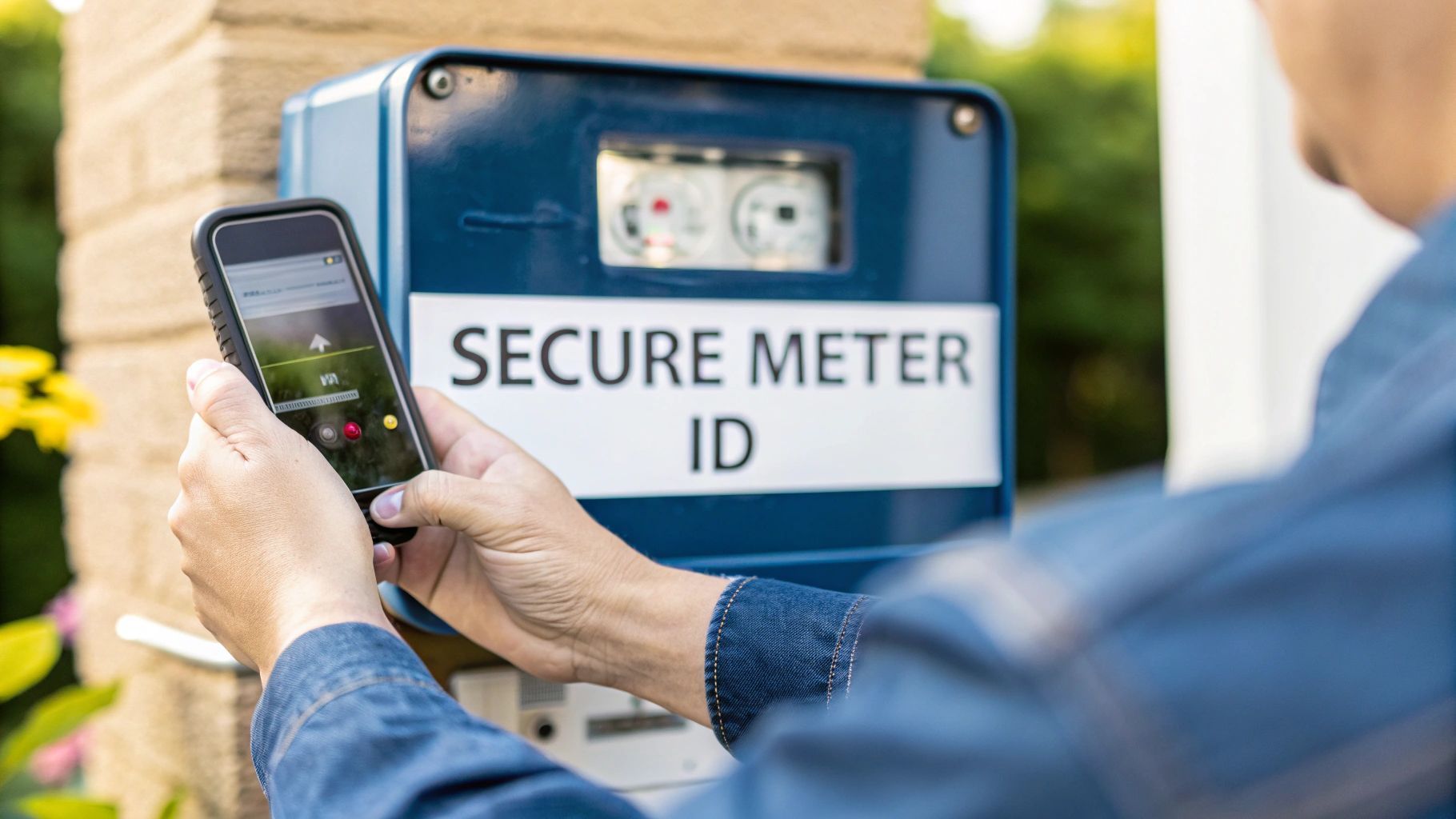
Here is a practical tip from experience: take a clear, well-lit photograph of the entire meter face. This not only captures the serial number but also gives you contextual evidence of the meter's condition and its readings at a specific moment. This photograph can be invaluable later on.
Once you have successfully located your serial number you might also want to learn how to read an electricity meter to get a better handle on your energy consumption. It is another layer of control that helps you monitor usage and ensure your bills are always accurate.
How to Decode Your UK Electricity Meter Number
That string of letters and numbers on your electricity meter is not just a random code. It is a story—a coded message that tells you about the meter's manufacturer, its age and its history. Once you learn to read it you unlock a powerful tool for verifying details, spotting inconsistencies and reinforcing the integrity of an insurance claim.
At first glance a serial number like F21AB12345 might look like nonsense but it follows a specific format used across Great Britain. Understanding this structure is a practical skill, letting you confirm that the meter on-site matches the one on an energy bill or insurance policy. A mismatch can be a huge red flag that points to anything from a simple admin error to a swapped meter or even a fraudulent setup.
This is not just about identification; it is about verification. For an underwriter or claims investigator, confirming the meter's age and origin is a crucial piece of the puzzle that helps ensure every detail is accurate and defensible.
Breaking Down the Alphanumeric Code
The standard UK electricity meter number packs a surprising amount of information into its sequence. Whilst there are some variations out there, the common format reveals the manufacturer, the year it was certified and even the company that first bought it. The whole system is designed for traceability and creates a clear history from the factory floor to the final installation.
Think of it as the meter's passport. This structured approach is what allows millions of devices across the country to have a clear auditable trail.
To help you get to grips with what you are looking at, here is a simple breakdown of the most common format.
Decoding Your UK Meter Serial Number Format
| Component | Example | What It Means |
|---|---|---|
| Manufacturer Code | F 21AB12345 | The first letter identifies the manufacturer. For example 'F' often stands for Siemens Metering Ltd whilst 'A' or 'D' can indicate Landis + Gyr. |
| Certification Year | F 21 AB12345 | These two digits show the year the meter was calibrated and certified. In this case '21' means 2021. |
| Purchasing Company | F21 AB 12345 | These next two letters represent the energy company that originally purchased the meter from the manufacturer. |
| Serial Batch Number | F21AB 12345 | The final digits are the unique serial number within that specific batch, identifying the individual meter unit. |
As you can see, every part of the number has a purpose. For more background on how the system works you can find extra details in the UK's specific meter number system on Wikipedia.
Why Every Character Matters
Let us put this into a real-world scenario. Imagine you are handling a fire damage claim for a commercial property. The policyholder sends over photos of the meter and its serial number starts with A09 . The 'A' points to a manufacturer like Landis + Gyr but the '09' tells you it was certified way back in 2009.
Now if the claim states the entire property was refurbished with brand-new electrical systems in 2020 you would rightly question why a meter from 2009 is still in place. It does not automatically scream fraud but it is an inconsistency that demands another look. That small detail hidden in plain sight adds a layer of provable fact to your investigation.
The meter's age revealed by its serial number can corroborate or contradict a policyholder's account of a property's history. It is a small but powerful piece of data that strengthens the integrity of the claims process.
This ability to cross-reference facts is what makes the serial number so valuable. It is an independent data point that can either support or challenge the other evidence on the table.
The Problem of Duplicate Serial Numbers
Whilst the system is designed for uniqueness it is not perfect. It is rare but duplicate electricity meter serial numbers do exist in the UK. This is usually a hangover from old administrative errors or manufacturing issues from decades ago.
A duplicate number can cause chaos and link two completely different properties to the same identifier. This is precisely why relying on the serial number alone is risky. For absolute certainty you need to cross-reference it with two other key identifiers:
- The full property address: The primary locator for the supply.
- The Meter Point Administration Number (MPAN): This is the 21-digit number on an energy bill that is unique to the electricity supply point , not the meter hardware itself.
When all three—serial number, address and MPAN—line up perfectly you have an undeniable, verifiable link. This triangulation of data is best practice for any situation needing definitive proof, from settling a simple bill dispute to validating a high-value insurance claim. It closes the loop and leaves zero room for doubt.
Creating Verifiable Proof of Your Serial Number
Knowing your electricity meter serial number is a great first step but when it comes to insurance claims or legal matters simply knowing it is not enough. You need to be able to prove it.
Creating a clear, unambiguous and verifiable record is essential to protect yourself from potential disputes. It is also a cornerstone of preventing insurance fraud. The goal is to shift from simply reading a number to creating a robust piece of evidence that can stand up to scrutiny. This is what transforms a simple string of characters into a powerful tool for validation.
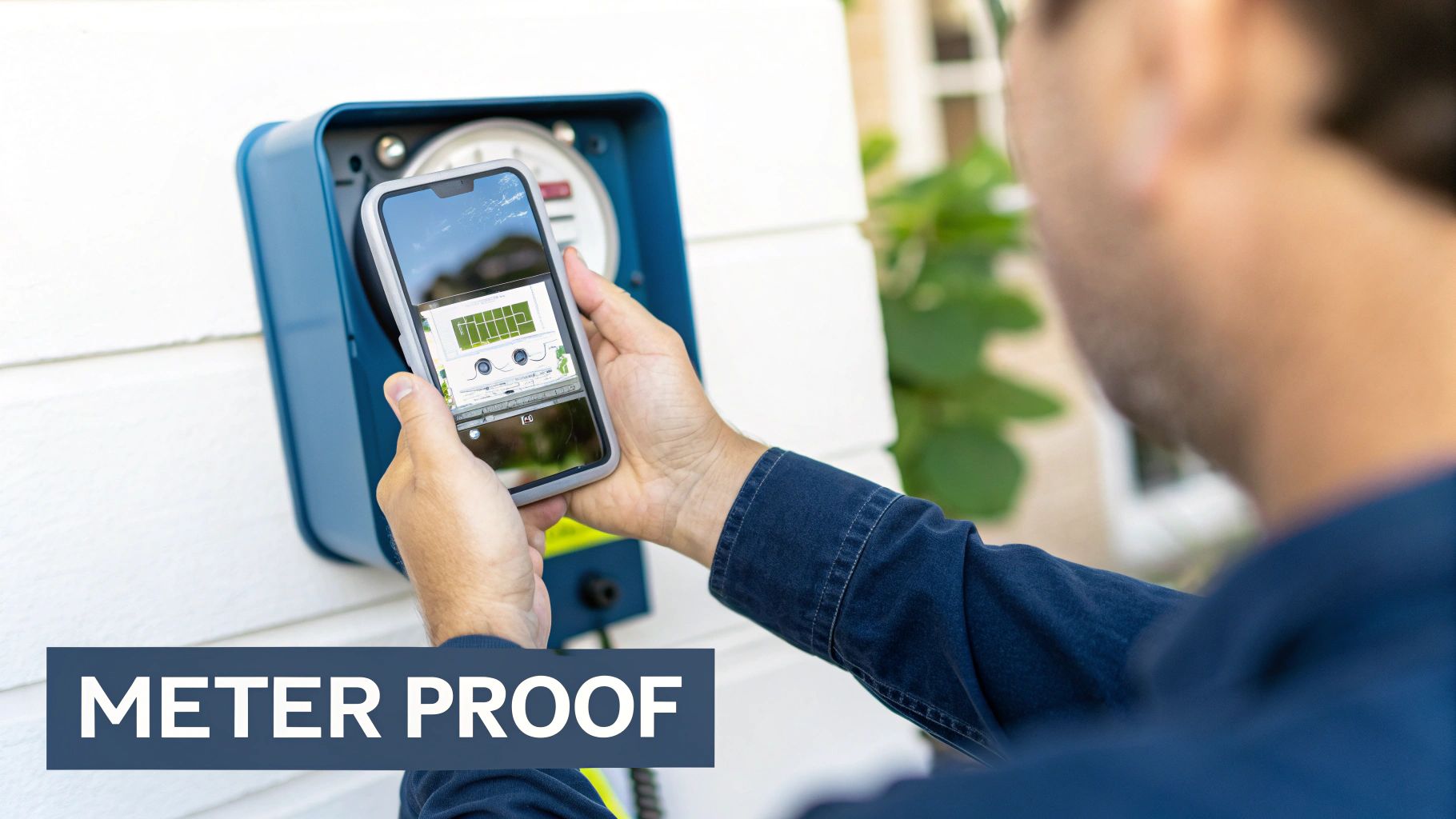
This becomes especially critical in claims scenarios. A mismatched or unproven serial number can introduce just enough doubt to delay proceedings or worse, lead to a negative outcome. Ultimately the cost of those delays and the increased risk of fraud gets passed on to everyone through higher premiums.
Photographing Your Meter The Right Way
A photograph is the most common way to document your meter but not all photographs are created equal. A blurry, poorly lit image can be just as useless as no image at all. To create evidence that is genuinely useful you need to capture the details with both clarity and context.
Your aim is to take a photograph that leaves no room for interpretation. It should clearly show the electricity meter serial number , the meter reading and the overall condition of the unit.
Here are a few practical tips I have picked up for creating unambiguous photographic proof:
- Light it up. Use your phone’s torch or an external light to illuminate the meter face. Natural light is best but let us be honest, most meters live in dark cupboards.
- Dodge the glare. Take the photograph from a slight angle rather than head-on. This simple trick minimises the chances of a flash reflection or overhead light obscuring the numbers.
- Capture the whole picture. Do not just zoom in on the serial number. A wider shot that includes the entire meter provides crucial context and makes the image far more credible.
- Take a couple of shots. I always recommend capturing a close-up of the serial number and a wider view showing the meter in its location. This combination provides both detail and context.
Think of it as creating a visual dossier for your meter. The clearer your evidence, the stronger your position will be if a dispute ever arises.
A verifiable photograph is more than just a picture; it is a timestamped record that authenticates the state and identity of your meter at a specific moment. This digital fingerprint can be indispensable in a claims investigation.
The Power of Metadata and Secure Storage
That photograph you just took contains more than just pixels. Embedded within the file is data known as metadata which adds a powerful layer of authenticity. Every photograph from a modern smartphone automatically includes a timestamp that records the exact date and time it was captured. This can be crucial for proving when you made the record.
But capturing the evidence is only half the battle; you also need to store it securely. Just leaving the photograph on your phone’s camera roll is risky. Devices get lost, stolen or damaged and take your proof with them.
A much better approach is to use a secure digital storage solution. Uploading the photographs to a dedicated, encrypted platform ensures they are protected and most importantly, accessible when you need them. This is where modern verification tools really come into their own by providing a secure repository for this exact type of evidence. Understanding the technology behind secure evidence storage can provide real peace of mind. For a deeper dive you can learn more about the tech that secures insured items in Proova’s digital vault.
Ultimately by taking a few moments to properly document your electricity meter serial number you are investing in your own security. You create an irrefutable record that protects your interests, supports legitimate claims and contributes to a fairer, more transparent insurance system for everyone.
Why Your Meter Serial Number is a Secret Weapon in Insurance Claims
That little string of numbers on your electricity meter? It is far more than just some admin code for your energy supplier. In the world of insurance it is a critical piece of evidence, a unique identifier that ties a physical property to its energy consumption. Think of it as the fingerprint of your home's activity.
This link between a place and its power usage is fundamental for validating claims. When an incident happens an insurer’s first job is to piece together the facts. The meter serial number provides a powerful impartial data point that can make or break a claim by anchoring energy usage directly to a specific insured location.
Establishing the Facts in a Claims Scenario
Let us imagine a classic and often costly scenario: a burst pipe during a nasty winter cold snap. The policyholder insists they left the heating on to prevent the pipes from freezing but the damage happened anyway. Without solid proof it boils down to one person's word against another's.
This is where the electricity meter serial number steps in and changes the game. An investigator can request the energy data linked to that exact meter. If the data shows a consistent draw of power, the kind you would expect from a heating system ticking over, it powerfully supports the policyholder’s story. On the other hand if the data reveals little to no usage it strongly suggests the heating was off which could invalidate the claim.
The meter serial number is the definitive bridge connecting a property to its energy history. It provides the objective evidence needed to approve a legitimate claim or flag a suspicious one and cuts through ambiguity to ensure a fair outcome.
This same principle applies to countless other situations. In a theft claim for instance energy data can help establish occupancy patterns, corroborating a story that the residents were away on holiday. Being able to verify these kinds of details is absolutely essential for navigating the often tricky home insurance claims process with our comprehensive guide.
A Frontline Defence Against Fraud
Insurance fraud is not a victimless crime. It is a massive drain on the industry that ultimately pushes up premiums for every honest policyholder. Fraudsters thrive on ambiguity and gaps in information and a mismatched or unverified meter serial number is exactly the kind of vulnerability they look to exploit.
Accurate meter identification is a powerful deterrent. Here is how it helps shut down fraudulent activity:
- Verifying the Location: In blocks of flats or multi-unit buildings it confirms the claim is for the correct insured property, preventing claims for neighbouring uninsured units or even non-existent ones.
- Confirming Occupancy: It helps prove a property was genuinely lived in when damage occurred, thwarting claims for vacant properties that might have been deliberately damaged.
- Validating the Timeline: Energy usage patterns can help pinpoint when an incident likely happened. This stops 'after-the-fact' fraud where damage that occurred before a policy started is later claimed for.
A simple check of the serial number against policy records can instantly raise a red flag. If an investigator finds a different meter at the property than the one documented it immediately warrants a deeper look into the claim’s legitimacy. This diligence does not just protect insurers; it protects the entire pool of customers from paying for fraud.
Distinguishing Between Key Identifiers
For rock-solid verification it is crucial to know the difference between the numbers linked to your electricity supply. Whilst the serial number identifies the physical meter another number is equally important in the UK: the Meter Point Administration Number (MPAN) .
Introduced back in 1998, the MPAN is a 21-digit reference (also called a Supply Number) that identifies the supply point itself—the spot where the electricity enters your property. It is made up of a core 13-digit identifier plus other data describing the supply's characteristics. This system is vital for managing supplier switches and ensuring accurate billing for millions of UK homes.
In short, the electricity meter serial number is a linchpin of the claims process. It offers a clear data-driven way to verify facts, support legitimate claims and root out fraudulent ones. By ensuring this number is accurately recorded and checked both insurers and customers help build a more transparent and fair system for everyone.
Common Problems and Smart Meter Solutions
Trying to document an electricity meter serial number is not always straightforward. We have seen it all. Older meters in particular can be a real headache. After years tucked away in a dark cupboard or braving the elements in an outdoor box it is no surprise that printed numbers can become faded, scratched or just caked in grime, making them impossible to read.
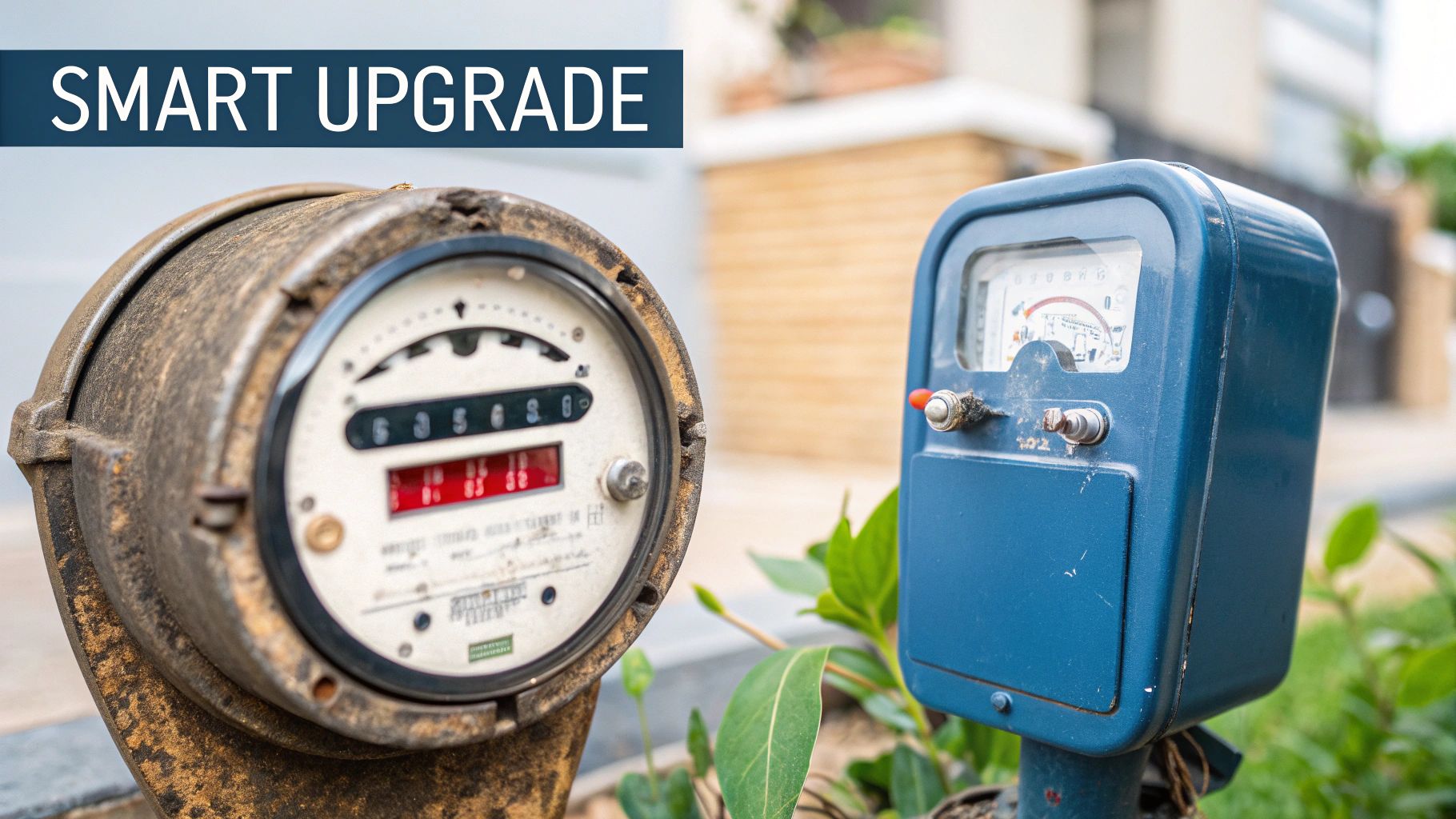
Sometimes the serial number is missing entirely, perhaps due to damage or a sloppy repair job in the past. This creates a serious gap in verification as a key piece of identifying information is simply gone. An unreadable or missing serial number is a significant vulnerability that makes it difficult to prove the correct meter is tied to the right property—a loophole that can be exploited in fraudulent insurance claims.
When this happens you need a clear course of action. Guessing the number is never an option and will only lead to major headaches with energy suppliers or insurers down the line.
What To Do When the Number Is Unreadable
If you find yourself staring at a meter with an illegible serial number the first and most important step is to contact the energy supply company. Do not try to clean or tamper with the meter yourself; you could cause more damage or even put yourself in danger. Your supplier is responsible for the upkeep and functionality of the meter.
When you get in touch have this information ready:
- Your full name and the property address. This is how they will find your account.
- Your Meter Point Administration Number (MPAN). You can find this 21-digit number on any recent electricity bill.
- A clear description of the problem. Simply explain that the serial number is faded, damaged or otherwise unreadable.
Your supplier will then schedule an engineer to visit, check the situation and most likely replace the old meter. This guarantees you will have a fully functional unit with a clear verifiable serial number for the future.
The Rise of Smart Meter Technology
The nationwide rollout of smart meters is a game-changer for data accuracy and fraud prevention. Unlike their old-school analogue cousins smart meters offer a far more robust and reliable way to identify a property’s energy supply point. With their digital displays and remote reporting capabilities they make the verification process smoother and much more secure.
Smart meters provide a continuous verifiable stream of data linked directly to a unique identifier. This digital connection offers an incredibly strong layer of evidence for billing, underwriting and claims verification that was simply impossible with older meters.
For insurance purposes the data from a smart meter is invaluable. It provides a detailed timestamped record of energy consumption that can help prove occupancy, verify heating was active during a cold snap or establish a clear timeline of events. This reduces the reliance on manual readings and physical inspections and closes off avenues for fraud that thrive on ambiguity.
Since 2018 the UK has even standardised the digital displays on smart electricity meters to improve clarity. A key change required single-phase meters to show only five digits for kilowatt-hour consumption which simplified the interface and cut down on human error. This push for standardisation is making accurate data reporting easier for the 30 million electricity meters installed across the country.
To get the most out of this technology understanding how to read your smart meter is an excellent first step in taking control of your energy data.
Still Have Questions? We Have Answers
Getting to grips with the technical side of your electricity meter can feel a bit overwhelming but a few key details make all the difference. Understanding the lingo helps you speak the same language as your supplier and ensures you have exactly what is needed for critical tasks like verifying an insurance claim.
Let us clear up some of the most common questions we hear.
What's the Difference Between an MPAN and a Meter Serial Number?
This is easily the number one point of confusion but it is simple once you know what you are looking for. The electricity meter serial number (MSN) and the Meter Point Administration Number (MPAN) are two completely separate identifiers for two different things.
- Meter Serial Number (MSN): This is the shorter code (like F21AB12345 ) you will find physically printed or stamped onto the meter itself. Think of it as the hardware's unique passport. It identifies that specific piece of equipment.
- Meter Point Administration Number (MPAN): This is a much longer 21-digit number that lives on your energy bill, usually set out in a little grid. It does not identify the meter; it identifies the unique connection point of your property to the national grid.
When it comes to insurance claims the serial number is the crucial piece of the puzzle. It directly links the energy data from a bill to the actual device installed at the property.
Can Two Properties Have the Same Meter Serial Number?
It is extremely unlikely but not impossible. In the UK duplicate serial numbers can occasionally pop up, usually as a hangover from older manufacturing processes or administrative mix-ups from decades ago. Whilst the system is designed for uniqueness it is not an absolute guarantee.
This is exactly why you should never rely only on the serial number as definitive proof of location. For rock-solid verification, especially in an insurance context, you need to cross-reference three key pieces of information:
- The full property address.
- The Meter Serial Number (from the meter itself).
- The MPAN (from a recent energy bill).
When all three of these line up you have got irrefutable proof you are dealing with the correct supply point and the right hardware.
Why Does My Insurance Company Need My Meter Number?
Your insurer asks for the electricity meter serial number because it is a powerful tool for validation and fraud prevention. It creates a solid provable link between your property and its energy consumption data which is essential for investigating claims accurately and fairly.
An accurate meter number transforms an energy bill from a simple document into a verifiable piece of evidence. It confirms presence, activity and location, helping to approve legitimate claims faster whilst flagging inconsistencies that may indicate fraud.
For example it can help prove the heating was on during a cold snap and strengthen a claim for a burst pipe. On the flip side a mismatched serial number can be a major red flag for fraud—a massive issue that costs the industry billions and ultimately drives up insurance costs for everyone.
Managing and proving ownership of insured items, from business assets to home contents, can be impossible from memory. Proova makes it simple. Our app allows you to create a secure, verifiable inventory of your possessions, complete with photos and serial numbers, so you are always prepared. When it is time to make a claim you will have all the proof you need right at your fingertips, ensuring a faster, fairer process. Learn how you can protect your assets and streamline your claims.