A UK Guide to Fraud Insurance
Staring at your insurance renewal notice and wondering why the numbers keep creeping up? A big part of that cost is driven by something that acts like a hidden tax on every single policyholder in the UK—insurance fraud. While you cannot buy a "fraud insurance" policy the term really describes the entire system insurers use to protect the integrity of the insurance pool and keep costs fair for everyone.
The Hidden Tax of Insurance Fraud on UK Policyholders
Insurance works on a beautifully simple principle: shared risk. We all pay our premiums into a large communal pot of money which is then used to pay out genuine claims when things go wrong. Simple right?
But fraudulent activity acts like a steady leak in that pot. Every false or padded claim drains resources that were meant for honest members of the community.
To cover those losses and keep the fund topped up insurers have no choice but to increase premiums across the board. It means a slice of your motor home or business insurance premium is directly covering the cost of someone else's dishonesty. It truly is a hidden tax that penalises the honest majority.
The True Cost of Deception
This is not just a minor issue; the financial impact is staggering. The Association of British Insurers (ABI) reported that in 2023 insurers detected fraudulent claims worth a record £1.3 billion .
The sheer volume is also on the rise with the number of detected fraudulent claims increasing by 18% to 113,000 . Unsurprisingly motor insurance remains the biggest headache making up over half of all fraudulent claims by volume. You can dig deeper into these trends on the ABI website.
This constant financial drain has consequences that go far beyond just higher prices. It forces insurers to pump huge sums of money into sophisticated fraud detection systems and investigative teams. This adds another layer of operational cost that you guessed it is ultimately passed on to customers. You can learn more about the economic impact of insurance fraud in our detailed article.
The core challenge for the industry is balancing robust fraud prevention with a fair and efficient process for genuine claimants. Proving the legitimacy of a claim is the cornerstone of a healthy and affordable insurance market for all UK policyholders.
How Fraud Inflates Your Policy
The ripple effect of insurance fraud touches multiple parts of your cover. Understanding this makes it clearer why insurers have to take such a firm stance against it.
This table provides a snapshot of how fraudulent activities translate into real-world costs for honest policyholders.
| Area of Impact | Key Consequence for Policyholders |
|---|---|
| Increased Premiums | The most direct impact. Your annual cost rises to cover the shortfall from fraudulent payouts. |
| Stricter Claim Processes | Insurers must ask for more detailed provable evidence from everyone which can slow down genuine claims. |
| Higher Excess | Policies may come with a higher compulsory excess to discourage small opportunistic fraudulent claims. |
| Data & Verification Checks | More resources are spent on identity and asset verification adding friction to the process. |
Ultimately tackling this issue is not just a job for the insurers; it's a collective responsibility. By seeing how fraud directly inflates costs we can all better appreciate the importance of the verification and detection measures that protect the entire insurance ecosystem.
Mapping the Landscape of UK Insurance Fraud
Insurance fraud is not a single straightforward crime. It’s a wide spectrum of deceit and understanding this landscape is the first step for UK insurers to tackle the complex challenge it presents. The tactics range from simple exaggeration to highly organised criminal conspiracies each posing a unique threat.
At one end of this spectrum is opportunistic fraud . This is often committed by otherwise honest people who simply see a chance to profit from a bad situation. It's the most common type of insurance fraud frequently seen by those who do it as a victimless crime.
Think of it as the difference between finding a lost wallet and actively planning a bank heist. One is a spontaneous act of dishonesty; the other is a calculated criminal enterprise.
Understanding Opportunistic Fraud
Opportunistic fraud usually follows a genuine loss. A policyholder might have their home burgled and decide to add a few extra items they never owned to the claim form. Another common example is exaggerating the extent of damage to a vehicle after a minor prang.
These actions might seem small but their cumulative effect is enormous. The sheer volume of these 'padded' claims contributes significantly to the billions in detected fraud each year driving up premiums for everyone.
This type of fraud blurs the lines for some who might not even consider it a serious crime. To an insurer however intentionally providing false information for financial gain is unequivocally fraud and will be treated as such. The key is proving the claim is fraudulent.
Exploring Premeditated Fraud
Far more sinister is premeditated fraud where the loss or incident is entirely fabricated or staged for the sole purpose of making a fraudulent insurance claim. These are not crimes of opportunity but deliberate plots to deceive insurers.
These schemes are often carried out by organised criminal groups and can be incredibly complex. Examples of premeditated fraud include:
- Staged Accidents: Deliberately causing a motor collision often by braking suddenly in front of an innocent driver. These ‘crash for cash’ scams are dangerous and designed to generate multiple false claims for vehicle damage personal injury and hire car costs.
- Fabricated Burglaries: Reporting a theft that never happened claiming for a house full of high-value items that were never owned.
- Arson: Intentionally setting fire to an insured property often a failing business to claim the insurance payout.
These large-scale deceptions are a major focus for fraud insurance investigators and require significant resources to uncover and prove. The organisation behind these crimes underscores why robust verification is not just a procedural step but a critical line of defence.
Application Fraud and Ghost Broking
Fraud is not limited to the claims process; it can start the moment a policy is taken out. This is known as application fraud or underwriting fraud and it happens when an applicant knowingly provides false information to secure a lower premium.
Common examples include lying about where a car is kept overnight failing to disclose previous claims or convictions or misrepresenting the type of locks on a property. While it may seem minor it means the insurer cannot accurately assess the risk leading to an unfairly priced policy.
A particularly harmful form of this is conducted by ‘ghost brokers’. These criminals sell fake or invalid insurance policies to unsuspecting victims often through social media. They might forge insurance documents or take out a genuine policy using false information then cancel it and pocket the victim's premium.
This leaves drivers on the road completely uninsured facing severe legal and financial consequences if they have an accident or are caught. This growing problem highlights why proving authenticity from the very start of the insurance journey is so vital. You can find out more about how insurance fraud is a growing concern for businesses and individuals alike.
The High-Stakes Battle Against Modern Fraudsters
The game of insurance fraud has changed. What was once the territory of lone opportunists making small exaggerations has escalated into a high-stakes battle. Today insurers are up against sophisticated organised criminal networks using advanced methods to exploit the system for huge payouts.
This shift has forced the insurance industry to move from a reactive to a proactive stance. Insurers are no longer just reacting to suspicious claims after the fact; they are now investing heavily in expert teams and powerful technology. The goal is clear: to stop fraudulent payouts before a single penny leaves the bank.
In this environment insurers are turning to advanced tech solutions. Understanding the fundamentals of Intelligent Automation strategies can shed light on how these tools are being deployed in the fight against modern fraudsters.
The Industry's Determined Response
The sheer scale of the problem demands a powerful and coordinated response. And it’s working. Insurers are detecting fraudulent activity at an unprecedented rate demonstrating their commitment to protecting honest policyholders.
The numbers speak for themselves. Major insurers are reporting significant wins with Allianz UK detecting £92.6 million worth of fraudulent activity in just the first half of a recent year—a 34% increase on the previous period. Aviva was not far behind preventing over 6,000 fraudulent claims worth more than £60 million in six months alone.
These figures send a clear message. The industry is not just identifying more fraud; it's getting much better at quantifying and stopping it. This proactive approach is essential for keeping the insurance pool stable for everyone.
Insurance fraud is far from a victimless crime. Every fraudulent claim that gets paid directly contributes to higher premiums for honest families and businesses across the UK. The industry's fight against fraudsters is a fight to keep insurance fair and affordable for all.
The Severe Consequences of Getting Caught
The idea that insurance fraud is a low-risk gamble could not be further from the truth. The legal consequences for those caught are severe and often life-altering reinforcing that this is a serious crime with serious penalties.
The courts are taking a firm stance handing down significant sentences to deter would-be criminals. The fight against fraud is not just about financial recovery; it's about justice. A proactive stance helps ensure that only genuine provable claims are paid which is why insurers are exploring ways of fighting fraud before it happens with verified evidence.
Just consider these real-world outcomes for convicted fraudsters:
- Custodial Sentences: Prison time is a very real possibility especially for organised or high-value fraud. Aviva alone reported that prison sentences for fraud it detected surpassed a cumulative 32 years in a single year.
- Criminal Records: A conviction for fraud results in a permanent criminal record. This can severely impact future job prospects travel and the ability to get financial products like mortgages.
- Financial Ruin: On top of any fines or court costs fraudsters may be ordered to repay the stolen funds. They will also find it nearly impossible to get insurance cover in the future as they will be blacklisted by the industry.
This determined response from insurers and the legal system paints a clear picture. The battle against modern fraudsters is being fought on all fronts protecting the integrity of the system and ensuring that crime simply does not pay.
How Insurers Prove and Disprove Claims
So how does an insurer spot the difference between a genuine claim and a fraudulent one? It’s less about a claims handler’s gut feeling and far more about a powerful mix of technology sharp data analysis and old-fashioned meticulous investigation. The modern toolkit is not just about catching fraudsters; it’s also designed to speed up the process for honest customers by focusing on the provability of the claim.
This all kicks off the moment a claim is filed. Insurers now use sophisticated systems to perform triage on incoming claims sorting them into different risk categories. Think of it like a hospital’s A&E department where the most critical cases are seen first. In the same way high-risk or unusual claims get flagged immediately for extra scrutiny.
A major weapon in the modern arsenal is AI in insurance claims processing. These digital detectives can sift through enormous datasets in seconds spotting subtle patterns and inconsistencies a human might easily overlook.
The Triage and Verification Process
Once a claim is flagged as potentially high-risk a much deeper investigation begins. This is where the claim’s provability comes under the microscope. Insurers do not just take submitted evidence at face value; they dig in to verify its authenticity.
A huge part of this is ensuring the integrity of the evidence itself. For example a digital photo of a damaged item is not just a picture. It’s packed with metadata that can reveal exactly when and where it was taken and on what device. If a photo of a supposedly recent accident was actually taken months ago that’s a massive red flag.
The same logic applies to all other forms of proof:
- Receipts and Invoices: These are checked for any signs of forgery or alteration. Investigators might even call the retailer to confirm the purchase details for a high-value item.
- Witness Statements: Claims handlers will carefully look for consistency between different accounts of an incident. Wildly conflicting stories can be a strong indicator that an event has been staged or exaggerated.
- Digital Footprints: It is not uncommon for investigators to review public social media profiles. Someone claiming severe whiplash who then posts photos of themselves skiing the next day is going to face some serious questions.
This simple graphic shows the typical three-stage process insurers follow to combat fraud.
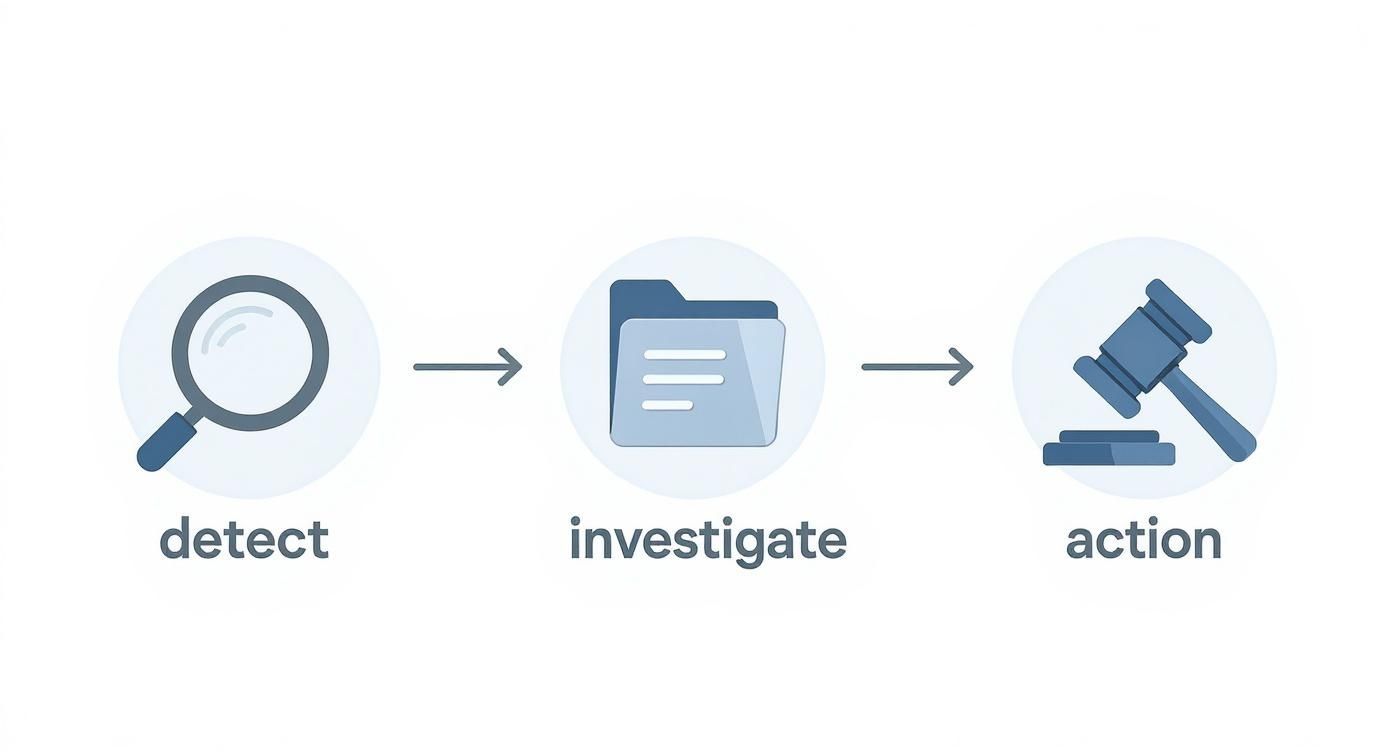
This structured flow—from detection to investigation and finally to action—ensures that expert resources are focused on the most suspicious cases protecting the interests of all policyholders.
Comparing Old and New Detection Methods
The tools available to fraud insurance teams have come a long way. Where investigators once relied heavily on manual checks and instinct today they’re backed by powerful analytical technology. This shift has made the detection process more efficient more accurate and ultimately fairer for everyone.
This table compares traditional and modern methods for detecting insurance fraud highlighting the advantages of new technologies.
Comparing Fraud Detection Approaches
| Detection Method | Traditional Approach | Modern Technological Approach |
|---|---|---|
| Data Analysis | Manual review of claim history and forms. Relied on identifying obvious red flags. | Automated analysis of vast datasets to spot subtle patterns links between claimants and predictive scoring. |
| Evidence Verification | Physical inspection of documents. Relied on the investigator's ability to spot forgeries. | Digital forensics to check photo metadata verify document authenticity and analyse digital footprints. |
| Claim Triage | All claims treated similarly with investigators relying on experience or random audits. | AI-powered systems that automatically score claims for fraud risk prioritising high-risk cases for review. |
The key takeaway is that technology has fundamentally changed the game moving from a reactive to a proactive stance against fraud.
The goal of modern verification is not to create hurdles for honest customers. Instead it’s about creating a system that can quickly and confidently approve genuine provable claims while dedicating expert resources to the cases that truly threaten the integrity of the insurance pool.
Ultimately this methodical approach is what keeps the system fair. By using technology to establish the provability of every piece of evidence insurers protect the communal fund from the financial damage of fraud. That in turn helps keep premiums stable and affordable for everyone—a critical function that underpins the trust essential to the entire industry.
Uncovering the UK's Insurance Fraud Hotspots
Insurance fraud is not something that happens randomly. It clusters in specific geographical hotspots which often become the operational playgrounds for organised criminal gangs. These networks burrow into local communities pushing up the cost of cover for everyone who lives there.
This concentration of criminal activity takes the conversation about fraud insurance away from abstract national statistics and turns it into a very real local problem. When gangs target a particular area they’re not just stealing from insurers; they are hitting honest residents with a direct financial penalty through higher premiums.
The Rise of Organised Policy Fraud
A major force behind these hotspots is a sharp increase in identity theft frequently fuelled by sophisticated phishing scams. Criminals harvest personal data to create fake insurance policies and it's a practice that has surged in recent years. This is not just about single false claims; it's about building a foundation for large-scale deception.
The UK's Insurance Fraud Bureau (IFB) has tracked a worrying trend noting a significant rise in policy fraud hotspots directly linked to these organised networks. In fact reported cases have skyrocketed surging more than sevenfold and showing just how fast this threat is growing. This explosion in identity theft driven by data phishing and false applications has contributed to a 25% increase in insurance fraud. You can find out more about the UK's top policy fraud hotspots.
The link between identity theft and regional fraud hotspots is undeniable. Organised crime groups use stolen personal information as the raw material to build their fraudulent enterprises making every citizen a potential target and victim.
Mapping the UK's Problem Areas
So where are these criminal networks most active? A close look at the data reveals a clear pattern pointing to specific regions that are bearing the brunt of this activity.
- England's Fraud Triangle: The primary hotspots are concentrated in a triangle covering parts of West Yorkshire Greater Manchester and the West Midlands. Cities within these regions have become focal points for organised insurance crime.
- Scotland's Epicentre: North of the border Glasgow has been identified as the leading area for this kind of fraudulent activity.
- Wales' Emerging Concerns: While not as concentrated as in England certain urban areas in Wales are also seeing a rise in organised policy fraud demanding increased vigilance.
This geographical mapping is crucial for insurers. It helps them focus their investigative resources where they’re needed most and get to grips with the localised tactics used by criminal gangs.
The Community Impact of Fraud Hotspots
Living in a fraud hotspot has real-world consequences that go far beyond statistics. For residents it can mean facing higher-than-average premiums for motor and home insurance simply because of their postcode.
This creates a deeply unfair situation where the honest majority is penalised for the actions of a criminal minority. It also erodes trust and can make it harder for legitimate claimants in those areas to get their claims processed smoothly as insurers are forced to apply much greater scrutiny. Tackling these hotspots is not just about fighting crime; it's about ensuring a fair and equitable insurance market for all UK communities.
Building a Fairer Future for UK Insurance
Ultimately tackling insurance fraud is a shared responsibility. It’s a collective effort that directly benefits every single policyholder in the UK. The ongoing battle against deceit is not just about shielding big companies from losses; it's about building a more stable affordable and trustworthy insurance market for everyone.
Robust detection is the cornerstone of this future blending sharp human expertise with powerful technology. When insurers can quickly and accurately prove a claim is legitimate the communal insurance pot is protected from those looking to exploit it. This stability is what allows premiums to be calculated on genuine risk not criminal activity.
Finding the Right Balance
A key challenge for the industry is striking the right balance: being uncompromisingly tough on fraud while ensuring honest customers have a smooth fair claims experience. The goal is never to create a difficult or adversarial process for people who have suffered a genuine loss.
Instead the aim is to use verification technology to fast-track legitimate provable claims releasing payments sooner and reducing stress for policyholders. This frees up specialist investigators to focus their limited resources where they are truly needed—on the complex and suspicious cases that threaten the integrity of the whole system.
The real measure of success in fraud prevention is a dual victory: fraudsters are stopped in their tracks and genuine customers feel supported and are paid quickly. This balance is critical for maintaining public trust in the insurance industry.
The Role of Every Policyholder
While insurers are on the frontline every policyholder has a part to play. Supporting and understanding the need for anti-fraud measures is a crucial first step. When you provide clear accurate information for a policy or a claim you are helping to strengthen the system against abuse.
By appreciating why an insurer might need to verify the details of a claim we can all contribute to a more secure environment. This collective understanding helps create a market where honesty is rewarded with faster service and fairer pricing.
The progress in fighting fraud insurance risks is not just about catching criminals. It’s about protecting the fundamental value of insurance for every family and business in the country. We all pay for fraud through increased premiums and we all benefit when it’s stamped out. By working together we can ensure the system remains a reliable safety net ready to help when it’s genuinely needed most.
Your Questions on Insurance Fraud Answered
When you’re navigating the world of insurance questions about fraud are bound to come up. It's a serious topic and it’s smart to be informed. Here are some clear straightforward answers to the questions we hear most often.
What Should I Do If I Suspect Insurance Fraud?
First things first: do not confront the person yourself. It's not safe and it’s not your job to investigate.
The right move is to report your suspicions and you can do so completely anonymously. The UK's Insurance Fraud Bureau (IFB) runs a Cheatline specifically for this purpose. Trained professionals will take it from there handling everything discreetly. Every report helps keep the system honest and stops premiums from rising for everyone else.
Will a Fraud Investigation Delay My Genuine Claim?
It's a common worry but a review does not automatically mean a long delay. Insurers want to pay legitimate claims quickly—it’s good for business and for their reputation.
If your claim is flagged it just means some details need a closer look. You can help move things along by providing clear and complete provable information right from the start and responding quickly if your insurer asks for anything else. Modern tech is great at spotting genuine claims and fast-tracking them so investigators can focus their energy where it’s truly needed.
Is It Really Fraud If I Just Exaggerate My Claim a Little?
Yes absolutely. This is known as opportunistic fraud and insurers take it very seriously. It includes everything from inflating the value of a stolen TV to adding a few extra items that were not actually lost in a burglary.
Even if the initial event was genuine deliberately beefing up the claim is illegal. It's not a harmless white lie; it's considered theft from the shared pool of funds that all policyholders pay into.
The consequences are severe and can include:
- Your entire claim being thrown out leaving you with nothing.
- Immediate cancellation of your policy which makes getting cover elsewhere a nightmare.
- Being added to an industry database flagging you as a known fraudster for future insurers.
What's the Difference Between Personal and Business Fraud Insurance?
This is a great question as the term can be used in two different ways.
In this guide when we talk about fraud insurance we're referring to the anti-fraud measures built into everyday policies like your car or home insurance. It's about protecting the entire system from dishonest activity.
Businesses however can buy specific policies called 'Commercial Crime' or 'Fidelity' insurance. This is different. It’s designed to protect the company itself from financial hits caused by fraud whether it’s from an employee (like embezzlement) or an external threat (like forgery or a cyber-attack).
At Proova our goal is to build a more transparent and trustworthy insurance process. By verifying assets and ownership before a claim is ever made we help insurers cut out fraud speed up genuine payouts and create a fairer system for honest customers. Find out how we can help at https://www.proova.com.