The Real Cost of Underinsurance: A Guide for Insurers & Brokers
A home insurance policy is a financial shield, designed to protect policyholders from disasters like fire, flood, or burglary. It consists of two key components: buildings insurance , covering the property's structure, and contents insurance , protecting the possessions within.
While the distinction seems straightforward, it's the source of significant commercial friction. For insurers and brokers, the gap between a policyholder's understanding and the reality of their cover is a major driver of claims disputes, operational inefficiency, and financial leakage.
Demystifying Policy Cover: The Commercial Risk

A simple analogy can be used: if a home is a box, buildings insurance covers the box itself—walls, roof, windows, and permanent fixtures like kitchens and bathrooms. Contents insurance covers everything that would fall out if the box were inverted—furniture, electronics, clothing, and jewellery.
This simplicity masks a critical operational challenge. At the point of claim, the burden of proof falls on the policyholder. However, asking a client to recall every item they owned and its value after a traumatic event is a recipe for dispute. This lack of verifiable, pre-loss documentation is the single biggest friction point where the claims process stalls, driving up costs and damaging customer relationships.
The Two Pillars of Protection
Every home insurance policy is built on these two cover types. Lenders mandate buildings insurance for mortgaged properties, while contents cover is typically optional but essential for comprehensive protection.
- Buildings Insurance: This protects the physical structure against perils like fire, storms, subsidence, or vandalism. The sum insured must reflect the full rebuild cost of the property, not its market value—a frequent point of underinsurance.
- Contents Insurance: This covers the replacement cost of personal belongings if stolen or destroyed. The sum insured should be sufficient to replace all possessions with new equivalents.
Consider the commercial reality of a major claim. Following a house fire, a policyholder is asked to catalogue every lost item, from furniture to books, complete with proof of ownership and value. This is an almost impossible task.
In the second quarter of the year, UK insurers paid out £1.6 billion in property claims, a 7% increase from the £1.5 billion in Q1. These figures represent thousands of claims processes, many of which are slowed by the difficulty of verifying losses after the event, leading to significant claims handling costs.
While encouraging clients to install essential home fire safety equipment is a sound risk management strategy, the most effective commercial defence is robust documentation at policy inception.
At-a-Glance Guide to Home Insurance Cover
This table outlines the typical scope of each policy, highlighting areas prone to dispute.
| Type of Cover | What It Typically Protects | Common Exclusions (and sources of dispute) |
|---|---|---|
| Buildings Insurance | The physical structure: roof, walls, windows, doors, fitted kitchens & bathrooms, pipes, cables, ceilings, floors. | General wear and tear, damage from pests, frost, faulty workmanship. Distinguishing these from insurable events is a key claims challenge. |
| Contents Insurance | Personal belongings: furniture, electronics, clothing, jewellery, carpets, curtains, ornaments. | High-value items over a specified limit unless declared, damage caused by pets. Proving ownership and value post-loss is a major cost driver. |
For insurers, clear differentiation is crucial. However, the real challenge lies in verifying the state and value of insured property before a claim occurs. Without this, every claim becomes a costly, evidence-gathering exercise.
Exploring Buildings and Contents Insurance in Detail
Home insurance is built on two pillars: covering the property structure (buildings) and its contents. Misunderstandings and incorrect valuations in these areas are a primary source of underinsurance, leading to claims disputes, financial loss, and customer dissatisfaction for insurers. Accurate assessment at policy inception is critical for setting correct premiums and ensuring a smooth claims process.

The image illustrates the core distinction: the structural asset versus the personal property it contains. Getting the valuation right for both is a commercial necessity.
Understanding Buildings Insurance Cover
Buildings insurance protects the physical structure of a property and its permanent fixtures.
This includes:
- Fitted kitchens, including worktops and integrated appliances.
- Bathroom suites, including toilets, basins, and showers.
- Internal fittings like doors, skirting boards, and ceilings.
- Outbuildings such as garages and sheds, plus boundary walls and fences.
The single biggest commercial risk is underinsurance due to incorrect valuation . Policyholders frequently insure for the property's market value, not its rebuild cost . This cost—to clear the site and construct the house from scratch, including labour, materials, and professional fees—is often significantly different from the sale price.
When a property is underinsured, insurers are entitled to apply the 'average clause' during a claim. This results in a proportionally reduced payout, creating severe customer friction and reputational damage. For the insurer, it represents a failure in risk assessment and a potential source of claims leakage.
Deconstructing Contents Insurance Cover
Contents insurance covers movable possessions within the home. The traditional test is to imagine inverting the house; everything that falls out is 'contents'.
For insurers, the primary challenge is the lack of an accurate, verified inventory at policy inception. Initial sum insured values are often rough estimates provided by the policyholder. This creates a significant problem at the claims stage, as reconstructing a lost inventory post-event is fraught with difficulty and potential for fraud. To understand the nuances, you can review the essentials of contents insurance definition.
There are two principal types of contents cover, with different payout mechanisms:
- New for Old: The most common basis of settlement. It provides funds to replace a lost or damaged item with a new equivalent at current market prices.
- Indemnity Cover: This accounts for wear and tear, paying out the item's value at the time of loss. While less common in standard policies, it highlights the importance of accurate, pre-loss condition assessment.
The core operational challenge for insurers is verifying ownership and condition post-loss. Without a verifiable record created at policy inception, claims handlers are forced into a lengthy, inefficient process of validating claims through receipts and bank statements, exposing the business to fraud and dispute costs.
Considering Optional Home Insurance Add-Ons
Standard home insurance policies provide a foundational layer of protection against common perils. However, they cannot cover every eventuality. Optional add-ons, or endorsements, allow for tailored cover that addresses specific risks, enabling more precise underwriting.
These add-ons exist to manage risks that are too specific or frequent to be included in standard policies without inflating premiums for all customers. By offering them separately, insurers can provide flexibility and ensure pricing accurately reflects the risk being underwritten, moving away from a one-size-fits-all model.
For insurers and brokers, these endorsements are essential tools for risk segmentation and creating tailored solutions for different client needs.
Accidental Damage Cover
A crucial add-on, accidental damage cover addresses losses not caused by a specified peril like fire or theft. It covers sudden, unintentional, one-off incidents that a standard policy would exclude.
Examples include spilling red wine on a carpet or drilling through a water pipe during DIY. These common mishaps fall outside the scope of basic cover.
Two levels are typically available:
- Limited Accidental Damage: Often covers non-portable electronics like televisions and audio systems.
- Full Accidental Damage: Provides broader protection for both the building (e.g., a foot through a ceiling) and its contents (e.g., knocking over a valuable ornament).
Personal Possessions and Home Emergency Cover
Many policyholders carry valuable items outside the home. Personal possessions cover , also known as 'all-risks cover', extends protection to items like laptops, mobile phones, and jewellery when they are away from the property, often worldwide.
Without this, a laptop stolen from a café or a ring lost on holiday would not be covered. For insurers, a significant challenge is verifying the existence and condition of these items pre-loss, a problem directly solved by a pre-verified digital inventory.
Home emergency cover is another critical add-on, designed for urgent situations that pose a risk to the property or its inhabitants, such as:
- A burst pipe causing a flood.
- Complete failure of the heating or hot water system.
- A security issue, like a broken window or main door lock.
This cover typically provides a 24-hour helpline and covers call-out fees and initial repairs to secure the home, subject to cost limits.
Legal Expenses Protection
Legal expenses cover provides financial support for property-related disputes, covering solicitors' fees and court costs up to a specified limit.
It is invaluable for issues like boundary disputes with neighbours or conflicts over faulty workmanship by contractors. Advising clients that installing robust residential security systems can positively impact their premiums and cover options also serves as part of a comprehensive risk management conversation.
What Your Home Insurance Probably Won't Cover: A Look at Common Exclusions
Understanding what a home insurance policy excludes is as critical as knowing what it covers. Exclusions are not arbitrary; they are necessary for managing risk and keeping insurance viable. They create a clear distinction between fortuitous, insurable events and the predictable consequences of property ownership. For insurers, this distinction is fundamental to preventing the policy from becoming a general maintenance contract.

The principle of fortuitous loss is central to insurance: cover is for sudden, accidental, and unexpected events. It is not designed to pay for gradual deterioration or damage resulting from a lack of maintenance. Commercially, this grey area is a primary source of claims disputes.
General Wear and Tear
A core exclusion in every home insurance policy is general wear and tear . Insurance does not cover items simply because they have aged or worn out through normal use. Examples include a threadbare carpet, faded curtains, or a fence that has rotted over time. These are gradual processes, not sudden insurable events.
For insurers, wear and tear claims are a significant operational burden. Claims handlers must attempt to differentiate between legitimate damage and natural deterioration, often without any baseline evidence of the item's condition at policy inception. This ambiguity increases claims handling time and costs.
Damage from Poor Maintenance
Closely linked to wear and tear is damage resulting from a failure to conduct reasonable maintenance. Policies will not cover damage from a known issue that was neglected.
Common scenarios include:
- A slow radiator leak, ignored for months, causing floorboards to rot.
- Blocked gutters leading to water overflow and damage to external walls.
- Missing roof tiles allowing rainwater to cause damp in the attic.
In these instances, the damage was predictable. For a claims team, distinguishing this from a genuine storm or escape of water claim is a complex task. Verified documentation of the property's condition at inception provides the clarity needed to make these determinations efficiently.
Don't Forget Your Policy Excess
The policy excess is the portion of a claim the policyholder agrees to pay. For example, with a £250 excess, a £1,000 claim would result in a £750 payout from the insurer. The excess serves to deter small, trivial claims that are administratively expensive to process.
From an insurer's perspective, the clarity offered by policy exclusions is vital. When a claim arises from a poorly maintained property, the absence of verifiable, pre-loss evidence necessitates a costly and often adversarial investigation. This is a major source of claims leakage that can be prevented with better documentation at policy inception.
Other Common Exclusions
Several other situations are typically excluded from standard home insurance policies, often requiring specialist cover or being deemed uninsurable.
- Deliberate Acts: Damage intentionally caused by the policyholder is never covered.
- Theft Without Forced Entry: If entry is gained through an unlocked door, many policies will not pay out, as reasonable security precautions were not taken.
- High-Value Items: Standard policies have a 'single article limit' (e.g., £1,500 ). More valuable items like jewellery or art must be specified separately for full cover.
- Pest Infestations: Damage from insects, birds, or vermin is almost universally excluded as a maintenance issue.
These exclusions reinforce the purpose of insurance: to protect against unforeseen events. For insurers, having clear, documented proof of a property's condition at policy inception is the most effective way to enforce these terms, prevent disputes, and reduce the operational costs associated with ambiguous claims.
How the UK Home Insurance Claims Process Works
The journey from incident to settlement is a critical test of an insurer's efficiency and customer service. For insurers, the process is a balance between supporting customers, managing risk, and controlling costs. Every delay and dispute adds to the overall cost of the claim.
Understanding the typical steps reveals the operational bottlenecks that frustrate policyholders and increase expenses for insurers. While specific procedures vary, the core process is consistent.
The First Steps After an Incident
The actions taken immediately following a loss are crucial for both safety and the subsequent claim.
- Safety First: The policyholder must take reasonable steps to prevent further damage, such as shutting off mains supplies or securing the property. This is a standard policy condition.
- Call Your Insurer: Prompt notification is essential. The policyholder should contact their insurer as soon as reasonably possible with their policy number to initiate the 'first notification of loss' (FNOL).
- Document Everything: This is the critical juncture. The policyholder should take extensive photos and videos of the damage before any clean-up and begin compiling a list of damaged or stolen items. It is here that the lack of pre-existing documentation creates the single biggest bottleneck in the claims system.
The Documentation and Assessment Phase
Following FNOL, the focus shifts to damage assessment and policy validation.
For minor claims, this may be handled remotely with photos and receipts. However, larger or more complex claims involving structural damage or high-value contents often require a loss adjuster .
A loss adjuster is an independent claims specialist appointed by the insurer to:
- Visit the property to assess the extent of the damage.
- Confirm the cause of loss is a peril covered by the policy.
- Review the list of claimed items, seeking proof of ownership and value.
- Negotiate the final settlement figure.
The primary operational challenge for adjusters and claims handlers is their reliance on the policyholder's memory and ability to produce documentation. This manual, often stressful, search for proof is what extends the claims lifecycle, increasing costs and customer dissatisfaction.
The Great Divide: A Traditional Claim vs a Verified Claim
The claims journey diverges significantly based on the quality of documentation available at inception.
The Traditional Claim: A stressed policyholder attempts to reconstruct a list of possessions from memory. The claims handler spends weeks chasing incomplete information, disputing valuations based on vague descriptions, and attempting to validate ownership with inconsistent evidence. This friction leads to delays, customer complaints, and inflated administrative costs.
This inefficiency is a major financial drain. Despite 65% of UK households having home insurance, process inefficiencies and fraud are significant cost drivers. In Q2 alone, insurers paid £1.6 billion in property claims—a 7% increase from Q1. These costs are ultimately passed on to consumers. You can discover more insights from Mintel's latest UK home insurance report.
The Verified Claim: Contrast this with a modern, prevention-led approach. A policyholder with a digitally verified inventory created at inception simply provides a link to their insurer. The claims handler has immediate access to a complete, timestamped, and geolocated catalogue of all items, including photos and receipts.
This transforms the process. The need for lengthy investigation is eliminated. Disputes over ownership and value are prevented. The claim can proceed from submission to settlement in a fraction of the time. For insurers, this delivers a fundamental reduction in claims handling costs, closes a key avenue for fraud, and provides a superior customer experience. You can check out our guide on mastering the claims process to see how this works in practice.
The Commercial Cost of Unclear Home Insurance Cover
For a policyholder, discovering their insurance cover is inadequate is a source of immense stress. For insurers and brokers, this lack of clarity translates directly into financial loss. Customer friction points—disputes over underinsurance, claims denied for lack of proof, and protracted settlements—are not just service issues; they are significant drivers of operational inefficiency, claims leakage, and reputational damage.
Every ambiguous claim is a financial drain. When a policyholder cannot easily prove ownership or pre-loss condition, the claims process becomes a costly and protracted investigation. Staff time is consumed by chasing inadequate evidence, commissioning expensive loss adjuster visits, and managing preventable disputes. This inefficiency is a gateway to opportunistic fraud.
The Financial Drain of Ambiguity
An environment of poor documentation is the perfect breeding ground for after-the-event fraud. Without a clear, timestamped record from policy inception, distinguishing a legitimate claim from a fraudulent one is incredibly difficult. This forces insurers into a defensive, reactive posture, where every claim requires intense scrutiny, delaying payouts for genuine customers and eroding trust.
The financial impact extends far beyond a single claim:
- Increased Claims Handling Costs: Manual verification, prolonged disputes, and reliance on third-party adjusters inflate operational expenses.
- Claims Leakage: Overpayments on unsubstantiated or fraudulent claims directly impact profitability.
- Reputational Risk: Slow, adversarial claims processes result in poor customer satisfaction, negative reviews, and increased churn.
- Inaccurate Underwriting: Without a clear view of the assets being insured, premiums are based on estimates, leading to endemic underinsurance and unquantified risk exposure.
The typical home insurance claims process, shown below, reveals that the documentation stage is the source of most delays and costs.
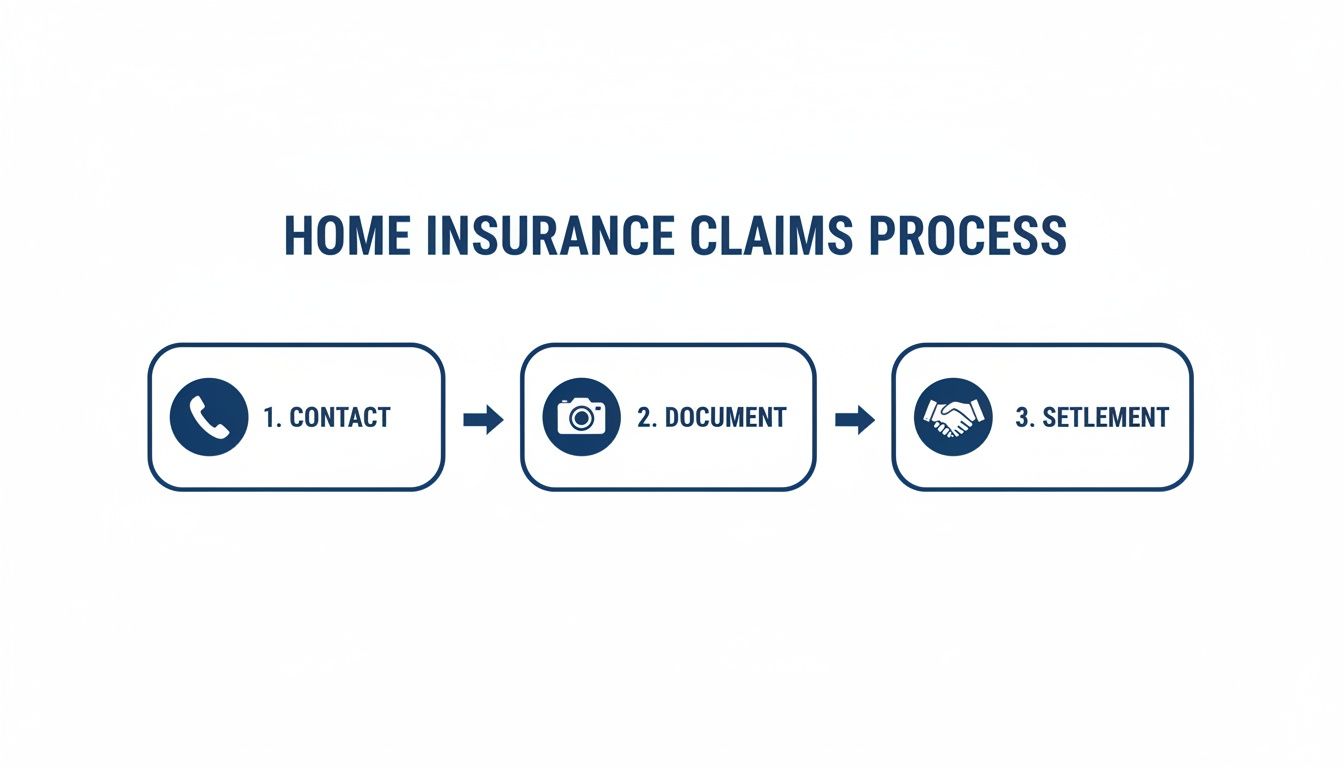
While the steps appear straightforward, the quality of information in the documentation phase determines the speed, cost, and fairness of the entire process.
A Commercial Imperative for Verification
This is why adopting verification technology at policy inception is a commercial imperative. It shifts the entire paradigm from a reactive, costly problem to a proactive, strategic advantage. By creating an irrefutable, digitally verified record of assets at the point of sale, insurers can fundamentally transform their operational reality.
The core argument is simple: prevention is more profitable than detection . By verifying assets before a policy is bound, insurers eliminate the ambiguity that fuels disputes, fraud, and inefficiency. This isn't just about improving the customer journey; it's about protecting the business from unnecessary financial loss.
To put the commercial impact into perspective, let’s compare the two approaches.
Traditional Claims vs. Verified Claims A Cost-Benefit Analysis
This table outlines the tangible commercial differences between a standard, reactive claims process and one supported by pre-inception verification technology.
| Metric | Traditional Claims Process | Verified Claims Process |
|---|---|---|
| Claims Handling Costs | High ; driven by manual investigations, adjuster fees, and dispute resolution. | Low ; automation and clear evidence reduce manual effort and third-party involvement. |
| Fraud Exposure | High ; ambiguity around ownership and condition creates opportunities for fraud. | Low ; timestamped pre-inception records make after-the-event fraud almost impossible. |
| Settlement Speed | Slow ; typically takes weeks or months, leading to poor customer outcomes. | Fast ; claims can be validated and settled in days, sometimes hours. |
| Underwriting Accuracy | Low ; premiums are often based on estimates, increasing the risk of underinsurance. | High ; accurate, verified data allows for precise risk pricing from the outset. |
| Customer Satisfaction | Poor ; long delays and confrontational processes damage trust and loyalty. | Excellent ; a fast, transparent, and fair process builds strong customer relationships. |
The business case is clear. A proactive, verification-led approach delivers a powerful competitive advantage by cutting costs, mitigating risk, and enhancing the customer experience.
Ultimately, tackling unclear home insurance cover is not a customer service initiative—it's an essential business strategy. It reduces operational drag, prevents fraud, enables more accurate underwriting, and transforms a major source of commercial friction into a powerful advantage. The delays in the claims process have a profound financial impact; you can learn more about the cost of delayed claims and their unseen losses in our detailed guide.
Your Home Insurance Questions Answered
These common questions from policyholders highlight key areas of confusion where proactive verification can prevent future disputes and streamline the claims process for insurers.
Is My Laptop Covered If I Take It Out of the House?
Standard contents insurance is designed to protect items within the home. If a laptop is stolen from a coffee shop or damaged while travelling, it is not typically covered.
Protection for such scenarios requires a Personal Possessions add-on. This is an optional extra that covers specified items taken outside the home. For insurers, claims for items lost away from the property are a significant challenge, especially without verifiable proof of ownership and condition established at policy inception.
Why Won't My Insurance Pay to Fix My Leaky Roof?
Home insurance covers sudden and unforeseen events, not issues arising from gradual deterioration. A roof that has been leaking for months due to age or poor maintenance falls under the exclusion of wear and tear .
Insurance is not a maintenance contract. It will respond if a storm damages a well-maintained roof, but it will not pay for the predictable consequences of neglect.
How Much Cover Do I Actually Need?
This is a critical area of misunderstanding. For buildings, the sum insured must be the rebuild cost —the full cost to demolish and reconstruct the property, including all professional fees, labour, and materials. For contents, the cover must be sufficient to replace all possessions with new equivalents.
Underinsurance is a systemic problem, with an estimated 76-80% of UK properties having inadequate cover. At the point of claim, this often triggers the 'average clause', leading to a reduced payout and significant customer dissatisfaction. This underscores the commercial importance of establishing an accurate sum insured from day one.