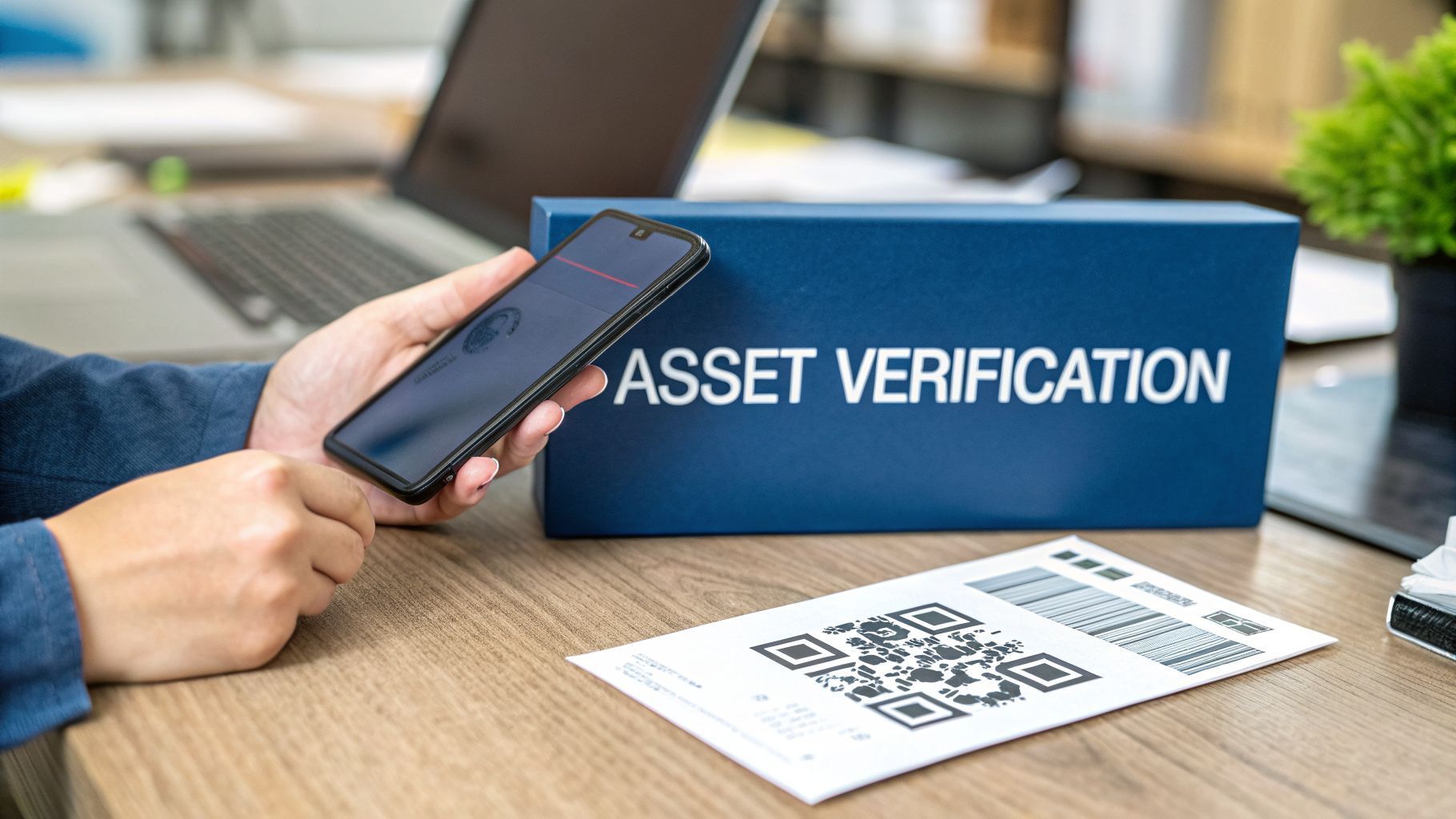
Insurers: Why Claims Leakage Spikes in Travel Insurance
When a holiday goes wrong, the policyholder’s first call sets in motion a process that can either be efficient and fair or become a significant source of claims leakage. For insurers, the challenge in travel claims isn't just validating the incident; it's the operational drag and fraud risk created by poor, after-the-event evidence. The secret to reducing claims handling costs isn't a complex new system; it’s about addressing the core problem: the chronic lack of verifiable proof of ownership and value at the point of claim.
Getting this right from the outset is the foundation for preventing disputes, combatting fraud, and protecting margins.
The Commercial Impact of a Travel Incident

The moments after a medical emergency, theft, or cancellation are chaotic for the policyholder. For the insurer, they represent a critical control point. The quality of information gathered in the first 24 hours dictates the entire claims journey, influencing everything from handling time to the likelihood of a dispute or fraudulent payout.
An insurer’s process is designed to establish a verified, third-party account of events. However, current methods rely heavily on the policyholder’s ability to produce documentation under duress, a system fraught with inefficiencies that lead to delays and increased operational costs.
From a claims director’s perspective, the first notification of loss (FNOL) is a fork in the road. One path leads to a quick, low-touch settlement based on clear evidence. The other leads to a high-touch, protracted investigation that erodes customer satisfaction and inflates claims handling expenses.
Medical Emergency Claims
Medical assistance is the priority for the customer. For the insurer, the process involves authorising treatment costs (often over a threshold like £500), coordinating with overseas providers, and managing payments. The operational challenges are significant.
- Cost Control: The assistance team's immediate intervention is vital to approve necessary treatments and prevent inflated billing. Failure to gain pre-authorisation is a common reason for disputes.
- Documentation Burden: Claims handlers rely on the policyholder to collect itemised bills, medical reports, and admission/discharge forms. Missing or incomplete paperwork requires extensive follow-up, delaying settlement.
Medical expenses are consistently the largest driver of claim value. In 2025 data from Tesco Insurance, medical claims accounted for 51.1% of all travel claims paid. The financial exposure is substantial, highlighting the need for robust validation processes. You can explore the data behind common travel insurance claims to understand the risk landscape.
Lost or Stolen Property Claims
Theft claims are a primary source of claims leakage and fraud. The core problem is the difficulty of verifying ownership and value after the item has gone.
The Commercial Challenge: A policyholder must report theft to local police within 24 hours. A missing police report is a clear red flag and a primary reason for rejection. However, even with a report, proving they owned the three-year-old laptop they are claiming for is another matter entirely.
This lack of proof triggers a high-cost, manual investigation. The claim moves from a simple administrative task to a complex validation exercise, requiring handlers to seek alternative evidence like bank statements or old photographs—all of which are easily manipulated.
The Evidence Bottleneck: Why Claims Stall
A claim is won or lost on the quality of its supporting evidence. Once the immediate crisis has passed for the policyholder, the focus shifts to collecting the documentation required for assessment. For claims teams, this is where the operational bottlenecks form.
An insurer's role is to validate a claim based on verifiable facts. The policyholder’s responsibility is to provide them. When they can't, the cost to the insurer multiplies.
For Medical Costs
The evidence must create an unbroken chain linking the incident to the treatment and the cost.
- Itemised Bills vs. Totals: A simple total on an invoice is insufficient. Claims adjusters need a detailed breakdown to check for excluded treatments or inflated charges.
- Medical Reports: The official diagnosis is crucial for confirming the necessity of treatment and checking against policy exclusions or undeclared pre-existing conditions.
- Proof of Payment: Receipts for out-of-pocket expenses must be scrutinised to prevent reimbursement for non-covered items.
For Cancellations or Curtailment
These claims require proof of two distinct elements: the non-refundable cost of the trip and the valid, unforeseen reason for the cancellation.
- Booking Invoices: Verifying the original cost against what is being claimed is step one.
- Evidence of Non-Refund: Proof that refunds from suppliers (airlines, hotels) were unobtainable is essential to prevent paying out on recoverable costs.
- Supporting Justification: The document proving the reason for cancellation (e.g., a doctor's note, death certificate) must be assessed for legitimacy and to ensure the cause is covered by the policy.
For Stolen or Lost Property
This is the highest-risk category for fraud and disputes. The "lounge exercise" illustrates the problem perfectly: ask any policyholder to list the valuables in their suitcase before a trip, and it's easy. Ask them after a theft, and you can spend six weeks in a dispute over ownership and value.
The core challenge for any insurer is verifying ownership and value after the fact. A claim for a stolen camera bought three years ago without a receipt creates immediate friction, requiring more investigation and delaying the payout.
The required evidence includes:
- A Police Report: This is a non-negotiable procedural requirement, confirming the incident was officially reported within the stipulated timeframe (usually 24 hours ).
- Proof of Ownership: This is the critical failure point. Insurers currently rely on receipts, bank statements, or user manuals. This evidence is often unavailable, forcing handlers into a lengthy and inconclusive investigation.
This post-incident scramble for proof is a major driver of claims leakage. Shifting verification from a reactive investigation to a proactive, pre-travel process is the solution. When a policyholder can provide a verified, time-stamped catalogue of their belongings, it transforms a contentious claim into a simple validation exercise. Learn more about how real-time evidence changes everything for theft claims and helps accelerate payouts. This is the difference between a six-week dispute and a six-day settlement.
Submitting the Claim: Optimising for Efficiency
Once the evidence is gathered, the formal submission process begins. The clarity and organisation of the submission directly impact the speed and cost of handling. A well-presented claim allows for faster, lower-touch processing. A confusing or incomplete one guarantees delays.
Claims handlers need verifiable facts presented logically. Their goal is to assess the claim against the policy terms as efficiently as possible. A submission that facilitates this reduces the cost per claim.
This short infographic breaks down the crucial evidence required for the most common claim types, highlighting the reliance on official, third-party documentation.
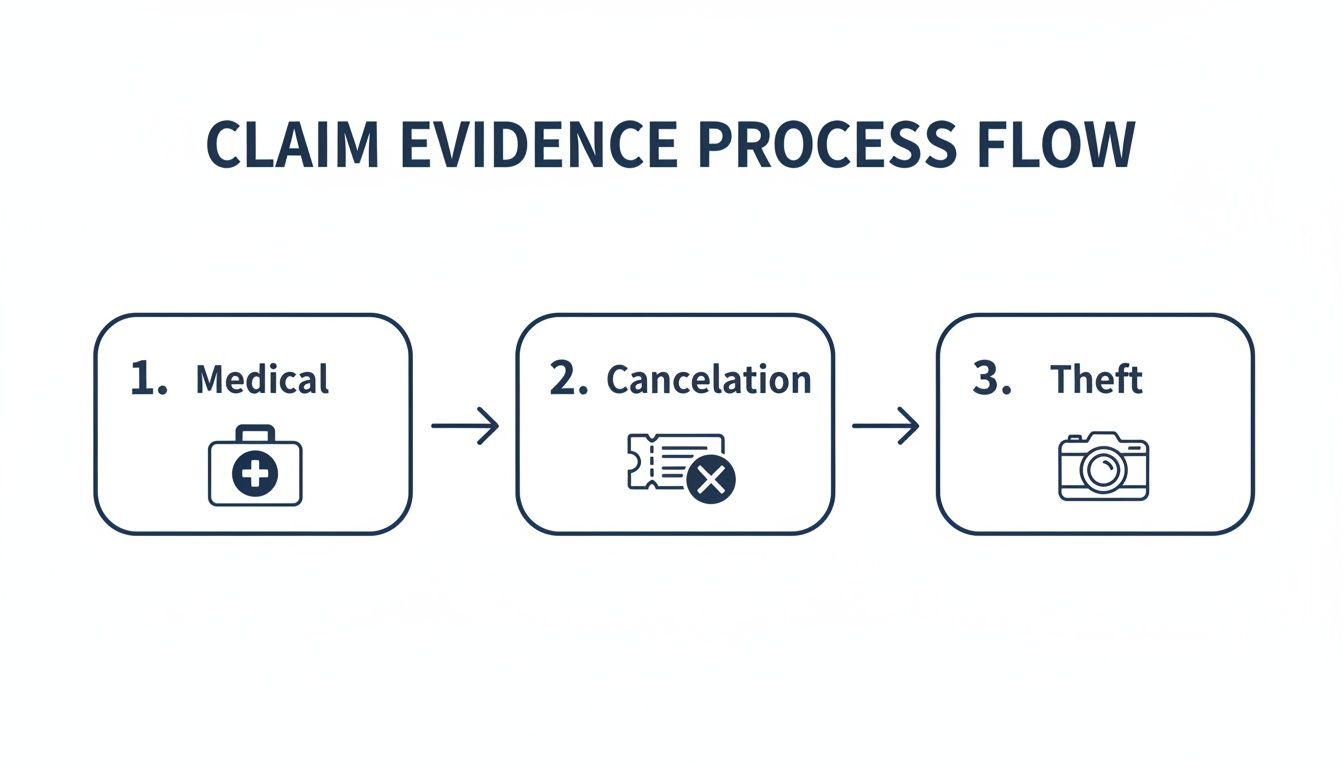
As shown, every claim type depends on specific, official paperwork. Medical reports, booking invoices, or police records are the bedrock of a valid claim. The absence of this proof is what drives up costs.
The Claim Form as a Data Input Tool
The claim form is the primary data source for the claims handler. Inaccuracies create friction and require manual intervention.
- Accuracy is Paramount: Any discrepancy in dates, times, or amounts raises a flag and triggers further investigation. Incomplete sections cause delays.
- Factual Narrative: The description of the incident should be a chronological statement of facts, not an emotional story. For example: "The bag was last seen at 14:00. It was discovered missing at 14:15. The incident was reported to police at 15:00."
- Evidence Referencing: A well-structured claim references the supporting documents directly (e.g., "See attached Police Report Ref: 12345"), simplifying the handler's review process.
The Claims Timeline and Its Costs
Understanding the claims journey highlights the touchpoints where costs accumulate.
- Acknowledgement: An automated first step, providing the policyholder with a claim reference number.
- Review and Investigation: A claims adjuster assesses the submitted documents. This is the most time-consuming stage. Any request for further information (RFI) adds days or weeks to the cycle time and increases handling costs.
- Decision: The outcome—approved, partially approved, or denied—is communicated. A denial often leads to disputes or complaints, adding further expense.
The scale of this process is immense. In 2024, UK travel insurers paid out £472 million across more than 500,000 claims, according to the Association of British Insurers (ABI). This volume underscores the critical need for efficient, evidence-based processing to manage claims leakage. You can read the full report on recent travel insurance claims for a detailed breakdown.
Common Drivers of Claims Leakage and Rejection
A rejected claim is often seen as a cost-saving outcome, but it can also signify a failure in the underwriting or claims process that leads to disputes and reputational damage. Understanding the root causes of rejection provides insight into key risk areas.
For a claims director, a high rejection rate isn't necessarily a sign of success. It can point to unclear policy wording, poor risk selection at inception, or systemic issues that increase handling costs and regulatory scrutiny. Most rejections stem from a few common, and often preventable, failures.
Undeclared Conditions and Policy Exclusions
A primary reason for rejecting medical claims is the failure to declare a pre-existing condition at policy inception. This is a clear breach of policy terms. Similarly, claims arising from activities not covered by the policy (e.g., winter sports without the appropriate extension) are straightforward rejections. These point to a breakdown in communication and transparency during the sales process.
Failure to Adhere to Claims Protocol
Insurers establish clear procedures to validate claims and mitigate fraud. Non-compliance is a major reason for denial.
Key procedural failures include:
- Late Notification of Theft: Failure to report theft to police within the required 24-hour window.
- Missing Submission Deadlines: Policies contain strict time limits for claim submission post-trip.
- Unauthorised Medical Expenses: Incurring significant non-emergency medical costs (e.g., over £500) without pre-authorisation from the insurer’s 24/7 assistance line.
The Core Problem: Insufficient Proof of Ownership
The single biggest driver of disputes, delays, and potential fraud in property claims is the lack of credible evidence.
A claim for a stolen high-value item without a receipt or bank statement is an immediate red flag. It forces a manual investigation that is costly, time-consuming, and often inconclusive. This ambiguity creates a significant operational burden and opens the door to after-the-event fraud.
This ambiguity is a major source of friction in the claims process. For claims directors and fraud prevention teams, a claim without solid, verifiable evidence represents a significant operational cost and a potential avenue for after-the-event fraud.
The statistics confirm the financial impact. Medical expenses were the top reason for claims in 2024, accounting for 34% of the total, according to the ABI. UK insurers paid out £472m on over 500,000 claims . Read the full ABI statistics on travel insurance payouts. While medical claims have their own verification challenges, the principle is the same: without robust proof, claims costs escalate.
When an insurer’s refusal to pay is understood as a symptom of these core evidence and procedural issues, the path to a solution becomes clearer. Learn more about why your insurance company might refuse to pay a claim and what you can do about it. A well-documented claim, supported by pre-verified evidence, aligns the interests of both insurer and policyholder, paving the way for fast, fair settlements.
Using Technology to Reduce Claims Leakage
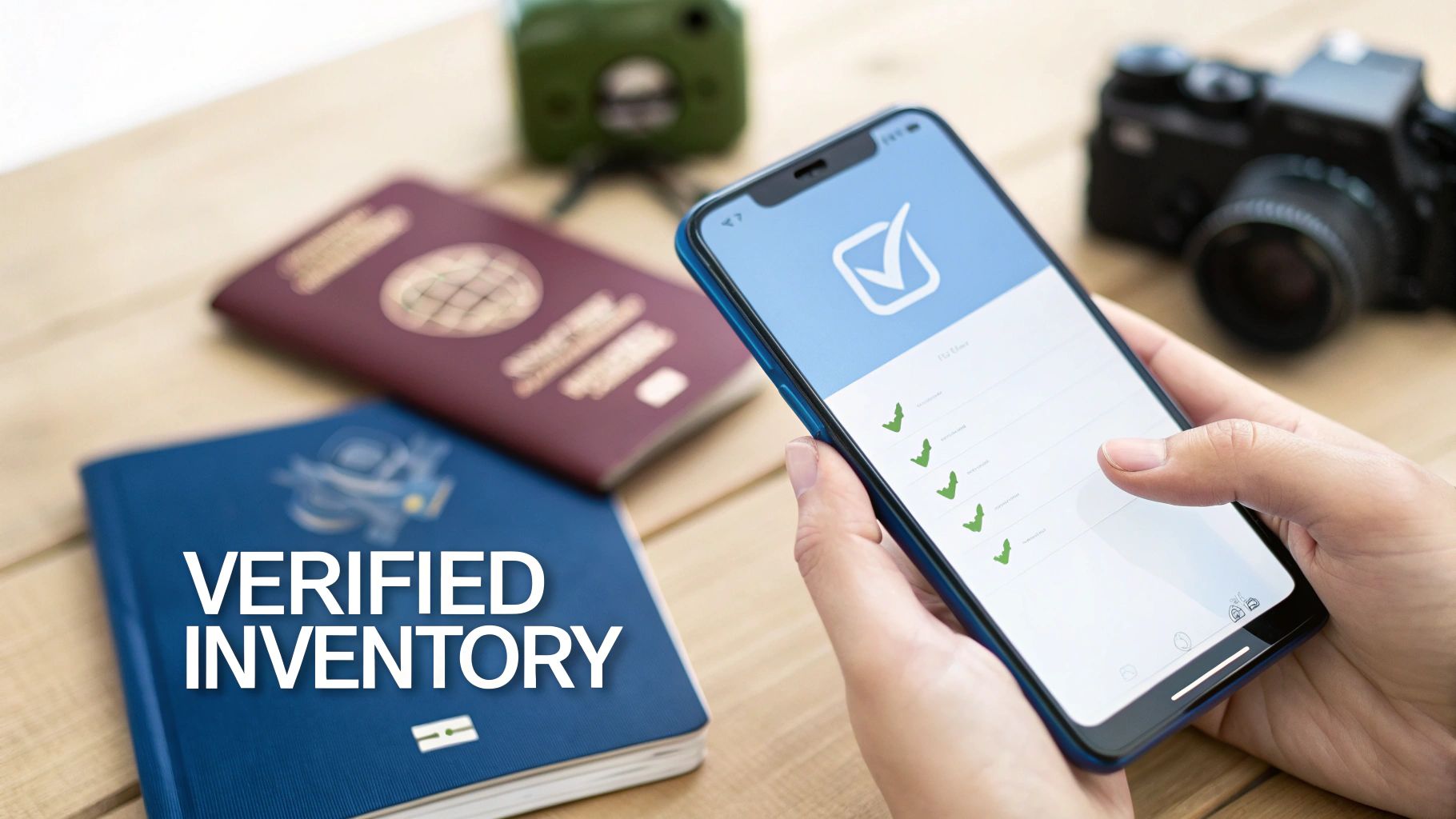
The primary point of friction in any property claim is proving ownership and value after a loss. This reactive, evidence-gathering process is inefficient, prone to dispute, and a significant vector for fraud. How can an insurer confidently pay a claim for a camera bought three years ago with no receipt?
This after-the-fact scramble for proof is a major operational headache. It consumes claims handlers' time, delays payouts for legitimate customers, and creates opportunities for after-the-event fraud (i.e., insuring an item that was already lost or damaged).
Shifting Verification from Post-Loss to Pre-Travel
The modern solution is to shift the point of proof from after the claim to before the trip. By empowering policyholders to catalogue their valuables using a verification platform like Proova, insurers can obtain a time-stamped, digital inventory of items at policy inception.
This flips the claims dynamic entirely.
- For the policyholder: The stress of finding old receipts is eliminated. Their evidence is organised, verified, and ready to share, which accelerates their payout.
- For the insurer: The ambiguity is removed. A verified inventory confirms an item’s existence and condition at the start of the policy, slashing investigation time, reducing the administrative burden, and mitigating fraud risk.
This technology creates a clear commercial advantage. The benefits of automated claims processing are well-established; pre-verified inventories are the next logical step to improving efficiency and accuracy.
How a Verified Inventory Reduces Handling Costs
In a high-volume claims environment, efficiency is paramount. A claim supported by a pre-verified digital inventory is processed fundamentally differently from one requiring manual investigation.
When an insurer receives a claim backed by a digital inventory, the process shifts from investigation to simple verification. This builds trust, mitigates fraud risk, and enables claims handlers to approve legitimate claims with confidence and speed.
This proactive approach directly reduces claims handling time and associated costs, improving the loss ratio. You can learn more about how AI is transforming claims for home, travel, and gadget insurance and making the entire system more robust.
By integrating pre-travel verification into the customer journey, insurers can effectively address a key driver of claims leakage before the policyholder even leaves their home.
Frequently Asked Questions for Claims Professionals
Navigating the complexities of travel insurance claims requires clarity on policy terms and procedures. Here are answers to common questions from a claims management perspective.
A robust claims process begins with a well-structured policy. Understanding how to choose the right travel insurance is the first step for the consumer, but for the insurer, the policy wording defines the boundaries of every subsequent claim decision.
How Long Do Policyholders Have to Make a Claim?
This is a critical procedural control. Most policies stipulate that the insurer must be notified of an intent to claim within a specific period, typically 28 to 31 days of the trip's conclusion. Enforcing this deadline is a key tool for preventing stale claims where evidence may be harder to verify. Missing this window provides clear grounds for rejection.
How Are Claims Handled Without Receipts?
Claims for low-value items may be processed with alternative evidence like bank statements, but this increases handling time. For high-value items, the absence of a receipt is a major red flag for fraud and significantly complicates valuation. This is the primary scenario where pre-travel documentation provides immense value. A verified, time-stamped digital record can serve as credible proof of ownership, turning a difficult case into a straightforward one.
What Is the Role of the 'Excess'?
The excess is the portion of the claim the policyholder must bear. For example, with a £100 excess on a £500 claim, the insurer's payout is £400. This is a risk management tool that discourages small, frivolous claims. It is typically applied per person, per incident , which can be a point of contention for customers if not clearly communicated at the point of sale. A high excess may reduce premium but also increases the risk of customer dissatisfaction when a claim is made.
How Does Alcohol Consumption Affect a Claim?
Nearly all policies contain a 'reasonable care' clause. Claims for accidents or losses that occur while the policyholder is under the influence of alcohol or non-prescribed drugs are almost always rejected on the grounds that they failed to take reasonable care. From an insurer's perspective, impairment due to alcohol invalidates the policyholder's side of the contract, as it directly increases the risk of loss.
A well-prepared claim is a low-cost claim. By encouraging policyholders to catalogue valuables with Proova before they travel, insurers can replace the high cost of post-loss investigation with the efficiency of pre-travel verification. This simple step reduces claims leakage, combats fraud, and allows claims teams to settle legitimate claims faster. Learn more at https://www.proova.com.