how does no claims bonus work: UK guide to discounts
A No Claims Bonus (NCB) – sometimes called a No Claims Discount – is one of the best tools UK drivers have for cutting down their insurance costs. At its core, it is a reward system from insurers. For every year you drive without making a claim, you get a discount on your premium.
Think of it as a financial thank you for being a safe, claim-free driver.
What Is a No Claims Bonus in Car Insurance?
A No Claims Bonus is a fundamental part of how UK car insurance premiums are calculated and it directly rewards responsible driving. The whole system is built on a simple idea: a long history of claim-free driving strongly suggests you are a lower risk to insure.
This creates a powerful incentive for drivers to be careful on the roads. It also makes you think twice about whether making a small claim is really worth it in the long run. The entire model hinges on being able to prove what happened in an incident which is why establishing fault accurately is so important.
The True Cost of Fraudulent Claims
Unfortunately, the NCB system is often a target for insurance fraud, especially 'crash for cash' schemes where criminals deliberately cause accidents. These scams do not just hurt the people directly involved; they send ripples across the entire insurance industry.
When insurers are forced to pay out on these bogus claims, their costs shoot up. That financial burden gets passed on to every single policyholder in the form of higher base premiums. In short, honest drivers end up paying for criminal activity. The Association of British Insurers estimates that undetected general insurance fraud costs the industry over £1 billion every year.
This makes every driver's commitment to honesty and clear evidence a shared responsibility. By making sure claims are legitimate and properly backed up, we not only protect our own NCB but also help keep costs down for everyone.
A No Claims Bonus is more than just a discount. It is a reflection of your driving history and a key factor in making insurance fair and affordable for responsible motorists. Protecting it means protecting your wallet and contributing to a more honest insurance system.
The chart below gives you a quick look at how fast the average discount can build up in just the first few years of claim-free driving.
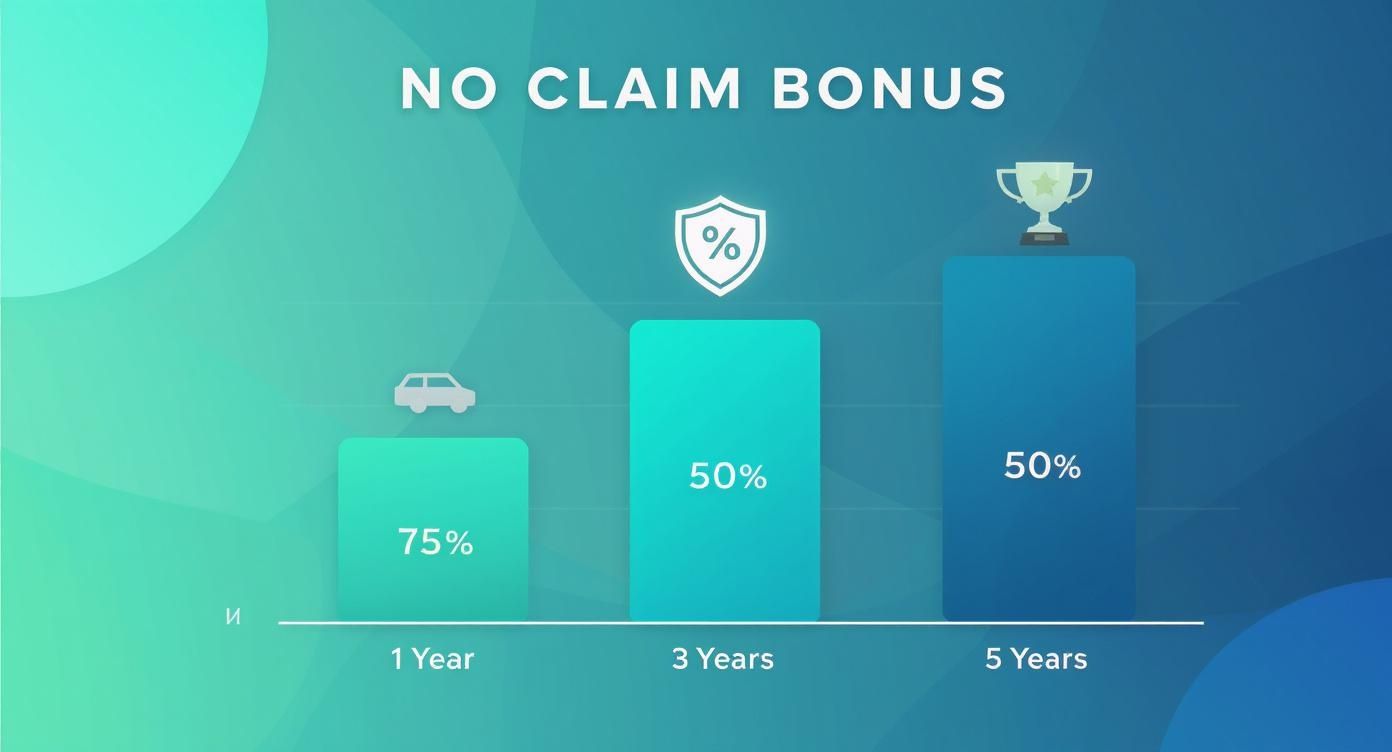
As you can see, even one year without a claim can lead to a healthy reduction in your premium and the savings really start to stack up from there.
How to Build and Grow Your No Claims Bonus
Building up a healthy No Claims Bonus (NCB) is actually pretty straightforward. It is all about rewarding you for being a careful driver. The journey starts the second your policy kicks off and from there, it grows year by year.
Think of it as a loyalty reward for your good driving. For every full 12-month period you drive without making a claim (or having one made against you), your insurer adds another year to your NCB. Simple as that. This steady, year-on-year growth is the core of how it all works.
And of course, each year you add translates directly into a bigger discount when you renew. It is hands-down one of the most effective ways to slash your insurance costs over the long term.
The Annual Growth of Your Discount
As your NCB years stack up, so does the discount on your premium. The exact percentages will differ from one insurer to the next but the principle is always the same: more claim-free years equals more money in your pocket.
A typical journey might look something like this: you could earn a 30% discount after just one year, which might jump to 40% after two and then 50% after three. The discount keeps climbing until it hits the insurer's ceiling. Most providers cap the NCB discount somewhere between five and nine years but the good news is you can keep that top-tier discount for as long as you remain claim-free.
This is not just a token gesture; it is a real financial reward for safe driving. The numbers clearly show a direct link between NCB years and lower premiums. For example, the average premium for a driver with no NCB is worlds apart from someone with a few years under their belt. You can dig deeper into the financial benefits of an NCB on MoneyWeek.
A driver starting with an average premium of approximately £1,374 can see this cost fall by over 40% to about £802 after five claim-free years. Reaching ten years can reduce the premium to around £544 , saving nearly £830 annually.
Proving Your Bonus and Managing Gaps
A common worry is what happens to your hard-earned bonus if you decide to switch insurers. Do not stress. Your NCB is yours, not the insurer's and it is fully portable between most UK providers. It is tied to you as the driver, not to the car you own.
When you move to a new insurer, you will just need to provide proof of your NCB. This is usually a painless process and can be done in a few ways:
- Your renewal invitation: The letter from your current insurer will clearly state how many years of NCB you have built up.
- A proof of NCB letter: You can simply ask your previous insurer for a specific document confirming your bonus.
- The cancellation letter: Often, the letter confirming the end of your old policy will include your NCB details.
One crucial thing to watch out for is any break in your insurance cover. If you stop driving for a while and do not hold an active car insurance policy, your NCB will usually expire after two years . If you get back on the road after that period, you will unfortunately be starting from scratch again. This rule really highlights how important it is to maintain continuous cover if you think you will be driving again within that two-year window.
How Making a Claim Affects Your Bonus

Making an insurance claim is never fun. It is often stressful and the thought of losing a hard-earned discount only adds to the pressure. But it is crucial to know that not every incident automatically wipes out your No Claims Bonus (NCB).
The outcome really hinges on one key factor: who is deemed to be at fault.
In the world of insurance, claims fall into two camps: fault and non-fault. Getting your head around this distinction is central to understanding what happens to your bonus. If you are in a prang that was clearly someone else’s fault—and your insurer successfully recovers every penny from their insurance company—it is logged as a non-fault claim .
In these clear-cut situations, your NCB is typically left untouched. The system is designed to protect innocent drivers from being penalised for something that was not their doing.
The Impact of an At-Fault Claim
The story changes completely when you are involved in an incident where you are considered at fault. An at-fault claim is any situation where your insurer has to pay out and cannot get the money back from another party.
This does not just mean accidents where you are to blame. It also covers things like theft or vandalism where there is no third party to hold responsible.
When this happens, insurers apply a standard penalty known as the 'step-back' rule. It is a common practice right across the UK insurance industry.
The step-back rule typically reduces your NCB by two years for a single at-fault claim. This industry-standard practice is designed to reflect the increased risk associated with a driver who has recently made a claim.
This reduction directly hits the discount you receive at renewal, leading to a noticeable hike in your premium. The system rewards careful, claim-free driving but it also has to adjust for a driver's recent claims history.
A Real-World Example of the Step-Back Rule
Let us picture a driver named Sarah. She has been driving carefully for five years and has built up a five-year NCB, giving her a hefty discount of around 60% on her premium.
Unfortunately, Sarah has a minor collision in a car park that is deemed her fault. After she makes a claim, her insurer applies the step-back rule.
- Initial NCB: 5 years
- At-Fault Claim: 1
- Step-Back Applied: -2 years
- Resulting NCB: 3 years
Overnight, Sarah's NCB drops from five years to three. At her next renewal, her discount might fall from 60% down to around 40% . This seemingly small change could mean her premium jumps by hundreds of pounds, making the financial sting of that one claim last for years.
The Critical Role of Evidence and Provability
This example shows just how important proving what happened really is. In any incident, establishing who was at fault is paramount. Without clear evidence, you risk being held partly or even fully responsible, even if you are certain you were not to blame.
This is where a bit of preparation and technology can be a lifesaver for your discount. Dashcams have become an invaluable tool, providing indisputable video evidence that can resolve disputes in an instant and prove you were not at fault.
Similarly, grabbing witness details at the scene or taking clear photos can make all the difference. To get the full picture, it helps to understand how to file an auto insurance claim properly. That knowledge, combined with solid evidence, is your best defence for protecting your NCB and ensuring claims are settled fairly.
Understanding NCB Protection and When to Use It
You have spent years building up a healthy no claims bonus, driving carefully to keep your premiums down. The thought of losing all that hard work after one small mistake can be infuriating. This is exactly where NCB Protection comes into play. It is a popular add-on that acts as a safety net for your hard-earned discount.
Essentially, you pay a little extra on top of your premium to buy yourself a layer of security. This protection lets you make one or two at-fault claims within a few years (the exact number depends on your insurer) without seeing your discount level plummet.
Think of it as taking out insurance on your insurance discount. It is a calculated risk, weighing the small, certain cost of protection against the potentially huge financial hit if you need to make a claim.
Is Protecting Your NCB a Smart Investment?
Deciding whether to pay for NCB Protection is a personal financial call. It is not the right move for everyone but it can be incredibly valuable in the right situation. The trick is to weigh the cost of the protection against the savings your NCB is actually giving you.
If you only have one or two years of no claims under your belt, the discount is pretty small. In that case, the extra cost of protection probably is not worth it. The financial sting of losing that small bonus would be manageable.
But for drivers who have been claim-free for years, the maths changes completely. When your discount is saving you hundreds of pounds every year, the risk of losing it all becomes a much bigger deal.
When Protection Offers the Most Value
NCB Protection really starts to make strategic sense once you have built up a significant discount. The higher your NCB, the more you have to lose financially from an at-fault claim.
Here are a few scenarios where protection is often a smart move:
- Drivers with Maximum NCB: Got five or more years of no claims? You are likely enjoying the highest possible discount. Protecting this asset makes a lot of financial sense.
- High-Mileage or Urban Drivers: If you spend a lot of time on motorways or navigating busy city streets, your statistical risk of a minor bump or scrape is naturally higher.
- Peace of Mind: For many drivers, the simple comfort of knowing that one slip-up will not undo years of careful driving is worth the extra cost alone.
The financial stakes are serious. Data shows that after five claim-free years, drivers can save up to 60% on their premiums, with some insurers pushing that discount closer to 75% . Drivers with just one year of no claims face average premiums around £1,076 . In contrast, those with five years see their premiums drop to roughly £675 —a saving of about £400 a year. Losing that discount after a single claim is a major financial blow, which makes protection a crucial decision. Find out more about how NCB protection works on brumble.co.uk.
A Critical Point to Remember
There is a common misconception about what NCB Protection actually does. It protects your discount percentage but it does not freeze your overall premium. This is a vital distinction.
NCB Protection saves your discount level, but your base premium can still increase after a claim. Your insurer will likely see you as a higher risk and this will be reflected in the underlying cost of your policy before the protected discount is applied.
Let us say you make an at-fault claim. Your insurer might raise your base premium from £800 to £1,000 at renewal to reflect your new risk profile. If you have a protected 60% NCB, that discount will be applied to the new, higher figure. Your NCB is safe but your total bill will still go up.
Insurance Fraud and the Cost to Honest Drivers
The No Claims Bonus system is built on a simple premise: rewarding careful, honest drivers. It is a system that works on trust. But where there is a reward, there is always someone looking to game the system and insurance fraud is a massive problem that ends up costing every single one of us.
When criminals find ways to get fraudulent payouts, the shockwaves ripple through the entire insurance industry. Those costs do not just disappear; they are passed straight back to honest customers through higher premiums. It means we all end up paying more, turning the fight against fraud into something that affects every driver in the UK.
How Fraudsters Exploit the NCB System
One of the most cynical ways fraudsters target the NCB system is through ‘crash for cash’ schemes. These are not accidents at all. They are premeditated, staged collisions designed purely to make bogus insurance claims. Often, an innocent motorist is deliberately targeted, becoming the fall guy in a setup designed to make them look entirely at fault.
These schemes can be alarmingly sophisticated. A common trick is for the criminal's car to brake suddenly and sharply for no reason, giving the driver behind no chance to stop. In the eyes of the insurer, without clear proof to the contrary, the person who drove into the back of them is usually deemed responsible.
For the victim, the fallout is huge. Beyond the shock and stress of a collision they could not avoid, they lose their hard-earned No Claims Bonus. This means their insurance premium will jump up significantly for years to come, all because of a criminal act.
The Critical Importance of Provability
In any insurance claim, proof is everything. The entire outcome boils down to one simple question: can you prove what really happened? Fraudsters thrive in ambiguity, creating situations where it is hard to assign blame definitively, leaving insurers to settle claims based on incomplete or outright false information.
Without solid evidence like dashcam footage or an independent witness, an innocent driver can easily be found at fault. This not only wipes out their NCB but also leaves a black mark on their claims history, branding them as a higher risk.
This is the exact vulnerability criminals are looking for. They know that without undeniable proof, an insurer might have to take their story at face value, leading to a fraudulent payout for them and an unfair penalty for you. Having provable evidence is your single best defence against these scams and the key to protecting your NCB.
The Hidden Costs Passed on to Everyone
Insurance fraud is far from a victimless crime. The financial damage is enormous and it is a cost ultimately shared by every honest policyholder. When an insurer pays out a fraudulent claim, that money has to be recouped from somewhere—and that "somewhere" is the collective pot of premiums paid by all of us.
The Association of British Insurers (ABI) estimates that undetected general insurance fraud costs the industry well over £1 billion every year. This staggering sum gets absorbed into insurers' running costs and is inevitably baked into the price of everyone's policy. The result? Premiums slowly creep up for all of us, no matter how good our driving record is.
This means that even with a spotless driving history and a maximum NCB, you are still paying a hidden 'fraud tax' within your premium. Every fake claim makes insurance a little bit more expensive for everyone. It is also why tackling all forms of insurance dishonesty, like the misrepresentation of risk known as 'fronting', is so important. You can learn more about this specific issue by reading our guide on what is fronting in insurance. By helping to expose and stop fraud, we are not just protecting our own NCB; we are contributing to a fairer, more affordable insurance market for every driver on the road.
How to Prove and Transfer Your No Claims Bonus

Building up a healthy No Claims Bonus is one thing but knowing how to manage it is just as important. Your discount is a valuable asset that is attached to you , not your car. When you decide it is time to switch insurers, you need to know the right steps to take your NCB with you.
The process is usually pretty straightforward. Your new provider will need official confirmation of your claim-free driving history from your previous insurer. Without it, they simply cannot apply the discount and you could see your premium jump significantly higher than the quote you were given.
Providing the Correct Documentation
When you move to a new insurance provider, they will ask for proof of your NCB. Thankfully, insurers make this easy and the information you need is never far away. You will typically need one of the following:
- Your renewal invitation: The letter or email from your old insurer inviting you to renew will clearly state how many years of NCB you have earned.
- A proof of NCB letter: You can simply ask your previous insurer for a dedicated letter or email that formally confirms your NCB status.
- Your cancellation letter: The document you receive confirming the end of your old policy often includes details of your final NCB.
Most insurers are happy to accept these documents digitally, which makes the whole transfer process quicker than ever. If you want to dive deeper into the specifics, this guide to proving your no claims discount has some really helpful information.
It is crucial to remember that your proof of NCB is typically only valid for two years . If you take a break from driving and do not have an active policy for longer than that, your hard-earned discount will likely expire. You will have to start again from zero.
Handling More Complex Scenarios
While transferring your bonus from a standard personal car policy is usually a breeze, some situations can get a bit more complicated. Navigating these scenarios means you will need to understand your insurer’s specific rules as they can vary quite a bit.
A common challenge is transferring a bonus you earned while driving a company car. If you had sole use of the vehicle and kept a clean record, many insurers will accept a letter from your former employer as proof. This letter needs to confirm the dates you were insured on their policy and give details of your claims history.
Similarly, trying to use an NCB earned abroad can be tricky. While some UK insurers might recognise a bonus built up in certain countries, it is definitely not guaranteed. You will need to provide official, translated documents from your overseas insurer and check directly with your new provider to see if they will honour it. Honesty is everything here—providing false information is insurance fraud and could invalidate your entire policy.
Your No Claims Bonus Questions Answered
The world of No Claims Bonus can feel a bit tangled but a few straightforward answers usually clear things up. Most drivers find themselves asking the same questions when it comes to the nitty-gritty of how their discount works.
Getting a handle on these details is more than just box-ticking; it is about making sure the system works fairly for everyone. When you understand the fine print, you are in a much better position to manage your policy and protect that hard-earned discount.
Can a Named Driver Earn a No Claims Bonus?
Traditionally, the No Claims Bonus has been the sole property of the main policyholder. But things are changing and a growing number of insurers are starting to recognise the good driving record of named drivers.
Some companies now offer what is called a ‘named driver NCB’. This can be a real leg-up, giving that driver a discount if they later take out their own policy with the same insurer. It is not usually a golden ticket you can take elsewhere, so always check the specific terms before you bank on it.
How Long Is My NCB Valid For?
If you take a break from driving, your NCB does not vanish into thin air immediately but it does have a shelf life. Most UK insurers will honour your discount for up to two years after a policy lapses.
Step outside that two-year window without taking out another policy and your NCB will expire completely. It is a tough pill to swallow but if you start driving again after that, you will be back at square one, building your discount from scratch.
Does a Windscreen Claim Affect My NCB?
In most situations, you can breathe easy. Making a claim for a windscreen repair or replacement will not affect your No Claims Bonus. The vast majority of comprehensive policies in the UK treat windscreen cover as a separate add-on.
That said, it never hurts to be sure. Always give your policy documents a quick scan. A handful of insurers might have different rules and it could count as a proper claim if you do not have specific windscreen cover built into your policy.
Your No Claims Bonus is generally safe if you claim for a chipped or cracked windscreen. Insurers see this as bad luck, not bad driving, so it does not usually flag you as a higher risk for future accidents.
What Happens if an Accident Was Not My Fault?
If you are in a collision that was clearly the other driver's fault, your NCB should come out unscathed. This all hinges on your insurer being able to recover every penny of their costs from the at-fault party's insurance company.
This is where proof becomes your best friend. Solid evidence like dashcam footage or statements from independent witnesses can make or break your case. Without it, a non-fault incident can quickly turn into a messy dispute, putting your discount at risk.
At Proova , we believe insurance should be clear and secure. Our platform helps you create an undeniable record of your insured items, making any future claims simple and fast. Protect what matters and ensure fair outcomes by visiting https://www.proova.com.