
Errors Omissions Insurance Explained for UK Businesses
Errors and omissions (E&O) insurance—or professional indemnity (PI) insurance , as it’s more commonly known here in the UK—is a specialist type of cover. It’s designed to protect your business against claims of negligence or mistakes made whilst delivering your professional services.
This insurance isn’t about admitting you’ve done something wrong. Think of it as a critical financial shield for those moments when a client claims your advice or work has caused them a financial loss.
Why Errors and Omissions Insurance Is Your Business Safety Net
Let’s say your business provides expert advice or designs critical systems for clients. You operate with the highest level of care but a simple human error, a misinterpretation of data or an unforeseen omission could lead to a client suffering a significant financial setback.
This is the exact moment a professional relationship can sour and turn into a legal battle. It’s also where errors and omissions insurance proves its worth, acting as an indispensable safety net.
This insurance is specifically designed to cover the staggering costs that come with a legal defence and any damages awarded if a client claims your service, advice or design fell short and caused them harm. For consultants, designers, tech firms and any professional providing a service for a fee, it is a non-negotiable part of modern risk management.

Protecting Against Honest Mistakes and False Allegations
Even the most diligent professionals can find themselves facing a claim. An architect can triple-check their blueprints but one minor calculation error could lead to costly structural issues down the line. A management consultant might give sound advice based on the data available but if market conditions unexpectedly shift, a client might still blame them for their losses.
Errors and omissions insurance is your defence against both genuine mistakes and baseless accusations. Defending your professional reputation can be financially draining and time-consuming, regardless of whether you are ultimately found liable.
The policy steps in to handle these situations, providing the funds for legal experts to manage the case. This frees you up to focus on running your business, rather than being consumed by a potentially ruinous legal dispute.
A Look at the Current UK Market
The good news is that securing this protection has become more accessible for UK businesses lately. The market for professional indemnity insurance has softened, with increased competition driving rates down.
According to Aon’s Q2 2025 UK Insurance Market Outlook, rates have fallen between 10% and 25% for many clients. This trend has also led to broader coverage options and fewer policy exclusions, making it an excellent time for businesses to lock in comprehensive protection. You can explore the full UK insurance market outlook for more detail on these developments.
This shift just goes to show how vital a robust policy is. It does not just protect individual businesses; it helps maintain stability across entire professional industries by offering a way to resolve disputes without businesses collapsing under the weight of a single claim.
Navigating the Difficult Landscape of Insurance Fraud
Insurance fraud isn’t a victimless crime. It is a direct and costly threat to every honest business. When we talk about errors omissions insurance , it is impossible to ignore the darker side of claims—the ones that are deliberately deceptive. This murky world stretches from clients subtly exaggerating their financial losses to individuals fabricating incidents from thin air.
The real problem for any professional is that proving a claim is fraudulent can be just as demanding and expensive as defending against a legitimate one. A baseless accusation can quickly spiral into a prolonged, draining investigation, pulling your focus and resources away from running your business. The provability of any claim, genuine or not, rests on clear evidence.
The Burden of Proof and Its Consequences
Picture this: you’re a marketing consultant who delivered a campaign for a client. A few months later, their product misses its sales targets. Instead of looking inwards, they decide to blame your strategy and file an E&O claim for a massive sum. You know your advice was solid and based on proper market research but they are adamant your negligence caused their losses.
Now, the burden of proof is on you. You have to retrieve every single email, report and meeting note to demonstrate your professional diligence. This isn’t just an administrative headache; it consumes billable hours, racks up legal fees and creates an incredible amount of stress for you and your team.
The harsh reality is that the mere act of defending a claim, whether legitimate or fraudulent, costs money. Insurers must fund investigations, legal teams and administrative processes and these expenses are inevitably passed on to all policyholders as a 'fraud tax'.
Even if you successfully prove the claim is baseless, the financial and emotional toll on your business can be huge. You might win the battle but you will still feel the hit to your productivity and morale.
Unravelling Different Types of Fraudulent Claims
Fraud in the professional indemnity world is not always some grand, elaborate scheme. More often than not, it appears in subtle ways, which makes it even harder to spot and challenge. It’s vital for businesses to know what to look out for.
Fraudulent claims generally fall into two categories:
- Opportunistic Fraud: This is the most common type. It happens when a client with a genuine, minor claim decides to exaggerate the extent of their financial loss to get a bigger payout. Think inflated invoices or claiming for business interruption that never really happened.
- Premeditated Fraud: This is far more deliberate and involves making up an entire incident from scratch. A client might forge documents or invent a story about professional negligence purely to get a payout from an insurance policy.
Telling the difference between a genuine error, an honest misunderstanding and deliberate deception is a massive challenge for insurers. Each scenario needs a careful, evidence-based approach to reach a fair outcome and this complexity is one of the biggest drivers of investigation costs in the industry.
The Collective Cost: The ‘Fraud Tax’
Every fraudulent claim that succeeds—and even those that are successfully defended—adds to a rising tide of costs for the entire insurance industry. Insurers are not abstract entities with bottomless pockets; they work by pooling everyone's premiums to pay out claims. When that pool is drained by deceitful activities, the only way to replenish it is to increase premiums for everyone else.
This is often called the 'fraud tax'. It’s a hidden cost that every honest business owner pays because of the dishonesty of a few. The more common fraud becomes, the more expensive essential cover like errors omissions insurance gets for the professionals who genuinely need it, impacting the entire industry.
Ultimately, tackling this is a collective responsibility. Whilst insurers invest heavily in detection methods, businesses also have a part to play by keeping meticulous records and promoting transparency. You can learn more about how insurance fraud is a growing concern for businesses and what you can do to protect your operations. By working together, we can help blunt the impact of fraud and keep insurance an affordable safety net for everyone.
The True Cost of a Professional Negligence Claim
A single professional indemnity claim can feel like an earthquake hitting your business. The final settlement figure, as big as it might be, is often just the epicentre. The real damage ripples outwards, hitting every part of your operations in ways that are far less obvious but just as devastating. Understanding these hidden costs is key to understanding why robust errors omissions insurance is not an expense—it is a critical investment in your company’s survival.
The most immediate and visible fallout is, of course, financial. Legal representation does not come cheap and defending a professional negligence claim can rack up eye-watering fees. These costs mount alarmingly fast, from initial consultations with solicitors to court costs and barrister fees if things escalate. Even if you win, you might not recover all your legal expenses.
Beyond the direct legal bills, there is the huge financial drain from lost productivity. Every hour you and your key people spend dealing with the claim is an hour you are not serving clients, bringing in revenue or growing the business. That distraction is a massive, unbillable cost.
The Unseen Toll on Your Business and Team
The financial bleeding is only part of the story. A professional negligence claim inflicts deep wounds on your most valuable asset: your reputation. Years spent building client trust and a solid name in the market can be wiped out overnight. News travels fast and the mere suggestion of negligence, whether it is valid or not, can scare off potential clients and make existing ones jittery.
This reputational damage has a long tail, affecting future business opportunities and potentially setting your growth back years. Rebuilding that trust is a slow, tough process that takes a huge amount of effort and investment.
Let's break down some of these often-overlooked costs:
- Lost Billable Hours: Just think of the time spent retrieving evidence, sitting in meetings with solicitors and preparing for hearings. This can easily add up to hundreds of hours of lost revenue-generating work for you and your senior team.
- Team Morale and Stress: A claim casts a cloud of anxiety over the entire business. It puts immense personal stress on the individuals involved, leading to burnout, lower productivity and a negative work environment that can poison the whole team.
- Increased Insurance Premiums: Even if your insurer covers the claim, it will almost certainly lead to higher premiums for your errors omissions insurance down the line. The claim flags you as a higher risk and that will be reflected in your renewal costs for years to come.
A negligence claim is not just a line item on a balance sheet. It is a direct assault on your business’s financial health, its reputation in the marketplace and the well-being of your team. The cumulative effect can be catastrophic for small to medium-sized enterprises.
Proactive Defence and Strategic Risk Management
Given what’s at stake, a reactive approach just won’t cut it. The best defence against a claim is stopping it from ever happening. This means embedding rigorous quality control, keeping meticulous records of all client communications and having clear, documented processes for every single project. These practices do not just reduce the odds of an error; they also give you the hard evidence needed to defend your corner if a claim does land on your desk.
To proactively reduce your exposure to professional negligence, it is crucial to explore effective risk management strategies and tools. You can compare the latest in top risk management software to find solutions that fit what your business needs. Putting these systems in place provides a structured way to manage project risks, document decisions and ensure professional standards are met every time, massively strengthening your defence against any potential allegations.
How Technology Strengthens the Claims Process
When a dispute over professional services begins, the whole issue often boils down to one simple question: who can prove what actually happened? In the fog of a disagreement, verifiable proof is your best friend. This is where modern technology is stepping in to completely change the game for how errors and omissions insurance claims are handled, putting honest professionals back in control.
New solutions are creating an unchangeable, timestamped record of professional advice and every bit of client communication. Think of this digital audit trail as a 'single source of truth' that both you and your insurer can depend on. It provides a crystal-clear, unalterable history of every interaction, decision and sign-off, making the provability of a claim's details straightforward.
Creating an Undeniable Digital Audit Trail
For any business defending itself against a claim of negligence or omission, this kind of evidence is invaluable. It lets you show, without a shadow of a doubt, that you followed the right procedures, gave solid advice and got the client's approval at every critical stage. Baseless or fraudulent claims simply fall apart when they come up against a concrete, chronological record of events.
This technology helps both you and your insurer by providing hard evidence to assess claims with far greater accuracy. An insurer can quickly get to the facts, separating genuine grievances from opportunistic claims. This slashes investigation times and reduces the associated costs, which ultimately helps keep premiums down for everyone.
By establishing a verifiable record right from the start, technology cuts through the ambiguity. It replaces the messy 'he said, she said' dynamic with a clear, factual account, paving the way for a faster, fairer resolution.
This visual breaks down the escalating costs that technology helps to control in an errors and omissions insurance claim, from the initial legal fees right through to the wider impact on business operations and reputation.
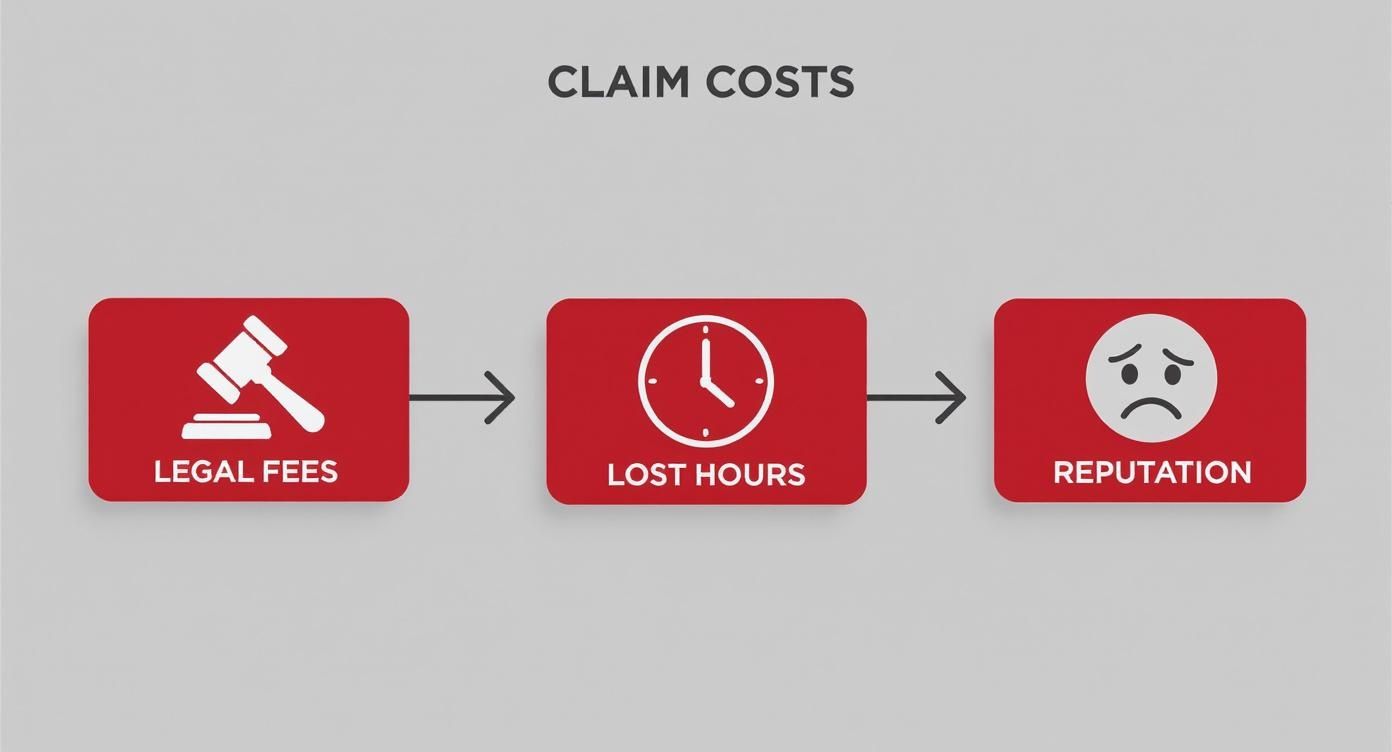
As the infographic shows, a claim's financial impact snowballs over time. That is why an efficient, evidence-based resolution is so vital for containing these expanding costs.
How Verifiable Records Impact Claims
The real-world benefits of having a digital 'single source of truth' are huge. It directly tackles the core challenges that make professional indemnity claims so complex and expensive, especially when fraud is involved. A system like Proova gives you a platform to document communications and milestones as they happen, not after a dispute has already erupted.
Just think about how this strengthens your position:
- Disproving False Allegations: A client claims they never saw a final design or did not approve a strategy. With a timestamped record of that exact communication, you have an irrefutable defence.
- Preventing Scope Creep Disputes: It provides clear evidence of the originally agreed scope of work. This stops clients from later claiming you failed to deliver services that were never part of the deal.
- Validating Timelines and Advice: A verifiable log proves you provided advice in a timely manner and that the client acknowledged it, shutting down claims of costly delays or miscommunication.
This level of detailed proof is not just for defending against claims. It also encourages better professional habits and clearer client communication from day one, which can stop many disputes from ever happening in the first place.
Driving Down Costs for Everyone
Ultimately, when this kind of technology becomes commonplace, the entire insurance ecosystem benefits. When insurers can resolve claims faster and with more certainty, their administrative and legal costs plummet. This reduction in overheads and fraudulent payouts leads to a more stable and affordable insurance market for all.
For you, the policyholder, the value is immediate. It means less time away from your business retrieving evidence, lower stress levels and a much stronger defence if a claim ever comes your way. By investing in tools that create verifiable records, you are not just buying software; you are actively contributing to a system that reduces risk and cost for everyone. You can discover more about the role of technology in reducing insurance claims costs and see how it builds a fairer system for honest businesses and insurers alike. This proactive approach helps to dismantle the 'fraud tax' that unfairly penalises everyone for the dishonesty of a few.
Meeting Your Duty of Disclosure to Secure Valid Cover
An insurance policy is not just another business transaction. At its heart, it is a contract built on trust and complete transparency. The absolute cornerstone of this relationship is the duty of disclosure , a legal principle that every UK business owner needs to understand when arranging cover. Put simply, it’s your obligation to give your insurer all the relevant information when you apply.
Getting this wrong, even accidentally, can have devastating consequences. The insurer could have grounds to void the policy entirely, refusing to pay a claim right when you need that support the most. That is why understanding what you need to share is a fundamental part of securing errors and omissions insurance that you can actually rely on.
What Counts as Material Information?
The core of your duty is to disclose all ‘material information’. So, what does that mean? It’s any fact that would influence an underwriter's decision on whether to offer you cover and, crucially, on what terms. We are not talking about minor, everyday details but significant information that paints an honest picture of the risks your business faces.
Try to see it from the insurer's perspective. To price a policy fairly, they need the full story. This includes the details of your business activities, your financial history and any past claims or difficult situations that could potentially lead to one. Hiding or glossing over these facts shatters the foundation of the insurance agreement.
For instance, failing to mention a past disagreement with a client, even if it never became a formal claim, could be seen as a material non-disclosure. If a similar problem arises later, the insurer might argue that if they had known about the first dispute, they would have charged a higher premium—or perhaps not offered you cover at all.
Avoiding Common Disclosure Pitfalls
A rushed application is a recipe for disaster. Taking the time to be thorough and accurate from the outset will save you a world of pain later on. A carefully prepared application is your best defence against future disputes.
Here are a few practical steps to make sure you’re providing a fair and complete picture of your risk:
- Don’t wait to be asked. If you know something is relevant to the risk you’re asking an insurer to take on, you should disclose it. Be proactive.
- Get others involved. The person filling out the proposal form might not have the full picture. Involve senior staff from different areas of the business to ensure all the important details are captured.
- Keep good records. Document the information you provide and any conversations you have with your broker or insurer. This can be invaluable if a disagreement arises later.
A major hurdle for many businesses is simply figuring out what actually qualifies as ‘material’. The Law Commission’s consultation on insurance contract law found that non-disclosure is still a huge issue for UK businesses. Many policyholders are genuinely unsure about their duty, which leads to rejected claims and coverage gaps. You can read the consultation summary on business insurance issues for a deeper dive into their findings.
Before we move on, it is worth flagging some of the standard things a Professional Indemnity policy won't cover. Knowing these exclusions upfront helps you understand where your responsibilities lie.
Common E&O Policy Exclusions to Watch For
This table summarises some of the usual exclusions found in UK policies. Being aware of these helps you manage your risk better.
| Exclusion Category | What It Typically Means | Why It's Important |
|---|---|---|
| Prior and Pending Litigation | Claims arising from legal issues that you were aware of before the policy started are not covered. | You cannot buy insurance for a problem that has already started. This reinforces the need for upfront disclosure. |
| Contractual Liability | The policy will not cover liability you have voluntarily accepted in a contract that goes beyond your normal legal duty of care. | Always review client contracts carefully. Do not promise more than your insurance will back up. |
| Dishonest or Fraudulent Acts | Deliberate, criminal or fraudulent actions by you or your employees are always excluded. | E&O insurance is for mistakes and negligence, not intentional wrongdoing. This is a standard moral hazard clause. |
| Bodily Injury/Property Damage | E&O typically covers financial loss, not physical harm to people or damage to tangible property. | You need separate Public and Employers' Liability insurance for these types of physical risks. |
| Insolvency | Claims arising directly from the insolvency or bankruptcy of your business are usually not covered. | The policy is designed to protect third parties from your professional errors, not to act as a financial guarantee for your business. |
These are just examples and every policy is different, so always read the fine print of your specific contract.
Ultimately, the test is simple: if you were the underwriter, would this piece of information affect your decision? If the answer is yes, or even maybe, you must disclose it. Being overly transparent is always the safest approach.
Failing to meet this standard can have serious repercussions and is one of the main reasons why an insurance company might refuse to pay a claim. By being diligent and honest from the beginning, you ensure your errors and omissions insurance policy is a reliable safety net, ready to do its job when you need it most.
Specialist E&O Risks in the UK Technology Sector
The UK’s fast-moving technology sector is a unique minefield of risks. For businesses in software development, AI services or cyber security, a simple error or omission can trigger colossal financial losses for a client. A standard professional indemnity policy often just cannot keep up.
These traditional policies were built for architects or accountants, not for companies whose mistakes could lead to catastrophic data breaches or system-wide service failures. Generic errors omissions insurance was not designed for these digital-age threats, making specialist cover an essential tool for survival, not just a nice-to-have.
Defining the Unique Risks of Technology Firms
Let's look at a few scenarios you will only find in the tech world. Imagine a software development firm releases a product with buggy code. That code then crashes their client’s entire e-commerce platform during the Black Friday sales rush, causing millions in lost revenue.
Or consider an AI consultancy that develops a flawed algorithm. Unbeknownst to them, it produces biased outputs, leading their client into discriminatory hiring practices and a messy lawsuit. These are not straightforward negligence claims; they are intricate failures with massive, cascading consequences. The situations often involve thorny issues like intellectual property disputes or service outages that expose sensitive customer data.
The UK's tech scene has seen a massive surge in demand for specialist errors and omissions insurance , driven largely by the explosive growth of AI and other digital services. Reflecting this, leading cyber risk company Resilience recently expanded its Tech E&O insurance coverage in 2025 to UK clients with revenues over £50 million. This move highlights the escalating financial stakes in sectors like fintech and software, with firms now able to secure up to £10 million in protection. You can learn more about this expanded Tech E&O coverage and what it signals for the industry.
The Blurring Lines Between E&O and Cyber Liability
One of the biggest headaches for technology leaders is the increasingly hazy line between professional indemnity and cyber liability. If your software service fails and directly causes a client’s data breach, where does one policy end and the other begin?
A standard PI policy might have exclusions for data-related incidents, whilst a standalone cyber policy might not cover the initial professional error that caused the breach. This leaves you dangerously exposed right in the middle.
For a tech business, a policy that integrates both professional indemnity and cyber liability is crucial. This combined cover ensures there are no dangerous gaps between policies, providing a single, coherent defence against the multifaceted risks that define the industry.
Tech leaders must seek out modern policies that explicitly cover these intertwined risks. Without this specialist cover, innovators and their businesses are left vulnerable to the very threats their groundbreaking work can sometimes create.
Common Questions About Errors & Omissions Insurance
When you are running a professional services business, navigating the world of professional indemnity can feel like a minefield. Let's clear up some of the most common questions that arise about errors & omissions insurance here in the UK.
What Is the Difference Between E&O and Professional Indemnity?
Honestly, in the UK, there's no real difference. The two terms are pretty much interchangeable. You'll find that Professional Indemnity (PI) insurance is the standard name used over here.
"Errors and Omissions" is a term you'll hear more often in the US but it covers the exact same ground—protecting you and your business from claims of professional negligence or mistakes.
How Much Cover Do I Actually Need?
This is the million-pound question and the answer is always "it depends". The right amount of cover hinges on a few key things: your industry, the value of the contracts you handle and what your clients demand.
Often, a professional body or a client contract will state the minimum level of indemnity you need. If not, a good rule of thumb is to look at your biggest contract and ask yourself: what’s the absolute worst-case financial fallout if a mistake made the whole project a write-off? That figure gives you a solid starting point for assessing your risk.
Start by thinking about your largest client or project. If a critical error on your part caused maximum financial damage to them, what would that number look like? That is your baseline for deciding on a suitable cover limit.
Is Errors & Omissions Insurance Legally Required?
For some professions, absolutely. If you are a solicitor, architect or financial adviser in the UK, having professional indemnity insurance is not just a good idea—it is a mandatory requirement set by your regulatory body.
For many others, it is not legally compulsory. However, you will quickly find it is a non-negotiable part of winning work, especially with larger corporate clients or public sector organisations. They will not even consider you without it.
If you want to get a better feel for how different policies fit into the bigger picture of business protection, you can explore some common insurance questions. But whether it is required by law or a client, having this cover is simply a cornerstone of responsible risk management for any professional services firm.
At Proova , we provide the tools to build a verifiable, timestamped record of your professional interactions, strengthening your position against unfair claims. Secure your professional reputation by visiting https://www.proova.com.