A UK Business Guide to Insurance for Fraud
When people talk about "insurance for fraud", it is easy to get the wrong idea. This is not about getting cover to commit fraud but rather getting protection from it. Think of it as a financial safety net for UK businesses when dishonest employees or external criminals find a way through their defences, causing what can be devastating financial and reputational harm. Getting this distinction right is the first step toward properly safeguarding your company.
The Growing Threat of Business Fraud
Fraud is a silent but incredibly effective drain on businesses across the United Kingdom. It hides in the shadows of everyday transactions—from doctored invoices to slick impersonation scams—and quietly eats away at profits and stability. For too many organisations, the true cost only becomes clear after the damage is already done.
This is not just a minor headache; it is a massive economic problem. The sheer scale of insurance fraud in the UK shows just how widespread these deceptive activities have become. In fact, the total value of detected fraudulent claims now consistently tops £1 billion every single year. That figure, highlighted by the Association of British Insurers (ABI), shows the immense pressure on the industry, which ultimately trickles down to every single policyholder, increasing costs for all of us.
The Real Cost to Businesses and the Industry
The fallout from fraud goes far beyond the initial cash loss. Each successful scheme adds to a higher-risk environment, which in turn forces insurers to push up premiums for everyone. It is a ripple effect; one fraudulent act spreads the cost across the entire pool of insured businesses.
This financial hit is then compounded by other damages that are harder to put a price on but are just as severe. A business hit by fraud can expect to suffer from:
- Reputational Damage: Losing the trust of clients, suppliers and investors can cripple business growth for years to come.
- Operational Disruption: The time and resources needed to investigate and recover from fraud are immense, pulling focus away from core business activities.
- Employee Morale: When fraud happens internally, it can breed a culture of suspicion and distrust, wrecking team cohesion and productivity.
The Challenge of Proving a Loss
A central, unavoidable theme in any discussion about insurance for fraud is the absolute need to prove a loss . An insurance policy is a contract that only responds to verifiable events. If you cannot provide clear, compelling evidence that fraud occurred and directly caused a specific financial loss, your claim is almost certainly going to be rejected. As we explore in our guide, insurance fraud is a growing concern for businesses precisely because of this challenge.
This is where so many businesses stumble. In the chaos that follows the discovery of a crime, crucial evidence can be lost, overlooked or compromised. Without a solid, provable claim, even the most comprehensive insurance policy is useless. The business is left to carry the full cost of the crime, alone.
Decoding Your Fraud Insurance Options
Navigating the world of insurance for fraud can feel like learning a new language. With so many overlapping terms and specific policy functions, it is easy to get lost but the core idea is simple: you need to match the right type of protection to the specific risks your business faces, whether they come from inside your company or from external criminals.
Think of it as picking the right tool for a job. You would not use a hammer to fix a leaky pipe, would you? In the same way, the insurance you need to protect against a dishonest employee is worlds away from the cover required for a sophisticated cyber-attack. Getting these distinctions right is the first step toward building a truly resilient financial defence.
This section will demystify the main types of fraud insurance. We will break down what each policy is designed to do, using real-world scenarios to show you how they work in practice. By the end, you will be able to confidently identify the protection your business truly needs.
Fidelity Insurance: The Internal Threat
The most fundamental form of insurance for fraud is often Fidelity Insurance , sometimes called a Fidelity Guarantee policy. Its focus is singular and incredibly important: it protects your business against direct financial losses caused by the fraudulent or dishonest acts of your own employees. This is the classic "insider threat" cover.
Imagine a trusted accounts manager has been creating 'ghost' invoices for a non-existent supplier, funnelling the funds into their own bank account for months. When this finally comes to light, the financial hit could be substantial. A Fidelity Insurance policy is built for this exact scenario, covering the stolen funds once the theft is proven.
Commercial Crime Insurance: Broader Protection
While Fidelity cover is essential, it leaves a big gap. What about fraud committed by people outside your organisation? This is where Commercial Crime Insurance comes in. It is a much broader policy that usually includes the cover from a Fidelity policy but extends it to guard against a range of external criminal acts.
A Commercial Crime policy can protect against losses from schemes including:
- Forgery or Alteration: When a criminal forges a signature on a company cheque or alters a payment instruction.
- Computer Fraud: Direct losses from an outsider hacking into your systems to illegally transfer money.
- Counterfeit Currency: Losses your business takes when it unknowingly accepts fake money.
This policy acts as a wider shield, acknowledging that threats are just as likely to come from outside your walls as from within.
Cyber and Social Engineering: Specialised Cover
The digital age has ushered in new and insidious forms of crime that traditional policies simply were not built to handle. This has led to the rise of more specialised insurance products.
Cyber Insurance is a critical policy covering a wide array of risks tied to your digital operations, including data breaches and network shutdowns. While some policies include elements of financial fraud cover, its primary focus is on protecting your digital assets and covering liability.
A more specific and increasingly vital form of cover is for Social Engineering Fraud . This targets scams where an employee is tricked into willingly transferring company funds to a criminal. The classic example is a "CEO fraud" email, where a fraudster impersonates a senior executive and urgently instructs a junior finance employee to pay a new supplier. Because the employee technically authorises the payment, it can fall into a grey area for standard crime policies. A dedicated social engineering extension is designed to fill this gap, covering losses from such deception.
To help you see how these policies stack up against different risks, here is a quick comparison.
Comparing Key Fraud Insurance Policies
This table breaks down the primary focus of each policy type, making it easier to see where your business might be vulnerable.
| Policy Type | Primary Risk Covered | Typical Scenario Example |
|---|---|---|
| Fidelity Insurance | Internal employee theft or dishonesty | An employee creates fake invoices and pays the money to their own account. |
| Commercial Crime | External criminal acts and internal fraud | A criminal forges a director's signature on a cheque to steal funds. |
| Cyber Insurance | Digital risks, data breaches and network liability | A ransomware attack encrypts company data, demanding payment for its release. |
| Social Engineering | Deception-based fraud targeting employees | An employee is tricked by a fake CEO email into transferring funds to a fraudster. |
Understanding these distinctions ensures you are not just buying insurance but investing in the right protection for the most likely threats you will face.
The infographic below shows how insurance forms one of the critical layers of business defence.
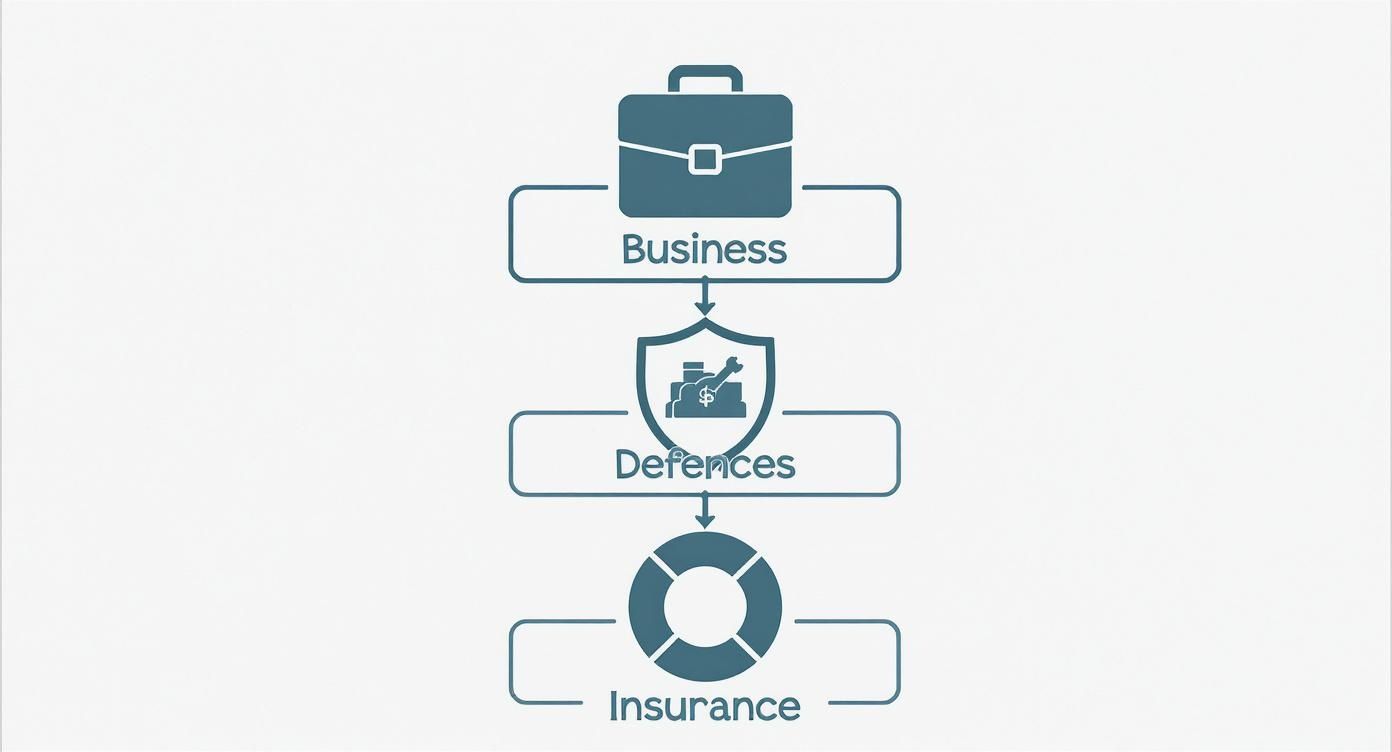
This visual drives home a key point: while internal defences are your first line of protection, insurance acts as the ultimate safety net when those defences are breached. As criminals find clever new ways to bypass internal controls, the role of insurance becomes even more critical for business survival. Forward-thinking insurers are developing new strategies to combat these evolving threats and better protect their clients.
What a Fraud Insurance Policy Really Covers
An insurance policy document is a promise but until you dig into the fine print, you do not really know what is being promised. When you buy insurance for fraud, you are not getting a magic shield against every possible business loss; you are buying a specific set of guarantees to cover very specific types of crime.
Getting past the sales pitch is the only way to set realistic expectations for what happens when you actually need to make a claim.
At its heart, a fraud policy is there to reimburse you for the direct financial hit from a criminal act. That is the most straightforward part. If someone steals money from your business account through a proven act of fraud, the policy’s job is to make you whole again.
But the real cost of fraud often goes far beyond the stolen cash. You will almost certainly need to launch a proper investigation to unravel the crime and prove your loss and that does not come cheap. That is why many good policies also cover these associated costs.
What Is Typically Included
While the details vary from one insurer to another, any quality commercial crime or fidelity policy will cover a core set of expenses. These are the inclusions designed to help your business get back on its feet, both financially and operationally.
You can generally expect cover for:
- Direct Financial Loss: This is the headline act. It covers the actual amount of money or securities stolen by an employee or an external fraudster.
- Forensic Investigation Costs: Policies often cover the reasonable fees for bringing in forensic accountants or digital investigators. Their job is to pinpoint how the fraud happened and calculate the exact loss, which is essential for building a solid claim.
- Legal Fees: Cover can also extend to the legal costs of trying to recover the stolen funds or defending your business if the fraud leads to third-party claims against you.
The sheer volume of criminal activity makes this protection more critical than ever. In the first half of one recent year, a single major UK insurer identified £92.6 million in fraudulent activity. That was a 34% jump involving over 15,800 separate cases, which gives you an idea of how busy the criminals are. You can learn more about these worrying fraud trends and the growing challenge for insurers.
Common Policy Exclusions to Understand
Knowing what your policy does not cover is just as important as knowing what it does. Exclusions define the boundaries of your cover and ignoring them can lead to a rejected claim and a nasty financial surprise. They are a reminder that insurance for fraud is a specialist tool, not a catch-all safety net.
Policy exclusions are not there to trick you. They exist to clearly define the risk the insurer has agreed to take on. Understanding them is just responsible risk management.
Here are a few common exclusions you are likely to see:
- Indirect or Consequential Losses: The policy will cover the money that was stolen but it will not cover the lost business opportunities, reputational damage or decline in share price that might follow.
- Acts by Partners or Directors: Fraud committed by senior partners or major shareholders is often excluded. The thinking here is that they are considered to be acting as the company, not against it.
- Losses Discovered Out of Period: Policies have strict timelines. A claim usually has to be for a loss that was both committed and discovered within the policy period (or an agreed-upon discovery window).
- Unexplained Losses: If you cannot prove a financial shortfall was the direct result of a specific fraudulent act, it probably will not be covered. A hole in your accounts from shoddy bookkeeping is not the same as a proven crime.
Taking the time to read and properly understand these inclusions and exclusions is not just a box-ticking exercise. It is the only way to be confident that your insurance for fraud will actually do its job when you need it most.
Securing Your Policy and Making a Claim

Getting insurance for fraud is not just about signing a piece of paper; it is a two-way street. Before any insurer will offer you a policy, they need to get a clear picture of the risk your business presents. This process, known as underwriting, is basically a deep dive into your company’s internal defences.
Insurers are not just selling a product; they are entering into a partnership. They need to be confident that you are already taking sensible, proactive steps to protect yourself. A business with robust internal controls is seen as a much lower risk, which often translates into better policy terms and more affordable premiums.
The Underwriting Assessment: What Insurers Look For
During the underwriting stage, an insurer will scrutinise several key areas of your business. Their goal is to build a complete picture of your fraud prevention posture, so expect them to ask some very detailed questions about your procedures and safeguards.
A strong application will show you have got a handle on three core areas:
- Internal Financial Controls: This is absolutely critical. Insurers want to see hard evidence of things like dual authorisation for payments, regular account reconciliations and proper segregation of duties. As a simple example, the person who raises an invoice should never be the same person who signs off on the payment.
- Employee Vetting and Training: Your team is your first line of defence. Underwriters will look for proof of background checks on staff in sensitive roles and, just as importantly, ongoing training programmes that teach employees how to spot threats like phishing emails and social engineering scams.
- Cybersecurity Measures: In today’s world, solid digital defences are non-negotiable. This means having up-to-date antivirus software, firewalls and clear protocols for how your team should handle suspicious emails and manage data access.
Think of this whole process as a health check for your business. By demonstrating strength in these areas, you not only secure better insurance cover but you also actively lower your chances of becoming a victim in the first place.
Responding When Fraud Strikes
Discovering your business has been hit by fraud is a chaotic and deeply stressful experience but the actions you take in those first few moments are critical—they can literally make the difference between a successful claim and a flat-out rejection. Your response has to be swift, methodical and focused on preservation.
The second you even suspect fraud, a clear chain of action must begin. Panic is the enemy of proof and you need undeniable proof to make a successful claim. The entire process hinges on your ability to present a clear, evidence-backed story of what happened and how much you lost.
The single most important rule when fraud is discovered is to act immediately but thoughtfully. Preserve everything, notify everyone necessary and prevent any further loss. A calm, organised response is your greatest asset in building a successful claim.
A structured approach ensures nothing gets missed. Following a clear, step-by-step process will secure your position and give your insurance claim the best possible chance of success.
Building Your Insurance Claim
A successful insurance claim is built on a foundation of solid evidence and timely communication. Follow these steps to navigate the process effectively:
- Immediate Notification: Your very first call should be to your insurer or broker. Every policy has a strict notification clause and delaying this step could put your cover at risk. Let them know what has happened, even if you do not know the full extent of the damage yet.
- Prevent Further Losses: Take immediate action to stop the bleeding. This might mean freezing bank accounts, revoking an employee's system access or shutting down a compromised part of your network. Make sure you document every single action you take.
- Preserve All Evidence: This is the most crucial step of all. Do not delete suspicious emails or alter any financial records. Secure computers, log files, bank statements and any messages related to the fraud. You have to treat the situation like a crime scene—because that is exactly what it is.
- Cooperate Fully: Your insurer will likely appoint a loss adjuster or a forensic accounting firm to investigate the incident. You must provide them with full access to your records, systems and personnel. Full and transparent cooperation is not just helpful; it is a requirement of your policy.
Ultimately, the insurer's decision will hinge on the quality of the proof you provide. A disorganised or incomplete submission just makes it harder for them to validate your loss. However, even with strong evidence, disputes can arise. If you want to understand more, explore our guide on why your insurance company might refuse to pay a claim and what you can do about it.
Proactive Prevention and Common Fraud Schemes

Insurance for fraud is your financial backstop but it should always be the last line of defence. Your first and most critical protection is a solid internal prevention strategy. By getting inside the mind of a criminal, you can build stronger walls around your business and make it a much less appealing target.
The threats are very real and growing more common by the day. Criminals thrive on predictability and human error, expertly exploiting gaps in company procedures. To fight back effectively, you need to make these abstract risks feel tangible for your entire team.
Common Schemes Targeting UK Businesses
Fraudsters tend to rely on a surprisingly small playbook of highly effective scams. Recognising their go-to moves is the first step toward building a proper defence. They often mix simple deception with clever technical tricks to sidestep standard security measures.
Here are three of the most prevalent fraud types you are likely to come across:
- Invoice Redirection Fraud: A criminal poses as one of your legitimate suppliers. They will send a professional-looking email—often from an address that is almost identical to the real one—informing you their bank details have changed. Your accounts team, acting in good faith, updates the record and the next payment goes straight to the fraudster.
- CEO Impersonation Scams: This is a classic social engineering attack. A scammer spoofs the CEO’s email and sends an "urgent and confidential" request to someone in finance. The message is designed to create panic, demanding an immediate transfer for a secret acquisition or a late tax bill, pressuring the employee to bypass normal payment controls.
- Payroll Fraud: This internal threat involves an employee manipulating the payroll system. They might create "ghost" employees and pay salaries into their own accounts or they could inflate their own hours or bonuses over time, siphoning off funds in small increments that are tough to spot.
These schemes often work because they prey on trust and urgency. A strong set of internal controls is the key to stopping them before a loss occurs—a factor that is also vital for proving your case if the worst should happen.
Best Practices for Fortifying Your Defences
A proactive security posture is not about a single piece of software; it is about creating layers of control and a company-wide culture of vigilance. Having a robust control framework is also your best argument to an insurer that you took all reasonable care.
To strengthen your business, focus on these practical best practices:
- Implement Dual Payment Controls: Never allow one person to both set up a new payee and authorise a payment. Requiring a second, senior staff member to sign off on any new or amended bank details creates a powerful barrier against invoice redirection.
- Conduct Regular Audits: Carry out periodic and unannounced reviews of payroll records, supplier lists and expense claims. This unpredictability makes it much harder for internal fraudsters to cover their tracks and sends a clear signal that accounts are being watched.
- Train Your Staff Relentlessly: Your employees are your human firewall. Consistent training on how to spot phishing emails, verify unusual payment requests and handle sensitive data is non-negotiable. Teach them to be healthily sceptical and to always confirm urgent demands via a known phone number.
A crucial element in the fight against fraud is tackling the misuse of personal data. Identity theft has become a major driver of insurance fraud in the UK, with a seven-fold increase in stolen details used for insurance scams since 2021. The Insurance Fraud Bureau (IFB) has reported that identity theft is now a leading cause of fraudulent insurance applications and claims, particularly in organised fraud networks. You can read the full report on UK policy fraud hotspots.
By embedding these controls into your daily operations, you make fraud significantly harder to pull off. To further bolster your defences against digital deception, it is worth exploring effective phishing prevention strategies.
Got Questions About Fraud Insurance? We've Got Answers.
When it comes to protecting your business from fraud, it is natural to have questions. Getting to grips with the finer points of fraud insurance can feel complicated but understanding the basics is the first step toward building a solid defence.
Here are some of the most common queries we hear from business owners, broken down into simple, straightforward answers.
Is Fraud Insurance the Same as Fidelity Guarantee Insurance?
Not quite, though they are definitely related and the terms are often used interchangeably. Think of it this way: a Fidelity Guarantee policy is your dedicated protection against the internal threat—dishonest acts committed by your own employees.
"Insurance for fraud" is a much broader umbrella, usually referring to a Commercial Crime policy. This typically wraps in the fidelity cover for employee theft but also extends to crimes committed by outsiders. We are talking about things like forgery, computer hacking or the increasingly common social engineering scams. Always, always check the policy wording to see exactly what you are covered for.
I've Just Discovered Fraud. What's the First Thing I Should Do?
Your absolute priority is to stop the bleeding. Act immediately to prevent any more losses. That could mean freezing a compromised bank account, revoking an employee's system access or shutting down a vulnerable part of your network right away.
Next, you must notify your insurer. Do not delay. Nearly every policy has a strict notification clause and waiting could jeopardise your entire claim. At the same time, start gathering all the evidence you can find—fraudulent emails, doctored invoices, bank statements—without changing a thing. It is also wise to get legal advice to understand your obligations and consider reporting the crime to Action Fraud or the police.
Does My Small Business Really Need Fraud Insurance?
In a word: yes. Small and medium-sized businesses (SMEs) are often seen as prime targets by criminals. Why? Because fraudsters assume you have fewer security controls and less dedicated resources to fight back compared to a large corporation. You are perceived as an easier mark.
A single, major fraud—like a sophisticated invoice redirection scam—could be financially crippling for an SME. While the premium is a business cost, you have to weigh it against the catastrophic damage of an uninsured loss. The good news is that many insurers now offer scalable policies built specifically for the risks smaller businesses face.
There is a dangerous misconception that insurance is an unnecessary expense for a well-run small business. The reality is that it is a critical financial safety net. Fraud has become an industrial-scale problem and even the most diligent companies get hit. The cost of a policy is a drop in the ocean compared to the potential loss from one successful attack.
How Do I Prove a Social Engineering Fraud Claim?
Proving a social engineering or 'impersonation' claim boils down to one thing: clear, detailed documentation that tells the story of how the deception happened. This type of fraud is all about tricking an employee, so your evidence needs to reconstruct that entire fraudulent narrative for the insurer.
To build a watertight claim, you will need to pull together:
- The Full Communication Trail: This means every fraudulent email, a record of any deceptive phone calls or transcripts of other messages used in the scam.
- Proof of Financial Transfer: You will need the bank confirmations showing money leaving your account and landing in the fraudster’s.
- Evidence of Good Faith: Your insurer will want to see that your staff were tricked while acting in good faith. You need to show you had reasonable payment procedures in place, even if the fraudster cleverly bypassed them.
- An Internal Report: A detailed write-up of your own internal investigation, outlining the sequence of events and the immediate steps you took, will add serious weight to your claim.
The ability to prove these claims is everything. Without a clear evidence trail, it is incredibly difficult for an insurer to tell the difference between a sophisticated scam and a simple payment error. In a crisis, meticulous record-keeping becomes your most powerful asset.
Proova provides a simple yet powerful way to document and verify assets before a loss ever occurs. By creating an undeniable, time-stamped record of what your business owns, you can accelerate the underwriting process, prevent after-the-event fraud and ensure any future claims are paid faster. Secure your business and prove your position with confidence. Learn more about how Proova can help.