
How a List of Contents Template Fuels Claims Leakage (And How to Stop It)
A simple list of contents template is often seen as a consumer tool—a document to record belongings for an insurance policy. From an insurer's perspective, this is a dangerous misconception. A list created after a fire or burglary is a notoriously unreliable document that serves as a direct pipeline to claims leakage, disputes, and fraud. The only list that matters is one verified before a policy is bound.
Why Post-Claim Content Lists are a Direct Cost to Insurers
For any claims director, the post-claim contents list is a familiar and costly bottleneck. It represents a fundamental flaw in the traditional claims model: relying on a policyholder's memory after a traumatic event to establish the basis of a multi-thousand-pound payout.

This isn’t just an administrative hurdle; it's a direct driver of claims leakage . The Association of British Insurers (ABI) reports that undetected general insurance fraud costs the industry £1.1 billion a year. When a customer tries to recall every item from their lounge under duress, the resulting list is inevitably plagued by inaccuracies and inflated valuations—creating the perfect environment for opportunistic fraud to thrive. This flawed document becomes the starting point for a protracted and expensive dispute.
The True Cost of Unreliable Inventories
The financial fallout from this outdated method is substantial. In the UK, insurers paid out a staggering £1.6 billion in domestic property claims in Q2 2023 alone, with the average household claim now sitting at £6,200 . You can get more details on these property claim trends from the ABI. Without a pre-verified inventory, each claim opens the door to unverifiable items and drawn-out negotiations that directly inflate these figures.
This reliance on post-event memory creates several direct costs for an insurer:
- More Loss Adjuster Visits: An ambiguous list requires physical verification, adding significant operational expense and delaying settlement.
- Longer Dispute Cycles: Every queried item extends the claim's lifecycle, consuming handler time and frustrating the policyholder.
- Inflated Valuations: Items recalled from memory are often assigned higher-than-actual values, leading to overpayments.
- Opportunistic Fraud: The lack of prior evidence creates an environment where claiming for non-existent or previously damaged items becomes far too easy.
Our "lounge exercise" illustrates this perfectly. Ask a policyholder to list their lounge contents on a normal Tuesday, and they'll probably manage. Ask them after a burglary, and you can kick off a six-week dispute over a TV model that can't be verified.
Shifting from Reactive Detection to Proactive Prevention
Ultimately, the post-claim list of contents is a reactive tool in a world that demands proactive risk management. It treats the symptom—the filed claim—rather than the root cause: the complete absence of proof at policy inception. This is the difference between costly fraud detection and cost-effective fraud prevention.
This reactive posture not only inflates individual claims costs but also erodes customer trust and increases the likelihood of complaints to the Financial Ombudsman Service. The entire process is built on a foundation of guesswork—a risky proposition when billions are at stake.
Building a Fraud-Proof List of Contents Template
A standard list of contents template, usually a simple spreadsheet, is better than memory alone. But from an insurer's standpoint, it barely scratches the surface of what's required. It’s a self-declared document that does little to prevent fraud or stop the financial leakage that comes from unsubstantiated claims.
To truly protect the business, the inventory must be built for verification from the ground up, providing irrefutable proof of ownership and condition before cover is granted.

This means moving beyond basic fields like 'Item Name' and 'Estimated Value'. A truly fraud-proof inventory requires specific, verifiable data points that leave no room for guesswork or manipulation after a loss has occurred.
The Non-Negotiable Data Fields for Fraud Prevention
A modern, effective list of contents isn't just a list; it's an evidence file created at policy inception. Every field must serve a clear purpose in validating that an item was owned, in a certain condition, and at a specific location before the policy was bound.
Here are the core components of a truly robust inventory:
- High-Resolution Photographs: Clear images of the item, including any existing damage, provide an indisputable record of its condition at policy inception.
- Make, Model, and Serial Numbers: This is critical for accurate valuation. It stops claims for superior models or high-value electronics that never existed.
- Digital Copies of Receipts: Invoices or purchase receipts confirm ownership and the original purchase price, simplifying valuation and preventing inflated claims.
- Geocoded, Time-Stamped Proof: This is the linchpin. Digital evidence tagged with the date and location of the insured property proves an item existed before the policy started. This instantly neutralises 'after-the-event' fraud.
Without these crucial elements, a contents list is just a self-declared statement waiting to be disputed. When it comes time to complete critical documentation like Insurance Proof of Loss Forms , a pre-verified inventory makes the process straightforward instead of confrontational.
Why Each Data Point is a Strategic Defence
Each data point has a distinct anti-fraud function. A geocoded photograph doesn’t just show a television; it proves that specific television was in the policyholder's lounge on the day they took out the cover. This simple verification step makes it impossible to later claim for an item damaged elsewhere or bought after the loss event.
This detailed, evidence-first approach directly tackles some of the biggest financial drains for UK insurers. Gaps in proof and contents under-penetration are already costing an estimated £240 million in lost renter premiums alone, a problem made worse by persistent claims inflation. With storm payouts hitting £322 million in Q2, the need to control every variable has never been greater.
Essential vs. Optional Fields for a Verifiable Contents List
| Data Point | Why It's Essential for Insurers | Fraud It Prevents |
|---|---|---|
| High-Resolution Photos | Provides a visual baseline of an item's existence and pre-loss condition. | Claims for phantom items; disputes over pre-existing damage. |
| Serial Numbers | Uniquely identifies an item, preventing substitution with a more expensive model. | Value exaggeration (e.g., claiming a premium model for a budget one). |
| Digital Receipts | Confirms ownership and original purchase price for accurate valuation. | Inflated value claims; claims for items never actually owned. |
| Time-Stamped Geotags | Irrefutably proves an item's existence at a specific time and location before the policy starts. | 'After-the-event' fraud (insuring an item after it's already damaged). |
This level of detail transforms a simple list into a powerful cost-control and customer service tool.
A serial number prevents a policyholder from claiming for a top-of-the-range 65-inch television when they actually owned a budget 42-inch model. It’s this level of detail that transforms a simple list into a powerful cost-control tool.
By insisting on this level of detail at inception, insurers can shift from a reactive, costly investigation model to a proactive, evidence-based one. This framework provides a single source of truth that shortens claims cycles, reduces the need for loss adjusters, and protects against the most common forms of opportunistic fraud.
How Verified Inventories Stop Underinsurance Disputes Before They Start
Underinsurance is a persistent drain on insurer profitability, directly causing messy claims, formal complaints, and customer churn at renewal. With 76% of UK properties estimated to be underinsured, the problem is systemic. The root cause is almost always guesswork at policy inception. When a sum insured is based on a rough estimate, you are setting the stage for a painful dispute when the average clause has to be applied.
This is where a robust, pre-verified list of contents template becomes a powerful risk management tool. By creating a verified inventory before the policy is bound, you build an evidence-based foundation for the sum insured. It systematically eliminates the ambiguity that fuels underinsurance arguments.
Eliminating the Average Clause Ambush
For a policyholder, the average clause feels like an unfair penalty at the worst possible moment. For the insurer, it’s a necessary tool to counter undervaluation, but one that almost always damages the customer relationship. A pre-verified inventory solves this problem for both sides.
- It establishes an accurate valuation upfront. By documenting high-value items with receipts and serial numbers, the true replacement cost is clear from day one, ensuring the sum insured is adequate.
- It provides a single source of truth. When a claim occurs, there is no debate over the value of the contents. The pre-agreed, evidence-backed inventory is the definitive record.
- It prevents "honest" mistakes. Most people have no idea what their belongings are really worth. A structured documentation process forces a proper assessment, preventing the unintentional underinsurance that causes so many disputes.
To achieve this, it’s crucial to implement essential asset tracking best practices that ensure every important item is accurately documented from the start.
The Commercial Case for Pre-Inception Verification
The business case for this is impossible to ignore. The UK home insurance market is already feeling the squeeze, with combined policy prices hitting an average of £231 as repair costs climb. Yet, even as claims costs soar, a simple lack of proof continues to undermine settlements. By verifying contents at inception, insurers sidestep these costly post-claim battles entirely.
Shifting the valuation conversation to the start of the policy lifecycle transforms it from a source of conflict into a point of clarity. It stops disputes before they can begin, protecting both the customer relationship and the bottom line.
This proactive approach doesn't just cut claims leakage; it also strengthens relationships with brokers by giving them a tool that demonstrates tangible value. For a deeper look at this issue, check out our guide on the real cost of underinsurance.
Ultimately, a verified inventory turns what was once a source of dispute into a tool for reducing claims costs and improving customer retention.
Turning Your Template Into a Verification Tool
A detailed spreadsheet is a massive leap forward from relying on memory, but it’s still just a static, self-declared document. A traditional list of contents template
can be manipulated and lacks the rock-solid proof needed to shut down disputes before they begin. It’s like having a map without GPS coordinates; useful, but not verifiable.
This is where technology must bridge the gap, transforming a theoretical inventory into an operational asset. The goal is to digitise the documentation process, making it simple for policyholders to create a verifiable record while giving insurers a single, undeniable source of truth.
Operationalising the Ideal Contents List
Proova transforms the outdated concept of a contents list into a practical, fraud-prevention tool. Instead of asking a policyholder to wrestle with a spreadsheet, the process is streamlined into a guided, app-based experience that captures and, most importantly, validates every critical data point.
- Geocoded and Time-Stamped: Every entry is automatically tagged with the precise date, time, and location. This provides irrefutable proof of an item's existence and condition at policy inception, instantly neutralising 'after-the-event' fraud.
- A Secure, Centralised Database: Claims handlers get immediate access to a complete, verified inventory for any policy, eliminating the need to sift through scattered files and emails.
- Reduced Underwriting Costs: For high-net-worth policies, digital verification can minimise the need for expensive physical surveys, making the entire underwriting workflow leaner and more profitable.
This infographic shows how a structured documentation process—from inventorying to valuation—directly prevents costly disputes.
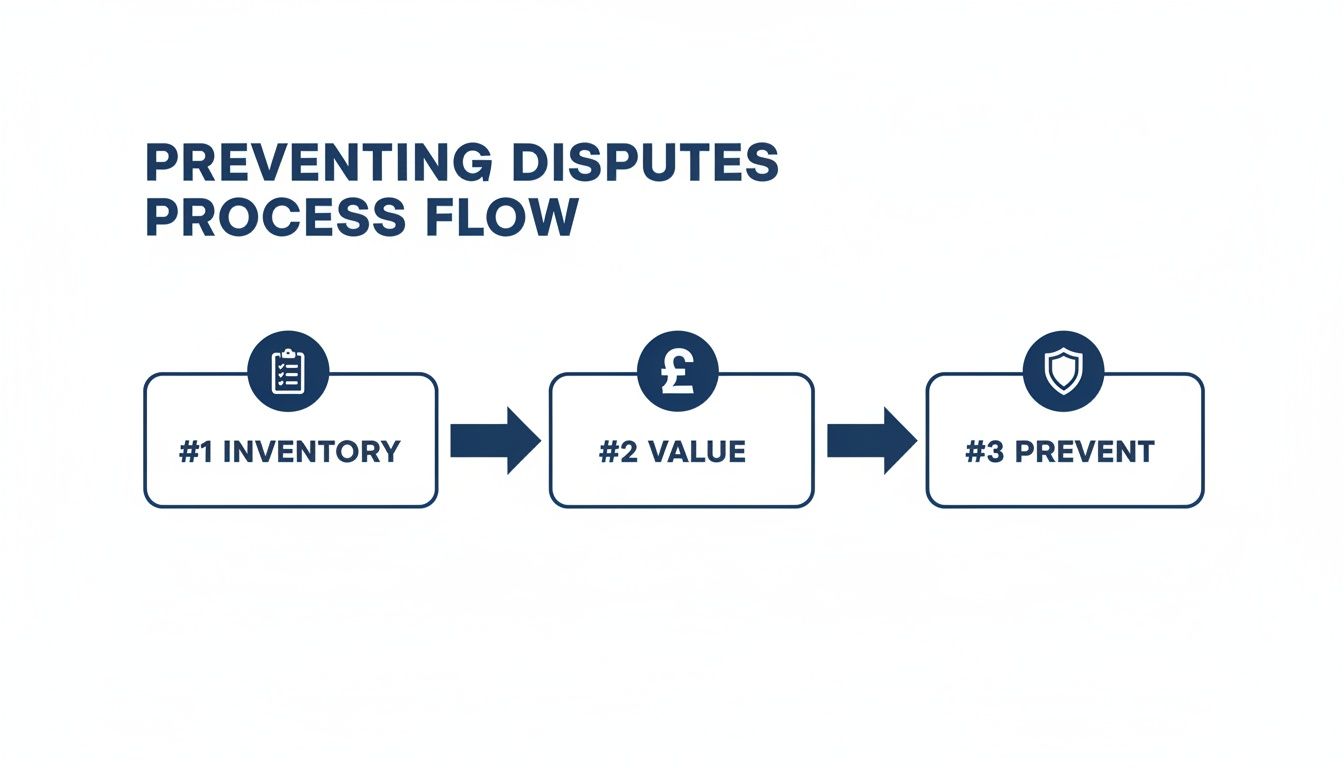
The key takeaway is that prevention isn't just about hoping a list is accurate. It’s an active, structured process driven by verification at inception.
From Ambiguity to Certainty
The commercial benefit for insurers is a dramatic shift from ambiguity to certainty. When a claim is filed, the entire process accelerates. Instead of a six-week dispute over a television's model or whether a piece of jewellery ever existed, the claims team has all the evidence they need from day one.
This isn't just about making a better list; it's about creating a single source of truth that proves ownership before a policy is bound. It’s the difference between investigating a claim and simply validating it.
By operationalising the list of contents template
with verification technology, you stop fraud at its source and transform the claims experience. The result is a significant reduction in processing times and a measurable drop in claims leakage. You can learn more about how a home inventory app cuts claims costs for insurers
in our detailed guide.
The Commercial Impact of a Verified Contents Strategy
Moving from a theoretical list of contents template to a pre-inception verification strategy delivers tangible, bottom-line results. For claims directors and underwriters, this is about fundamentally cutting off the financial drain that plagues the claims lifecycle. The commercial outcomes are direct, measurable, and too significant to ignore.
By putting verification first, insurers directly attack the main drivers of claims leakage and operational drag. The entire model shifts from costly, reactive investigation to efficient, proactive validation.
Quantifying the Return on Investment
The most immediate impact is a massive reduction in claims processing time. Instead of weeks lost to disputes over ownership and value, claims can be settled in days. A pre-verified inventory eliminates the endless back-and-forth, reduces reliance on expensive loss adjuster visits, and gives handlers a single source of truth.
That speed translates directly into lower operational costs and a dramatic improvement in customer satisfaction.
Furthermore, a verified contents strategy is a powerful tool for client retention, especially for brokers. Offering a simple, effective way for clients to document their assets provides clear value that goes beyond placing a policy. It shows a commitment to a smooth, fair claims experience—a powerful differentiator in a competitive market. You can explore this further by learning how the right property inventory software serves as a strategic tool for insurers and brokers.
The business case is simple: a one-time, low-cost verification process at inception is infinitely cheaper than a six-week, high-cost dispute at the point of claim. It's a clear and demonstrable ROI.
Comparing Operational Models
The difference between the traditional, post-claim model and a modern, pre-claim verification model couldn't be starker. One is built on ambiguity and invites conflict; the other is built on hard evidence and fosters trust.
The following table lays out the operational and financial benefits of making this critical shift, showing how much changes when you move from guesswork to proof.
Comparing Claims Processing Models Before and After Verification
| Claims Stage | Traditional Model (Post-Claim List) | Proova Model (Pre-Claim Verification) |
|---|---|---|
| First Notice of Loss | Policyholder submits a list from memory, often inaccurate and incomplete. | Claims handler accesses a complete, time-stamped, and verified inventory instantly. |
| Validation & Verification | Requires loss adjuster visits, lengthy email chains, and requests for proof of ownership. | Minimal validation needed. Ownership, condition, and location are already proven. |
| Dispute Resolution | High potential for disputes over item existence, condition, and value. | Disputes are virtually eliminated as all data was agreed upon at policy inception. |
| Settlement Time | Weeks or even months, leading to high operational costs and customer dissatisfaction. | Days, resulting in lower processing costs and a positive customer experience. |
| Fraud Risk | High exposure to after-the-event fraud and inflated valuations. | After-the-event fraud is neutralised by geocoded, time-stamped proof from day one. |
The move to a pre-claim verification model isn't an incremental improvement. It fundamentally rewires the entire claims process, replacing friction and cost with speed and certainty.
Your Questions, Answered
We often get questions from insurers and brokers looking to move beyond a basic list of contents template
. They want to know how a verified inventory process works in practice to cut claims costs and prevent fraud. Here are the most common ones.
How Does a Digital List of Contents Template Actually Reduce Claims Processing Times?
A digital, pre-verified inventory eliminates the most time-consuming part of a claim: gathering proof of ownership and value after a loss. As soon as a claim is filed, the handler has instant access to a complete, time-stamped, and photographed list of assets.
This stops the endless back-and-forth with a stressed policyholder. It also reduces the need for costly loss adjuster visits simply to confirm what was there. All the data needed to settle the claim quickly is already on file, which we’ve seen cut processing cycles by over 50% .
Can This Process Genuinely Prevent After-The-Event Insurance Fraud?
Absolutely. 'After-the-event' fraud hinges on ambiguity—uncertainty over when an item was damaged or if it was owned in the first place. A tool like Proova creates a geocoded and time-stamped record of an item's existence and condition at policy inception.
This provides irrefutable proof that the asset was owned and in a specific state before cover began. It makes it practically impossible for a fraudster to successfully claim for pre-existing damage or for an item they never had.
It fundamentally shifts fraud prevention from a costly, reactive investigation to an inexpensive, proactive verification at the start. It’s a complete change in how risk is managed.
Is It a Struggle to Get Policyholders to Use a Digital Inventory Tool?
Getting customers on board is about demonstrating the benefit to them: a faster, guaranteed claims payout with far less stress during a difficult time.
For brokers, this becomes a powerful value-added service. When you frame it as a way to ensure their claims are paid in full and without dispute, it stops feeling like an administrative chore. User-friendly apps like Proova make the process as simple as taking a few photos on a smartphone, removing technical barriers and encouraging adoption.
A pre-inception verification strategy is the single most effective way to reduce claims leakage and slash operational costs. At Proova , we provide the technology to make this strategy a reality, protecting your bottom line while delivering a superior claims experience for your policyholders.