A UK Insurer's Guide to Goods in Transit Risk
At its heart, goods in transit coverage is supposed to manage the financial fallout when items are lost, stolen, or damaged on the move. But for UK insurers, the real challenge isn't just defining the cover; it's proving what was actually in the van when something goes wrong. This creates a costly and frustrating evidence gap.
The Hidden Risk of Goods in Transit
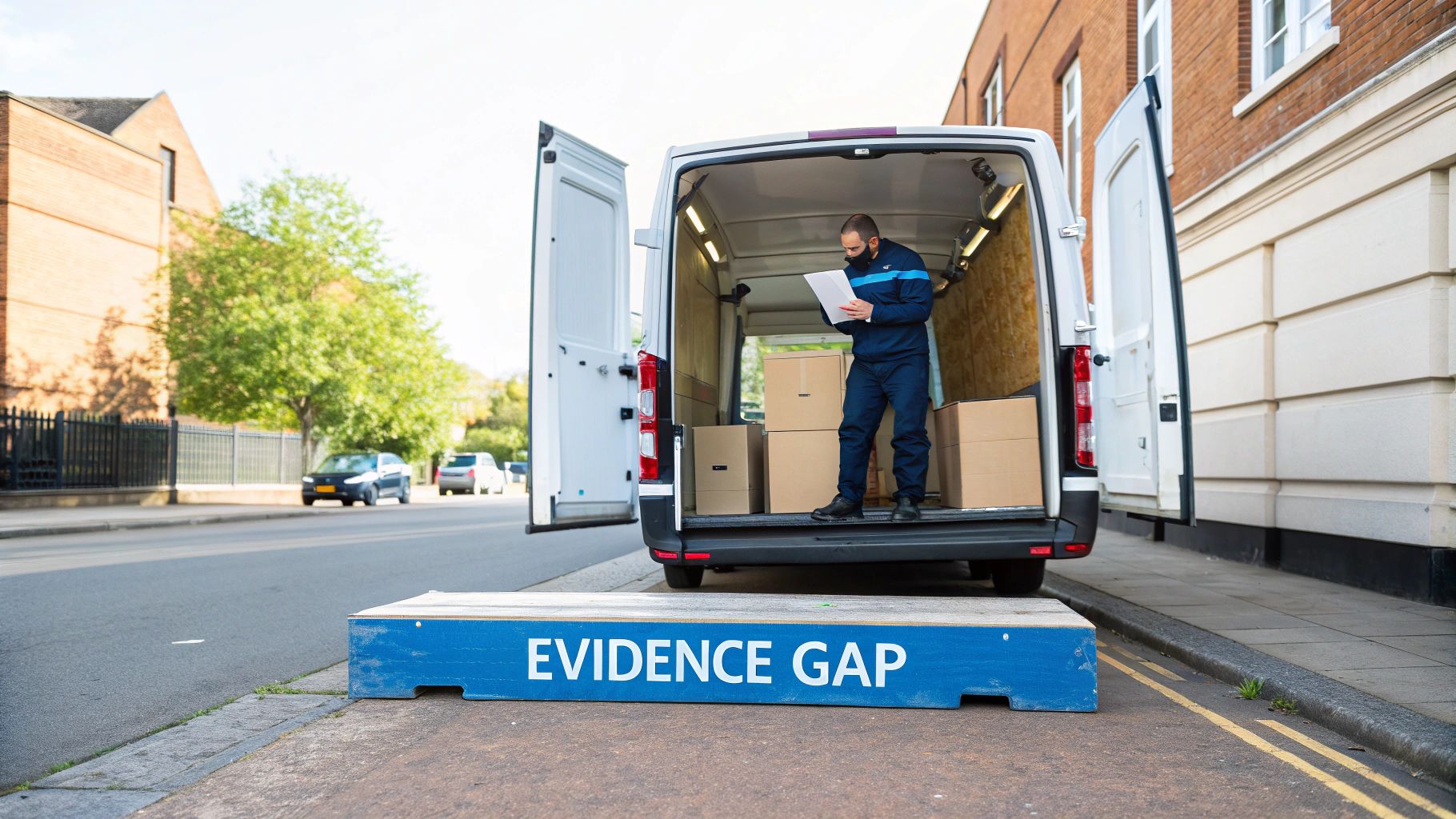
The moment an item leaves a secure, insured location—a warehouse, a shop, a home—it enters a high-risk evidence void. This is the fundamental headache with insuring goods in transit . The problem isn’t the journey itself; it's the lack of verifiable, independent proof of what started that journey in the first place.
Think of it like our "lounge exercise." If you ask a business owner to list every single item from a stolen van purely from memory, they’ll almost certainly miss something. Ask them for serial numbers, and the task becomes virtually impossible. Without that pre-transit proof, insurers are stuck trying to validate a loss based on memory and trust—a process that’s just asking for friction, fraud, and spiralling operational costs.
The Scale of the Problem
The sheer volume of goods moving across the UK at any given moment is staggering, creating endless opportunities for loss and disputes. In 2024 alone, an estimated 206 billion tonne-kilometres of domestic freight were moved, with heavy goods vehicles lifting a colossal 1.59 billion tonnes of goods. Every one of those shipments, from a single parcel to a full lorry load, is a potential claims headache without solid evidence. You can learn more about the scale of UK freight movement from the Department for Transport’s latest statistics.
This guide goes beyond simple definitions to get to the root of this evidence gap. We'll dig into how the absence of verifiable, pre-transit documentation drives up underwriting risks, fuels claims disputes, and opens the door to fraud.
The real risk isn't just a pallet being dropped or a van being stolen. For insurers, the bigger risk is the inability to definitively prove what was on that pallet or in that van in the first place.
By understanding this core problem, UK insurers and brokers can start putting practical solutions in place. The goal is to close this costly and persistent gap, turning ambiguous, high-friction claims into straightforward, evidence-based settlements.
The Three Big Headaches in Goods in Transit Underwriting
When an insurer covers goods in transit , they’re not just covering a box. They’re taking on a whole bundle of risks that spring to life the moment an item leaves a safe pair of hands. These risks run much deeper than a simple accidental drop, exposing insurers to drawn-out disputes, inflated claims, and outright fraud.
Getting to grips with these exposures is the first step in shutting them down. Three core underwriting risks consistently push up costs and jam the gears of the claims process. Every single one grows out of that fundamental evidence gap we talked about earlier—the black hole where verifiable proof of an item’s existence, condition, and value should be.
1. The Blame Game: Ambiguous Liability
The first major headache is ambiguous liability . When a parcel arrives damaged, the million-pound question is always the same: when did the damage happen? Was that new business laptop faulty before it was even boxed up? Did the courier drop it down a flight of stairs? Or did someone damage it while unpacking? Without a clear, time-stamped photo of its condition at dispatch, a simple claim can spiral into a frustrating three-way argument between the policyholder, the carrier, and the insurer.
Picture this: a small graphic design agency in Manchester orders a high-end monitor. It arrives with a spiderweb crack across the screen. The supplier points the finger at the courier, the courier blames the supplier’s flimsy packaging, and the agency files a claim against its business insurance. The insurer is now stuck in the middle, staring at a hefty claim with no clear way to pin down liability and recover the loss. This ambiguity hammers loss ratios and sends admin costs soaring.
2. The Valuation Maze
Next up is the inevitable valuation dispute . This is where that old "lounge exercise" becomes a very real financial problem. A policyholder reports that a parcel packed with valuable electronics is now "lost in transit." Sure, they might have a receipt for a new camera, but can they prove that specific camera , with its unique serial number, was actually inside that specific parcel ?
Without pre-transit evidence, the insurer is forced to rely on the policyholder's word. It’s a tricky spot to be in. Honest customers often struggle to find the proof needed, which leads to frustrating delays and a poor experience. At the same time, this lack of evidence is an open invitation for exaggeration, where an older, less valuable model is claimed for at the price of a brand-new one. This uncertainty makes it incredibly difficult to set accurate reserves and often means insurers end up overpaying.
3. An Open Door for Fraud
Finally, the whole transit phase is a magnet for elevated fraud opportunity . That evidence void creates the perfect environment for both opportunistic and highly calculated fraud. We're talking about more than just a bit of exaggeration here; this involves sophisticated schemes.
A classic example is after-the-event fraud . Someone might accidentally smash their uninsured smartphone screen. They then take out a new policy with goods in transit cover, carefully pack the broken phone, and send it via courier. When it predictably "arrives damaged," they file a claim for an item that was already broken before the policy was even live. The sheer volume of goods zipping around the UK makes this a massively scalable problem. With UK imports regularly fluctuating around the £80 billion monthly mark, it's easy to see how fraudulent claims can get lost in the noise. You can explore the latest UK trade statistics on ONS.gov.uk to see the scale for yourself.
These three risks—ambiguous liability, valuation disputes, and fraud—aren't isolated issues. They're all symptoms of the same core disease: the lack of a single, verifiable source of truth established before the goods ever started their journey.
Now, let's break down how these risks stack up for an insurer.
Goods in Transit Risk Exposure for Insurers
The table below summarises the key exposures, common scenarios an insurer in the UK might face, and the direct financial consequences.
| Risk Type | Common Scenario (UK Context) | Impact on Insurer |
|---|---|---|
| Ambiguous Liability | A high-value electronics shipment from a distributor to a retailer arrives damaged. The courier and sender blame each other. | Increased claims handling costs, inability to subrogate losses, and potential payout for pre-existing damage. |
| Valuation Disputes | A business owner claims for a "top-of-the-range" laptop lost by a national courier but can only provide a generic invoice. | Overpayment on claims, difficulty in setting accurate reserves, and friction with honest but unprepared customers. |
| Opportunistic Fraud | A policyholder claims for a new games console that "went missing," but dispatches an older, less valuable model. | Direct financial loss from paying out on an inflated claim and difficulty proving the exaggeration without evidence. |
| Premeditated Fraud | An individual intentionally sends a pre-damaged item to themselves to claim for "damage in transit" under a new policy. | Paying out on entirely fraudulent claims, which directly impacts loss ratios and drives up premiums for all clients. |
Ultimately, these interconnected risks create a cycle of financial leakage, operational drag, and customer friction that can only be broken by tackling the root cause: the evidence gap.
Why Common Policy Wordings Create Disputes

Insurance policies are meant to be a safety net, a contract of trust between the insurer and the customer. But when it comes to goods in transit , the fine print often creates more problems than it solves. Clauses that look perfectly sensible on paper can quickly become flashpoints for conflict when a claim is made.
Why? Because they often demand a level of proof that most customers simply can't provide.
These clauses are the insurer's defence mechanism, written to guard against fraudulent or inflated claims. In practice, however, they often end up penalising honest customers who, caught in the stress of a loss, can't recall every minor detail or produce flawless documentation on demand.
The Problem with 'Proof of Ownership'
A classic requirement in many policies is for the claimant to provide "proof of ownership." Sounds straightforward, right? But what does that really mean for a business shipping multiple items? An invoice might show they bought ten laptops, but it rarely proves that a specific laptop—with its unique serial number—was inside the exact box that vanished.
This ambiguity puts claims handlers in an awkward spot. They're forced to question the customer's integrity, asking for documents that often don't exist. It instantly sours the relationship, turning what should be a supportive process into a frustrating investigation for everyone involved.
Interpreting 'Condition Prior to Transit'
Another tricky phrase is the requirement for proof of an item's "condition prior to transit." It's there for a good reason: to stop claims for pre-existing damage. But let's be realistic. Who takes a detailed, time-stamped photograph of a brand-new item every single time they put it in a box?
Without that one piece of evidence, a claim for damage can quickly become a blame game. The courier points the finger at the sender's packaging, the sender blames the courier’s handling, and the insurer is stuck in the middle. The policy wording, intended to bring clarity, has instead created a stalemate.
Relying on clauses that the average customer cannot realistically satisfy creates an inherent friction point. It places the burden of proof on the policyholder at the most stressful time, which can lead to disputes, complaints, and ultimately, reputational damage.
The Regulatory Viewpoint
This isn't just about customer service—it's a regulatory minefield. The Financial Conduct Authority (FCA) is very clear about the need for insurers to treat customers fairly, especially during a claim. Policies built around clauses that are nearly impossible for a typical policyholder to meet could be seen as inherently unfair.
Leaning on these clauses as a primary defence against invalid claims puts insurers on shaky ground. It opens the door not just to individual complaints, but to scrutiny from the regulator. A good way to get ahead of these issues is by using a contract review checklist to spot ambiguous wording before it becomes a problem.
A simple, verified visual record created before an item ships cuts through all this complexity. It delivers undeniable proof of ownership, condition, and existence. This single piece of evidence can satisfy multiple policy clauses at once, turning a potential dispute into a fast, fair, and straightforward settlement that honours the insurer’s promise to the customer.
How to Prevent Goods in Transit Fraud
The moment goods are dispatched, an evidence gap opens up. This is a fraudster's playground. And while we hear about sophisticated criminal rings, the most common and costly types of goods in transit fraud are usually opportunistic. They exploit one simple fact: it’s tough to prove what was really in a box once it's out the door.
Insurers see the same old stories time and again. Claims for items that were never shipped in the first place. High-value electronics that mysteriously get "lost." Goods that were conveniently damaged before they even left the building.
The only way to stop this is to shift our focus. Instead of reacting to claims, we need to proactively close that evidence gap before anything is shipped. It's about creating a baseline of truth that makes these all-too-common fraudulent claims impossible to sustain. Without that, fraud teams are left trying to solve a puzzle with half the pieces missing—a costly and frustrating exercise for everyone.
Common Fraud Schemes and Red Flags
Fraudulent claims in the transit space often fall into a few predictable buckets. For any claims or fraud team looking to cut their losses, spotting the tell-tale signs is the first step.
- After-the-Event Fraud: This one’s a classic. Someone damages an item—let's say a laptop or a tablet—and then they arrange to ship it, often to themselves or a friend. When it arrives, they file a claim for damage that happened "in transit," waving a shipping receipt as proof. The gaping hole here? The lack of a dated photo showing the item's condition before it was packed.
- Value Exaggeration: A customer ships an older, lower-value item but claims for the latest, top-of-the-range model when the parcel vanishes. Without a record of the specific serial number, it descends into a messy "he said, she said" dispute. Insurers often end up overpaying just to make the problem go away.
- Phantom Goods: This scheme involves claiming for things that were never in the package to begin with. A claimant might ship an empty box or one filled with junk, then claim it contained expensive jewellery or electronics. The lack of photos showing the items being packed is the glaring red flag.
The real problem in all these scenarios is the total reliance on after-the-fact inventories. As our 'lounge exercise' proves, memory is unreliable even for honest claimants. For fraudsters, it's a tool to be twisted. A verifiable, pre-transit record completely dismantles this opportunity.
Shifting from Reaction to Prevention
The most effective way to beat these schemes is to remove the ambiguity they depend on. By integrating a simple documentation process before transit, insurers can lock in an irrefutable record of an item's existence, its condition, and its identity before it ever enters the courier network. This is the foundation of fighting fraud before it happens .
From an insurer’s perspective, goods in transit aren’t just about lorries and ships. The concept also cuts across highly specialised UK industries like cash and valuables in transit (CVIT), which highlights just how much location and proof of ownership drive both pricing and fraud risk. Claims and fraud teams know from bitter experience that after-the-event inventories are unreliable. Disputes ignite when a claimant insists a lost laptop or watch was in the parcel, but there's no pre-existing record to back it up.
A tool like Proova effectively brings CVIT-style discipline to everyday situations. It captures serial numbers, photos, and locations before an item is shipped, giving claims directors and brokers the confidence that what was claimed to be in transit actually existed and was owned at the time of loss.
Creating this baseline of truth is straightforward. It just involves capturing a few key data points at the point of dispatch:
- Date and Time-Stamped Photos: Images that clearly show the item's condition, including any existing scratches or marks.
- Serial Number Capture: A clean photo or manual entry of the unique serial number to stop model substitution in its tracks.
- Proof of Packing: A visual record of the actual item being placed into its packaging.
This simple, evidence-based approach is a powerful deterrent. When potential fraudsters know a verifiable record is being created, the opportunity to inflate a claim or invent a loss evaporates. It slams the door on the evidence gap they rely on, making honest claims a breeze to process and fraudulent ones stick out like a sore thumb. For an extra layer of security against theft and tampering, exploring practical solutions like selecting the right tamper evident bag can also be a game-changer.
Building a Modern Claims and Underwriting Workflow
To get a real handle on goods in transit risk, we need to shift our thinking. The old way of doing things—waiting for a loss to happen and then scrambling to gather evidence—is slow, confrontational, and full of friction. It just doesn't work. A modern approach flips this on its head by embedding simple documentation right at the start of the process, turning guesswork into certainty for everyone involved.
This isn’t about ripping out your existing systems and starting from scratch. It’s much simpler. We just need to introduce a few common-sense, evidence-based steps at key moments in the policy's life. By making verified, pre-transit documentation a standard part of the process, insurers can build a much more resilient and efficient operation from day one.
A Proactive Workflow for Underwriters
For any underwriter, the goal is to price risk accurately from the get-go. But a massive blind spot has always been the ambiguity around what’s actually being shipped, especially with high-risk commercial clients or high-net-worth individuals. A proactive documentation workflow closes this gap for good.
-
Identify High-Risk Segments: Start by pinpointing policies where transit losses are most likely. Think small businesses that regularly ship high-value gear, art dealers, jewellers, or even personal clients with a serious collection of electronics.
-
Request a Verified Inventory at Inception: For these specific groups, just make a verified digital inventory a standard part of the onboarding process. Send the client a simple request to document the items they plan to ship before you bind the cover.
-
Position It as a Value-Add: This is crucial. Don't frame this as another hoop to jump through. Explain that having a pre-agreed record is for their protection. It guarantees that if a claim ever happens, it will be handled quickly and without fuss because the existence and condition of their goods are already on file.
-
Review and Bind Cover with Confidence: The underwriter gets a time-stamped, verifiable report showing exactly what assets are being covered. This gives you a clear baseline of truth, allowing for more accurate premiums and shutting down the risk of inflated or fraudulent claims from the very beginning.
A Streamlined Workflow for Claims Handlers
When a claim for lost or damaged goods finally comes in, the job should be about validation, not a full-blown investigation. If you have that pre-existing inventory, claims handlers can act with speed and total confidence.
-
FNOL and Initial Triage: As soon as the First Notice of Loss hits, the very first step is to check if a verified inventory record is attached to the policy.
-
Compare Declared Loss to the Verified Record: The handler simply pulls up the time-stamped visual record and compares it to what the policyholder is claiming was lost or damaged. They can instantly check serial numbers, models, and pre-transit condition. No more guesswork.
-
Enable Straight-Through Processing: If the claimed items are a perfect match for the verified record, that claim can be fast-tracked. The need for loss adjusters, lengthy investigations, and endless back-and-forth emails is completely removed.
-
Settle the Claim Quickly and Fairly: With indisputable evidence already on file, the claim can be settled in days, not weeks. This doesn't just slash claims handling costs; it massively improves the customer's experience. This is the core principle behind modern insurance claims management software solutions that streamline processes and combat fraud .
The simple infographic below breaks down the three-step process: document items before they ship to head off fraud and disputes at the pass.
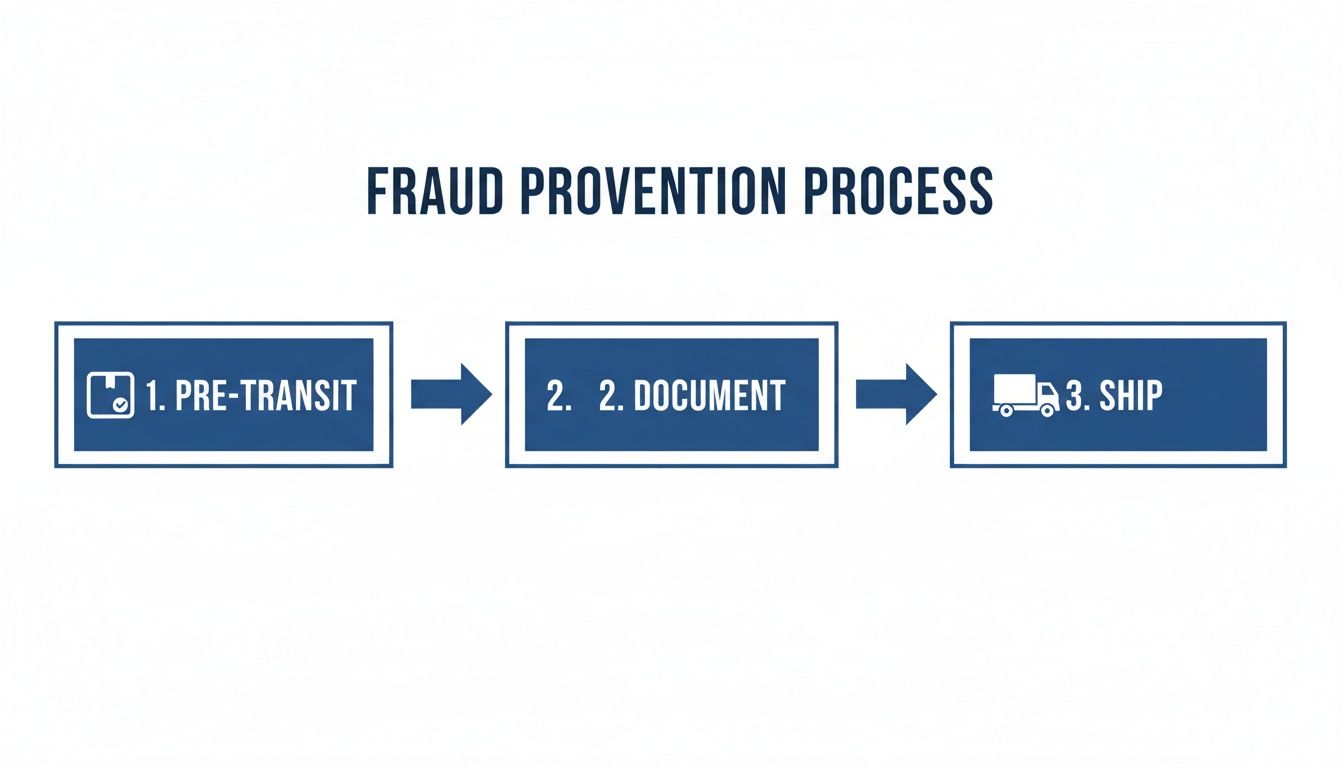
This workflow pulls the entire evidence-gathering stage from after a loss to before the risk even begins. The result is a fairer, faster, and more efficient process for everyone.
To illustrate the difference, here’s a look at how a typical goods in transit claim unfolds in a traditional, high-friction environment versus an enhanced, evidence-led workflow.
Traditional vs Enhanced Workflow for Transit Claims
| Claim Stage | Traditional Process (High Friction) | Enhanced Workflow (Low Friction) |
|---|---|---|
| FNOL | Policyholder reports loss with a handwritten list. No prior evidence exists. | Policyholder reports loss; handler immediately checks for pre-existing verified inventory. |
| Investigation | Handler requests proof of ownership/condition (receipts, photos). Back and forth begins. | Handler compares the claim to the time-stamped digital record of the items. |
| Validation | Delays occur as policyholder struggles to find proof. Potential for dispute is high. | Serial numbers and condition are instantly verified against the record. No dispute needed. |
| Settlement | Process takes weeks or months. Loss adjuster may be required. High handling costs. | Claim is validated in hours. Straight-through processing enables settlement in days. |
The contrast is stark. The enhanced workflow removes the ambiguity and conflict that so often bog down the traditional claims process, leading to better outcomes for both the insurer and the customer.
An Added-Value Workflow for Brokers
For a broker, standing out on more than just price is the key to keeping clients happy. Giving advice that genuinely protects a client before they ever need to make a claim is an incredibly powerful way to add value.
By guiding clients on pre-transit documentation, brokers transform their role from a simple policy seller into a proactive risk management partner. This strengthens the client relationship and demonstrates tangible value beyond the annual premium.
This advisory approach is straightforward:
- Educate Clients at Renewal: When you're having those renewal conversations, bring up the "lounge exercise" problem. Ask your clients how they would actually prove what was in a shipment if it went missing tomorrow. This highlights a common—and dangerous—gap in their protection.
- Recommend a Documentation Tool: Advise them to use a simple tool to create a verified inventory of their goods before they are ever shipped. This makes sure they are properly covered and can easily prove their loss if the worst happens.
- Simplify Future Claims: Explain that this one small step makes any future claims process incredibly fast and stress-free. As their broker, you'll have all the evidence needed to advocate for them effectively and get things sorted quickly.
How Brokers Can Add Value and Retain Clients
In a crowded market, simply selling a policy isn't enough anymore. The best brokers act as trusted risk management partners, and for clients dealing with goods in transit , this is a massive opportunity to deliver real value and lock in loyalty. It's time to shift the conversation away from price and towards preparation.
Instead of just arranging cover, you can set your service apart by tackling the critical evidence gap that sinks so many transit claims. This means going beyond the policy wording and offering practical, real-world advice that protects clients when they need it most.
From Policy Seller to Risk Partner
It all starts with a simple conversation. I call it the "lounge exercise." Ask your business client, "If a shipment was stolen today, could you prove exactly what was inside, right down to the serial numbers, without looking?" The answer is almost always a hard "no."
That one question instantly opens their eyes to a vulnerability they'd never even considered. It positions you, the broker, as someone who gets the gritty, real-world problems that happen during a claim, not just the paperwork of buying insurance.
By guiding clients on the importance of pre-transit documentation, brokers transform their role from a simple policy seller into a proactive risk management partner. This strengthens the client relationship and demonstrates tangible value beyond the annual premium.
This advisory approach shows you’re genuinely invested in their business succeeding and making sure their insurance actually works when they need to call on it. It’s a powerful way to build loyalty that a cheaper premium could never buy.
Simplifying Claims and Proving Your Worth
When you introduce a documentation tool or a simple process, you’re not just helping your client. You're making your own life much, much easier when a claim inevitably happens. With a verifiable, time-stamped record of their goods before they were shipped, the whole claims process becomes smoother and faster.
Here’s exactly how this adds value:
- Less Admin for You: You’ll spend far less time chasing down missing paperwork or playing mediator between a frustrated client and the insurer.
- Faster Payouts: Clear, undeniable evidence means claims get processed quickly. This is the best possible outcome for your client and reflects brilliantly on you.
- Reinforced Value: A fast, successful claim is the ultimate proof of your worth. It shows that your advice made a real difference and reaffirms their decision to trust you with their business.
By championing this simple, preparatory step, you provide a service that goes far beyond a transaction. You help your clients sidestep the stress of a disputed claim, ensure they get paid what they're owed, and cement your position as an indispensable advisor to their business.
Frequently Asked Questions
Understanding the finer points of goods in transit is a must for any insurer or broker. Here are a few common questions we hear about bringing modern, evidence-based workflows into this notoriously tricky area of cover.
How Can We Introduce Pre-transit Documentation Without Adding Friction?
The key is a phased, targeted approach. You don't need to change everything overnight. Start by looking at your highest-risk segments – think small businesses with lots of mobile equipment, or high-net-worth clients who regularly ship valuable items.
For these groups, a verified digital inventory should become a standard part of your onboarding process. When you use a modern platform, this isn't a chore for the customer; it's a genuine value-add. You're giving them a clear, simple way to make sure their prized possessions are properly documented and protected. A simple link sent by the underwriter or broker is all it takes, making it a low-touch but high-impact step in your risk assessment.
What’s the Most Common Failure Point in a Transit Claim?
Nine times out of ten, it comes down to proving the item’s possession and condition at the very moment it was handed over to the carrier. A policyholder might have a receipt, but that doesn't prove that specific item , in an undamaged state, was actually inside the box that was collected. This is the evidence gap where so many disputes begin.
Without a time-stamped, geolocated photo record taken right before dispatch, the entire claim hinges on someone's memory and a lot of trust. Those are shaky foundations for a settlement, and it’s what leads to friction as liability gets passed between the owner, the carrier, and the insurer.
How Does Verified Documentation Affect Loss Adjuster Costs?
This is where the real savings kick in. Good quality, pre-transit documentation can dramatically reduce – or even completely remove – the need for a loss adjuster on many goods in transit claims. A loss adjuster is usually brought in to investigate the circumstances of a loss and verify that the claimed items actually existed and were worth what the policyholder says.
When a digital report already provides irrefutable proof of what was in the shipment, complete with serial numbers and photos, the adjuster's main job is already done. The claim can move straight to settlement, saving the insurer significant external fees and massively speeding up the process for the policyholder.
This frees up your claims teams to focus their expertise on more complex cases, while straightforward claims get settled with speed and certainty. It’s a win for efficiency and an even bigger win for customer satisfaction.
Ready to close the evidence gap and de-risk your goods in transit portfolio? Proova provides the tools to build a baseline of truth before a claim ever happens, reducing fraud and streamlining settlements. Visit https://www.proova.com to see how it works.