A Guide to Insurance for Small Business in the UK
Take a moment and look around your business. Could you list every single tool, piece of stock, and electronic device you own, purely from memory? What about adding the serial numbers?
It’s harder than it sounds. This simple mental exercise – our "lounge exercise" – gets to the heart of a critical vulnerability for millions of UK small business owners. People think they know what they own, but proving it after a fire or theft is almost impossible.
Why Many Small Businesses Are Underinsured
It’s a common and costly myth that small businesses don’t need the same protection as larger companies. Many owners tell themselves, "I don't have enough to justify the cost," or the classic, "it won't happen to me." This kind of thinking creates a dangerous gap between perceived risk and reality, leaving countless livelihoods completely exposed.
The hard truth is that a single incident—a fire in your workshop, a theft from the van, or a liability claim after a customer slips—can financially cripple an unprepared business. Without that safety net, you’re the one personally absorbing all of that risk. The fallout can be devastating, forcing many to shut their doors for good.
The Staggering Reality of UK Underinsurance
The scale of this issue across the UK is startling. Research reveals that around 44% of UK SMEs and sole traders have no business insurance at all . That’s more than 2.1 million companies trading without any cover whatsoever.
This vulnerability often boils down to one simple problem: the inability to prove what you owned before it was gone. Insurers need evidence to process a claim, and without it, you're left in a frustrating battle, pitting your memory against the limits of your policy.
The core issue isn't just about having an insurance policy; it's about being able to make that policy work for you when you need it most. The burden of proof falls on the business owner, and guessing what you lost after a disaster is a recipe for a rejected or reduced claim.
The Hidden Costs of Inadequate Cover
Being underinsured isn’t just about having no policy. It can also mean having the wrong type of cover or an insufficient amount. You might have public liability insurance, for example, but no protection for your essential tools. A single theft could put you out of work for weeks. A deeper look into insurance risk management principles can shed more light on the pitfalls of getting this balance wrong.
Ultimately, proper protection is a fundamental part of running a healthy business. By understanding your vulnerabilities and taking proactive steps to catalogue your assets, you shift from gambling with your future to actively protecting it. Building a detailed framework for this is key, a process we outline in our guide to your business risk management framework. This isn't just about buying a policy; it's about building resilience.
Decoding Essential Business Insurance Policies
Trying to get your head around insurance for small business can feel like learning a new language. With so many policies and acronyms floating about, it’s easy to feel a bit lost.
The best way to cut through the noise is to split the options into two simple piles: the insurance you must have by law, and the cover you should seriously consider to protect your livelihood.
Think of it like building a house. The legally required policies are the foundations—without them, the whole thing is unsafe and illegal. The optional policies are the walls and roof, keeping everything you’ve worked for safe when the inevitable storms hit.
Legally Required Insurance Cover
For most UK small businesses, the list of mandatory insurance is actually quite short. But don't let that fool you—getting it wrong can lead to heavy fines from regulators like the Health and Safety Executive (HSE).
The big one is Employers' Liability Insurance . If you have any employees at all, even temporary or part-time staff, you are legally required to have this cover. It's there to protect you if a team member gets ill or is injured as a direct result of the work they do for you. The legal minimum for this is £5 million of cover.
On top of that, if your business uses any vehicles, you’ll need commercial motor insurance. Your personal car policy just won't cut it for things like making deliveries or driving between client sites.
Critical Optional Policies for Protection
Once you've sorted the legal must-haves, you need to think about the policies that shield you from the everyday risks that can stop your business in its tracks. Skipping these is a massive gamble.
To help you get started, here is a quick-glance guide to some of the most common types of business insurance, what they do, and who they’re for.
Key UK Small Business Insurance Policies Explained
| Type of Insurance | What It Covers | Who Needs It? |
|---|---|---|
| Public Liability | Claims of injury to a member of the public or damage to their property caused by your business activities. | Any business that interacts with the public, customers, or clients, either on your premises or theirs. |
| Professional Indemnity | Claims from clients who suffer a financial loss due to negligent advice, services, or designs you provided. | Consultants, accountants, architects, designers, and anyone providing professional services or advice. |
| Business Interruption | Lost income and fixed overheads (like rent and salaries) if you're forced to temporarily close due to an insured event. | Businesses with physical premises like shops, cafes, or offices that would lose income if they couldn't operate. |
| Business Contents | The cost of repairing or replacing your business equipment, stock, and tools if they are damaged, lost, or stolen. | Retailers, tradespeople, offices—essentially any business that relies on physical assets to function. |
Let's break these down a bit further. These are the key policies you should really consider non-negotiable for protecting your business:
-
Public Liability Insurance: This is absolutely vital if customers, clients, or the public visit your premises, or if you work at their properties. It handles claims made against you for injury or property damage. Think of a customer slipping on a wet floor in your shop, or you accidentally drilling through a pipe at a client's house. A comprehensive understanding of public liability insurance is essential for any business that deals with people.
-
Professional Indemnity Insurance: If your business gives advice, offers designs, or provides professional services, this cover is crucial. It protects you if a client loses money because of a mistake you made. A consultant whose strategy backfires or an architect whose plans contain a costly error would lean heavily on this policy.
-
Business Interruption Insurance: Imagine a fire in your café’s kitchen forces you to close for three months. You’d have no money coming in, but you’d still have to pay rent, rates, and salaries. This is where business interruption cover steps in, covering that lost income to help you stay afloat until you can get back to trading.
-
Business Contents & Equipment Insurance: This one is straightforward—it protects your physical gear. We’re talking about stock, tools, machinery, and electronics. For a tradesperson, having their tools nicked from their van could stop them from working entirely. This cover gets you back on your feet by helping you replace essential equipment quickly. And remember, this doesn't just apply to your main premises. If your business uses off-site storage, looking into storage unit contents insurance is a very smart move.
Figuring out your specific risks is always the first step. Once you know what you're up against, you can build an insurance safety net that truly protects the business you’ve worked so hard to create.
How Insurers Calculate Your Premiums
Ever looked at an insurance quote and wondered how they landed on that specific number? It’s not just plucked out of thin air. Insurers go through a careful process of risk assessment to calculate your premium, aiming to price the policy fairly based on how likely you are to make a claim.
Think of it this way: a construction company using heavy machinery on-site faces a completely different set of risks than a graphic design studio run from a home office. The insurer’s job is to weigh up those differences and work out a premium that mirrors your unique risk profile. A one-size-fits-all approach just doesn’t cut it.
At its core, the higher the perceived risk, the higher your premium will be. This calculation involves looking at several key factors that build a detailed picture of your business.
Key Factors That Influence Your Premium
Insurers analyse a range of data points to figure out how much your insurance for small business will cost. While the specific weight given to each factor can vary, the core elements they look at are pretty consistent across the industry.
These factors help an underwriter decide how likely your business is to suffer a loss and, just as importantly, how expensive that loss might be.
-
Industry and Business Type: Your line of work is one of the biggest factors. A roofer working at height has a much higher risk of a public liability claim than a freelance writer. In the same way, a jeweller's shop faces a far greater theft risk than a local greengrocer.
-
Annual Turnover: Higher turnover often suggests a larger scale of operations, more clients, and potentially greater financial exposure if something goes wrong. This can influence the level of cover you need and, as a result, the premium.
-
Number of Employees: If you have staff, Employers’ Liability insurance is a legal must-have. The more employees you have, the higher the statistical risk of a workplace injury or illness claim, which directly pushes up the cost of this cover.
Your Assets and Location Matter
Beyond what you do, your physical setup plays a huge part in premium calculations. Where you are and what you own are fundamental to assessing property-related risks like theft, fire, and flood.
Your business postcode, for example, is used to assess local crime rates and environmental risks like flooding. A business located in an area with a high rate of commercial burglaries will likely face higher premiums for contents and stock cover than one in a lower-risk postcode.
This is also where the value of your assets becomes critical. Insurers need to know what they are actually covering.
The core message from underwriters is that better information leads to more accurate pricing. A vague, guessed figure for your contents forces them to assume a higher risk. A detailed, verifiable inventory does the opposite.
Having a precise, documented catalogue of your equipment, tools, and stock is incredibly valuable. Think of it like trying to list everything in your lounge from memory after a fire – it’s a losing game. A clear, provable inventory not only makes the claims process smoother but also allows underwriters to assess your risk more accurately from the start. This transparency can lead to fairer, more precise premiums, simply because it removes the guesswork for the insurer.
Getting the Right Insurance Cover Step-by-Step
Alright, let's move from theory to action. Getting the right insurance for your small business isn't some dark art; it's a clear, manageable process. This isn't about ticking boxes. It's about building a safety net you can actually rely on when things go wrong. And that journey starts long before you even think about getting a quote.
The whole thing kicks off with a proper risk assessment. Before you can insure your business, you need a crystal-clear picture of what you actually have to protect. This is where so many business owners stumble, trying to do it all from memory.
Step 1: Start with a Comprehensive Asset Inventory
Remember that lounge exercise? Trying to list every single thing in a room without looking is almost impossible. Now, apply that same challenge to your workshop, your office, or your stockroom. To get the right level of cover, you first need to catalogue every asset—from laptops and specialist machinery to furniture and stock.
A vague guess at the total value is just a recipe for being underinsured. A detailed, itemised list is the only real foundation for accurate cover.
- List Everything: Go room by room and catalogue every single physical asset. Where you can, grab model numbers, serial numbers, and purchase dates.
- Photograph Your Assets: Visual evidence is incredibly powerful. Take clear photos of your equipment, your stock, and your premises.
- Use a Digital Tool: Let’s be honest, manual spreadsheets are a pain. They’re time-consuming to create and even harder to keep up to date. A digital inventory tool like Proova simplifies this whole process, creating a timestamped, verifiable record that insurers can actually trust.
This first step is the most critical one. A precise inventory informs every other decision you make, ensuring you don't pay for cover you don't need or, even worse, find yourself short when you need to make a claim.
Step 2: Find the Right Broker or Insurer
With your detailed asset list in hand, you're in a much stronger position to find the right insurance partner. You can either go directly to an insurer or, as many small businesses do, use a specialist business insurance broker.
A good broker can be invaluable. They live and breathe this market, have access to policies you might never find on your own, and can help translate the often-confusing jargon buried in policy documents. Crucially, they work for you , not the insurance company.
This flow chart shows how an insurer moves from assessing your business information to calculating the final premium.
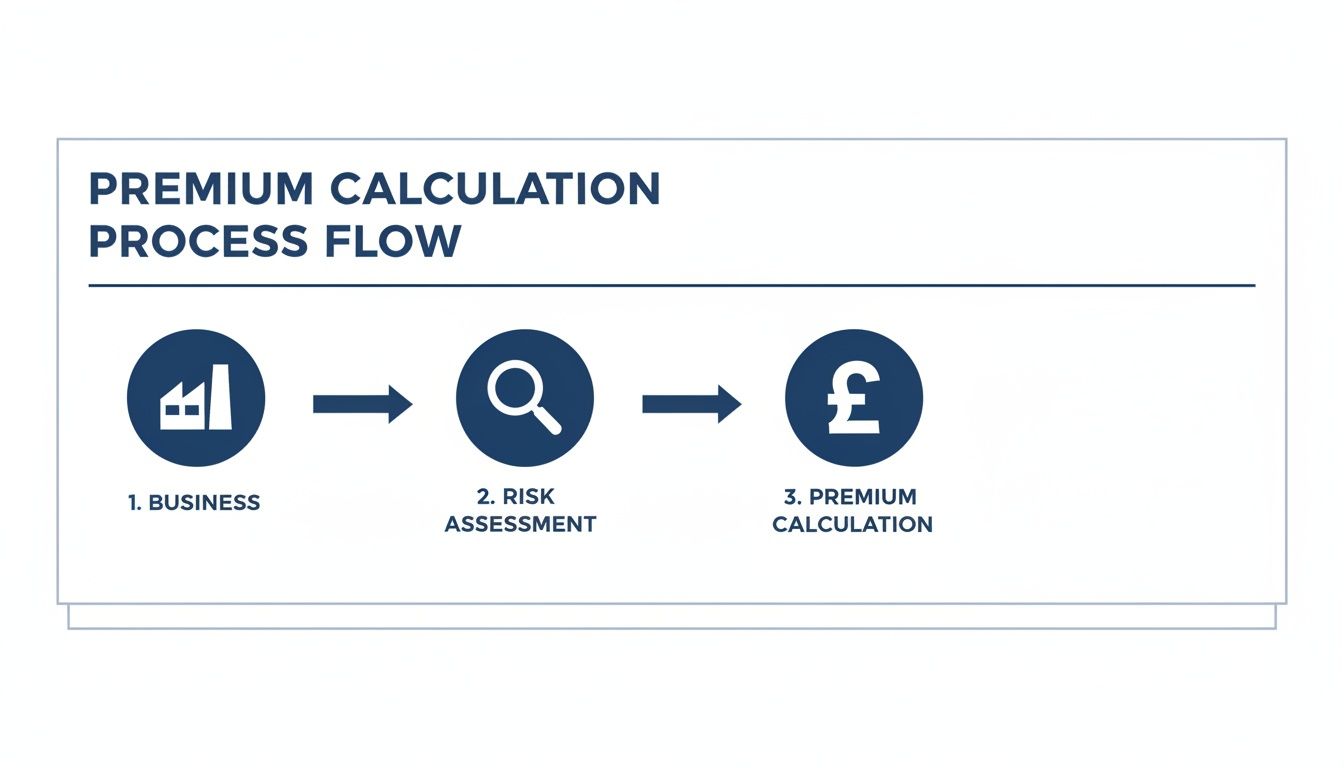
As you can see, the accuracy of your information directly shapes their assessment of your risk, which in turn determines the premium you pay. Rubbish in, rubbish out.
Step 3: Understand the Small Print
Once the quotes start coming in, your next job is to actually read the policy documents. We know, it’s not the most exciting task, but it’s absolutely essential for avoiding nasty surprises down the line.
Pay close attention to two key areas:
- Exclusions: These are the specific situations or items the policy will not cover. For example, a policy might exclude damage from certain types of flooding or theft that doesn't involve forced entry.
- Excess: This is the amount you have to contribute towards a claim before the insurer pays out. A higher excess usually means a lower premium, but make sure it’s an amount you can realistically afford to pay out of pocket.
Step 4: Declare Everything Accurately
When you fill out the application, honesty and accuracy are completely non-negotiable. You have a legal duty of ' fair presentation of risk '. In plain English, this means you must disclose all the important facts about your business, what it does, and any previous claims you've made.
Withholding information, even if it's an honest mistake, could give an insurer grounds to void your policy entirely. That means they could refuse to pay a claim, and you’d have paid all those premiums for absolutely nothing.
Being thoroughly prepared before you buy is the real secret to effective business insurance. By taking these steps, you make sure the cover you’re paying for is robust, accurate, and ready to protect you when you need it most.
Navigating the Claims Process After a Disaster

This is the moment of truth. After paying your premiums, the time you make a claim is when your insurance for small business really has to prove its worth. Whether you’re dealing with the aftermath of a workshop fire, a break-in, or severe flood damage, the steps you take right away can make or break your claim.
The whole process can feel overwhelming, especially when you're still reeling from the shock of the event itself. But knowing what to do brings order to the chaos and helps you avoid the common pitfalls that lead to delays or, even worse, a flat-out rejection. The trick is to act fast, be methodical, and focus on documenting everything.
Your Immediate Steps After an Incident
The first few hours are absolutely critical. Your number one priority is safety, but that needs to be followed swiftly by communication and gathering evidence. Don't put it off—the sooner you get the ball rolling, the stronger your claim will be.
Here’s a quick checklist of what to do first:
- Ensure Safety: Before anything else, make sure everyone is safe. Secure the premises as best you can to stop things from getting worse. If a crime has occurred, like theft or vandalism, call the police immediately to get a crime reference number.
- Contact Your Insurer: Get in touch with your insurance provider or broker as soon as you possibly can. They’ll start a case file, assign a claims handler, and walk you through the exact steps and paperwork they need from you.
- Document Everything: This is huge. Before you touch, move, or clean up anything (unless it’s to prevent more damage), get your phone out. Take loads of photos and videos of the scene, capturing the damage from every angle with both wide shots and close-ups.
The Critical Role of Evidence
This brings us to the most important part of any insurance claim: proof. The burden of proof is on you, the policyholder. Your insurer's job is to validate what you've lost, and their first question is always going to be, 'Can you prove it?'
This is where so many business owners get caught out. Trying to list every stolen tool, every damaged piece of stock, and every broken bit of kit from memory is a nightmare. It's incredibly stressful and almost impossible to do accurately. You’ll inevitably forget items, guess at values, and have no way of finding every single receipt.
Your insurer needs more than just your word for it. They require a credible, verifiable inventory of the items you're claiming for. Without solid proof, they're working blind, which only leads to delays, disputes, and lower settlement offers.
This is exactly why having a pre-existing, timestamped digital inventory is a game-changer. Instead of frantically trying to build a list from scratch in the middle of a crisis, you can just share a detailed, verified report with your insurer. It instantly takes the guesswork out of the equation and gives them the concrete evidence they need to get your claim moving.
The difference is night and day. One path involves weeks of stressful back-and-forth arguments. The other is a smooth, evidence-based process that gets your business back on its feet faster. Understanding why an insurance company might refuse to pay a claim often comes down to one thing: a lack of proof. A solid inventory is your best defence.
Got Questions About Small Business Insurance?
Stepping into the world of business insurance can feel like learning a new language. There are so many terms, policies, and what-ifs that it’s easy to feel overwhelmed. Getting clear, straightforward answers is the key to making sure you’re properly protected without paying for cover you don’t need.
Let’s tackle some of the most common questions we hear from UK business owners, clearing up a few dangerous myths along the way.
Do I Need Business Insurance If I Work From Home?
Yes, almost certainly. Thinking your home insurance has you covered is one of the most common—and riskiest—assumptions a business owner can make. Your standard home policy is designed for your personal life, not your commercial one.
Relying on it creates huge gaps in your protection. For example, if a client pops over for a meeting and trips on a rug, your home insurance is highly unlikely to cover their injury claim. That’s a job for public liability insurance .
It's the same story for your equipment. If a pipe bursts and floods your home office, your home contents policy might cover your personal laptop, but it won’t touch the high-spec machine, professional printer, and other gear you use purely for business. It also won't cover any stock you're storing in the garage. This single misunderstanding leaves thousands of home-based businesses in the UK dangerously exposed.
What Is the Biggest Insurance Mistake Small Businesses Make?
Hands down, the biggest mistake is underinsurance . This usually happens in one of two ways. The first is pretty obvious: deliberately buying less cover than you need to save a few quid on the premium.
The second is far more common, and it’s a bit more subtle: being unable to prove the true value of what you lost when it's time to claim. You might have diligently paid for £50,000 of contents cover, but if you can’t give your insurer a credible, detailed inventory with some proof of ownership, you simply won’t get the full amount.
This is where so many claims fall short. Failing to properly document your assets is like paying for a service you can't fully use when it matters most. Proving what you owned from memory after a disaster is a recipe for a deeply disappointing payout.
An insurer needs evidence to settle a claim fairly and quickly. Without it, you’re on the back foot from the start, trying to justify a figure you can no longer prove.
How Can I Lower My Business Insurance Premiums?
While insurance is a necessary cost, you're not powerless over the price. There are practical steps you can take to manage and potentially lower your premiums. Insurers reward businesses that actively manage their risks, because it makes a claim less likely.
When you're proactive, it signals to underwriters that you're a responsible business owner, and that can directly influence your quote.
Here are a few ways you can work to lower your premiums:
- Boost Your Security: Installing insurer-approved alarm systems, high-quality locks, and CCTV can make a real difference, especially for policies that include theft cover.
- Keep a Clean Claims History: A track record with few or no claims is the best evidence that you're a lower-risk client, which is often reflected in your renewal price.
- Increase Your Voluntary Excess: This is the amount you agree to pay towards any claim yourself. A higher excess means the insurer pays less, so they'll often reduce your premium in return. Just make sure it’s an amount you can comfortably afford if something goes wrong.
- Provide Accurate, Detailed Information: This is crucial. A vague, rounded-up figure for your business contents forces an underwriter to price for uncertainty. In contrast, a comprehensive digital inventory of your assets shows you’re organised and transparent, helping them assess your risk more accurately and often leading to fairer pricing.
By taking these steps, you’re not just buying insurance; you're becoming an active partner in protecting your business—something insurers always view in a positive light.
A detailed, verifiable inventory is the foundation of a solid insurance policy. It removes the guesswork for insurers and takes away the stress of having to prove your loss after a disaster strikes. Proova gives you a simple, powerful tool to catalogue all your business assets, creating the timestamped evidence you need to ensure your claims get paid quickly and in full. Don't wait until it's too late.